


Java Moss: The Emerald Foundation
Complete guide to Taxiphyllum barbieri — the moss that makes shrimp tanks possible for beginners and experts alike.
Origins & Taxonomy: a name with a complicated history
Java Moss belongs to the family Hypnaceae and was originally described in 1911 as Isopterygium barbieri from specimens collected near Vinh, Vietnam — its only confirmed wild origin to date.[1] Despite the name "Java," botanical records place the wild population entirely in Vietnam, not the Indonesian island of Java. The confusion stems from the aquarium trade's historically loose use of geography in plant naming.
For decades, every hobbyist called it Vesicularia dubyana. That name appeared in aquarium books, shop labels, and care guides through the 1960s and 70s — and it was wrong. In 1969, botanist G. Benl introduced a faster-growing moss to European aquarists under the name "Bogor moss," erroneously labeling it Glossadelphus zollingeri. It was actually Taxiphyllum barbieri. Because it grew faster than the original Java Moss (V. dubyana), it gradually displaced the slower species in cultivation worldwide.[2]
In 1982, Japanese moss expert Zennosuke Iwatsuki formally transferred the aquarium trade's "Java moss" to the genus Taxiphyllum after examining specimens from hobbyists. His reclassification was published to a wide audience in 2004 (Benito C. Tan et al.), which also established that the true Vesicularia dubyana — now called Singapore Moss — is a distinct, slower-growing species.[1,2] The naming debate technically continues: in Britain some still use "Java moss" to mean V. dubyana, while the rest of the hobby means T. barbieri. For this guide, Java Moss means Taxiphyllum barbieri.
🌱 Fun fact: The genus name Taxiphyllum comes from the Greek taxis (arrangement) and phyllon (leaf) — a reference to the organized pattern of leaves along its stems. The species epithet barbieri honors the French botanist who helped collect the original Vietnamese specimens.[1]
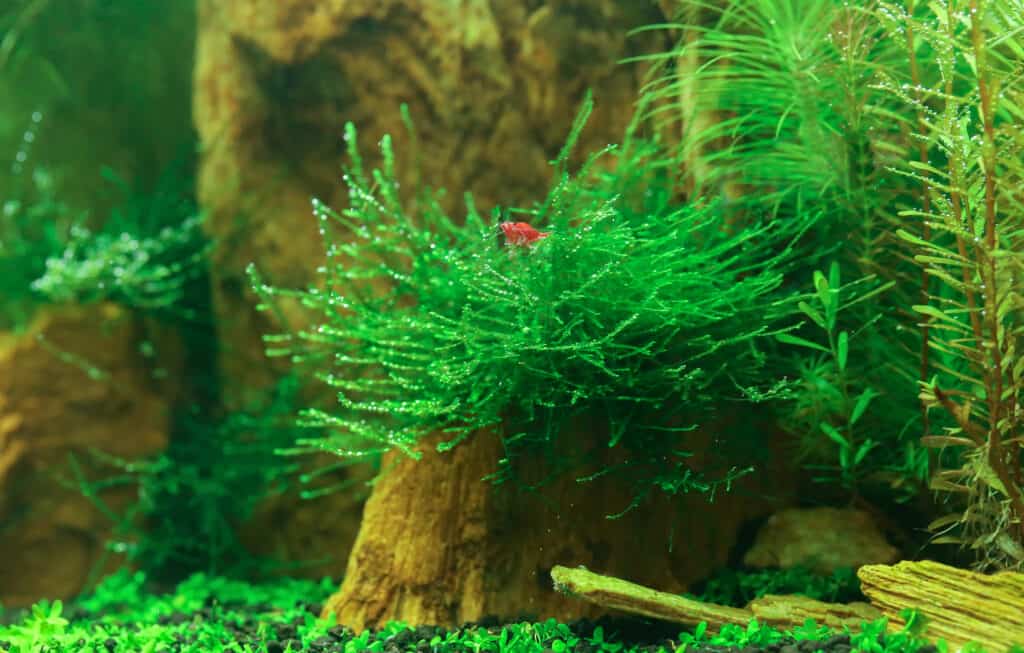
Taxiphyllum barbieri thriving submerged in a planted aquarium — its characteristic irregular branching and lush deep green are hallmarks of a healthy, well-lit colony. Photo © Aquariadise (aquariadise.com)
Morphology & Biology
Growth Form
T. barbieri is a pleurocarpous moss — meaning it branches laterally along its stems rather than from the tip. This gives Java Moss its characteristic irregular, sprawling mat shape rather than the upright form of acrocarpous mosses. Stems are slender (about 1.5 mm wide) and covered with tiny, overlapping, lance-shaped leaves. Under strong light the leaves are dense and growth compact; under low light, stems elongate and branching becomes sparse — still alive, just looser.
Rhizoids: How It Actually Attaches
Java Moss does not root in the traditional sense. It anchors via rhizoids — fine, hair-like structures on the underside of the stems that grip rough surfaces over time. Rhizoids work best on porous materials: driftwood, lava rock, and unglazed stone. Smooth glass or polished surfaces are difficult for rhizoids to grip, which is why moss on glass panels tends to drift. Tying or gluing moss to hardscape for the first few weeks dramatically improves long-term attachment — the rhizoids need time and pressure-contact to anchor properly.
Reproduction in the Aquarium
Taxiphyllum barbieri is dioecious — male and female reproductive structures occur on separate plants. It rarely produces sporophytes (spore capsules) in aquarium conditions.[1] In practice this means Java Moss reproduces almost exclusively by fragmentation in the hobby. Any piece that breaks off and finds a surface will grow into a new colony, which is why trimmings are genuinely valuable: every clipping is a fully viable plant.
Growth Rate
Under medium lighting and stable parameters, Java Moss grows at roughly 3–4 cm per month — fast for a moss, slow compared to stem plants.[2] This makes it manageable without constant trimming, unlike faster plants that can overwhelm a tank in weeks.
Growth rate vs. lighting intensity
| Light Intensity | Growth Rate | Density | Color | Trim Interval |
|---|---|---|---|---|
| Low | ~1–2 cm/month | Loose, threadlike | Duller green | 8–10 weeks |
| Medium | ~3–4 cm/month | Moderate, layered | Bright green | 4–6 weeks |
| High + CO₂ | ~5–6 cm/month | Dense, bushy | Vivid emerald | 2–3 weeks |
Why Java Moss Is Indispensable for Shrimp
Shrimplet Survival
The most important function of Java Moss in a shrimp tank is not aesthetic — it's survival architecture. Newborn shrimplets are extremely small (often 1–2 mm) and highly vulnerable in open water during their first weeks of life. Java Moss mats create a three-dimensional refuge where shrimplets hide and graze safely until large enough to venture out. This is why it is considered essential, not optional, for breeding Neocaridina, Caridina, or premium lines like Blue Bolts.
Biofilm Production
Every surface in an aquarium accumulates biofilm — the thin microbial layer of bacteria, microalgae, and protozoa that forms the base of the food chain. Java Moss is exceptionally effective at accumulating biofilm because its complex three-dimensional structure creates enormous surface area relative to its volume. Shrimp — especially juveniles — spend much of their day methodically picking through the fronds. A moss mat is a living buffet that replenishes itself continuously.
Biological Filtration Support
Beneficial bacteria that drive the nitrogen cycle colonize every available surface in a tank. Java Moss dramatically expands that surface area — the same biological principle behind porous ceramic filter media. A healthy moss mat contributes to ammonia and nitrate processing, helping buffer against parameter spikes in smaller tanks. It is not a replacement for mechanical filtration, but it meaningfully supplements it.
Pairing with Botanicals
Compared to botanicals like Lotus Pods or Casuarina Cones — which decompose over weeks to months, contributing tannins and organic input as they break down — Java Moss offers a living, renewable biofilm surface. Pods and cones complement moss beautifully: moss provides shelter and perpetual grazing, while botanicals provide ongoing organic structure. Together they replicate the layered ecology of shrimp's natural forest-stream habitats in Southeast Asia.
Java moss draped over driftwood — one of its most popular uses. The dense mat traps biofilm, microorganisms, and detritus, making it an all-in-one foraging ground and refuge for shrimp and fry alike. Photo © Aquariadise (aquariadise.com)
Care & Water Parameters
Java Moss is one of the most tolerant aquatic plants available. It survives conditions that would kill most stem plants. That said, "survives" and "thrives" are different — a healthy, dense, vivid green mat requires parameters that align with what your shrimp already need.
Water Parameter Reference Table
| Parameter | Ideal Range | Tolerance | Notes |
|---|---|---|---|
| Temperature | 70–78°F (21–26°C) | 60–82°F | Slows below 65°F; risk of melt above 82°F |
| pH | 6.5–7.5 | 5.5–8.0 | Neutral to slightly acidic preferred |
| GH | 4–10 °dGH | 2–20 | Needs Ca/Mg for cell wall structure |
| KH | 2–6 °dKH | 0–12 | Stable soft-to-moderate water ideal |
| Ammonia / Nitrite | 0 ppm | 0 ppm | Spikes cause browning and die-back |
| Nitrate | <20 ppm | Up to 40 ppm | Some nitrate aids plant growth |
| Lighting | Low–medium | Low–high | Densifies under higher; hair algae risk increases |
| CO₂ | Optional | Not required | Increases density and vivid color |
For a deeper explanation of KH, buffering, and why parameters matter for both plants and shrimp, see the Neocaridina Environment Guide.
The Temperature Ceiling Warning
The upper limit of 82°F is not arbitrary. Bryophytes are sensitive to sustained heat stress — above their thermal threshold, cellular processes break down faster than they can repair, leading to what hobbyists call a "melt": the moss rapidly browns and disintegrates. This most commonly occurs in summer without temperature management, or in tanks running warm for Caridina species. If temperatures regularly approach 80°F, consider a small fan aimed at the water surface for evaporative cooling.
⚠️ Ammonia spikes kill moss faster than most people expect. During a cycling event or after a livestock die-off, elevated ammonia causes Java Moss to brown and shed. If moss suddenly turns brown with no other explanation, test your water immediately — ammonia levels that harm moss are always harmful to shrimp too.
CO₂: When It's Worth It
Java Moss grows without CO₂ injection — this is part of its appeal. However, injecting CO₂ at 20–30 ppm accelerates growth, increases branch density, and produces the vivid emerald-green seen in competition aquascapes. The tradeoff: CO₂ also accelerates algae if lighting isn't carefully managed, and pH swings from CO₂ fluctuation can stress Caridina shrimp. For most shrimp-focused tanks, no-CO₂ is the sensible choice. For display tanks where aesthetics are the priority, CO₂ is worthwhile.
Aquascaping with Java Moss
Attachment Methods
The two most reliable methods for attaching Java Moss to hardscape are cotton thread and aquarium-safe superglue gel. Cotton thread is the traditional choice — wrap the moss lightly against the wood or rock, and the thread biodegrades over several weeks, by which time rhizoids have anchored the moss permanently. Superglue gel (cyanoacrylate) works well on stones and dense wood — apply a small dab, press the moss for a few seconds, and it bonds immediately. Avoid tying too tightly, which restricts growth and can cause die-back at contact points.
Moss Walls
A Java Moss wall is created by sandwiching moss between two plastic mesh panels (egg crate craft mesh works well) tied together with fishing line. The assembled panel is placed in the tank with good light exposure. Over 6–8 weeks, growth fills all gaps to produce a seamless green wall. These panels can be built to any size and trimmed flat once established — a popular background treatment in rimless aquascapes.
Bonsai Driftwood
Attaching Java Moss to branchy driftwood from the Hardscape Collection with thread produces the classic bonsai aquascape effect — a dense green canopy overhanging open substrate, mimicking a tree seen from below water. Rough-barked pieces like spider wood or manzanita provide more rhizoid anchor points than smooth round pieces.
Foreground Carpets
Java Moss forms a foreground carpet when attached to flat stones or mesh mats spread across substrate. Very thick carpets trap detritus beneath them, creating pockets of poor circulation and elevated ammonia. Keep carpet thickness to about 1–2 cm and vacuum lightly around edges during water changes.
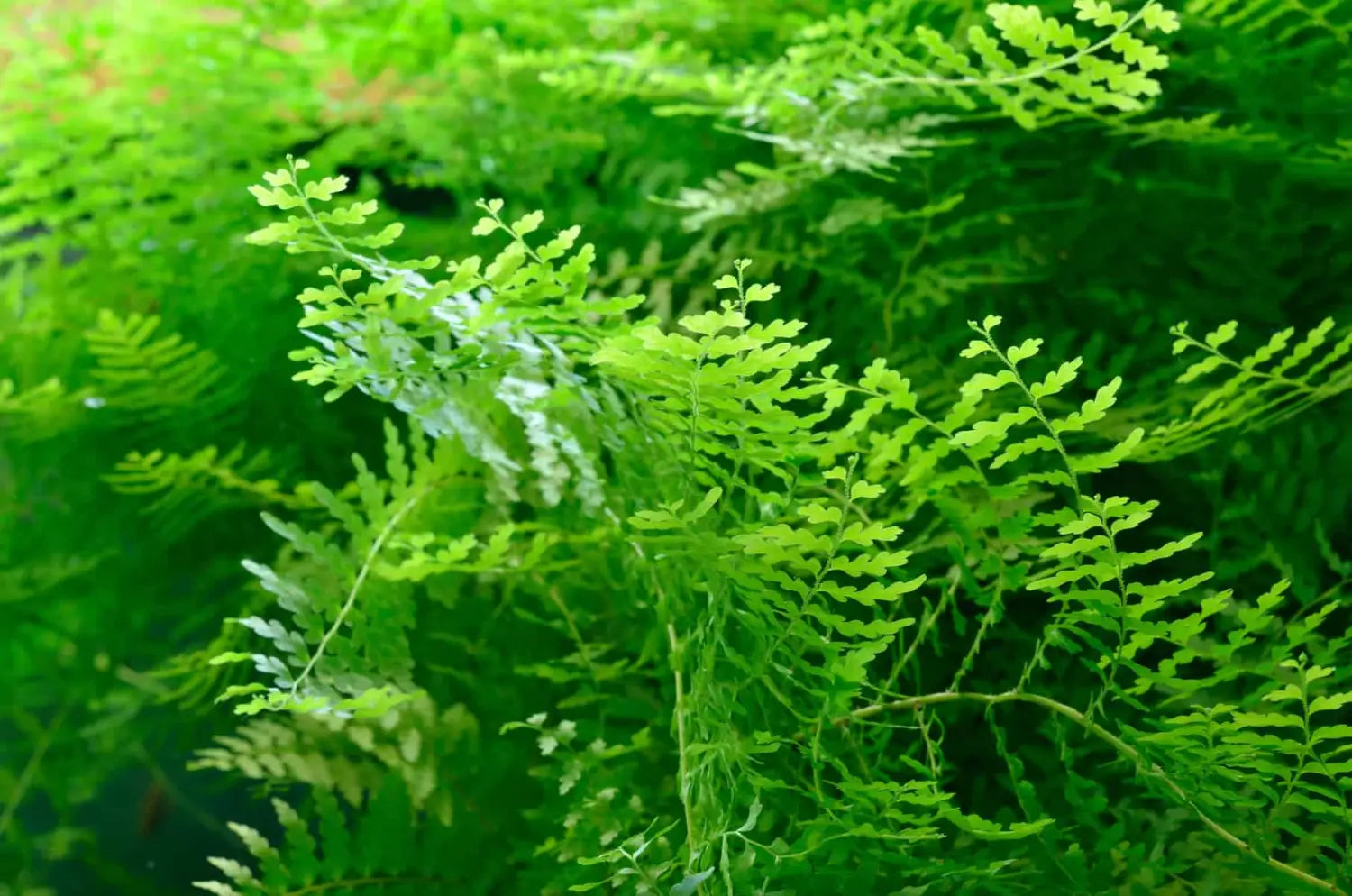
Close-up of Taxiphyllum barbieri fronds — the delicate, overlapping leaves are roughly 1.5 mm wide and branch irregularly. Good flow and moderate light produce this compact, richly green growth; low light yields longer, sparser shoots. Photo © Aquariadise (aquariadise.com)
Maintenance & Common Problems
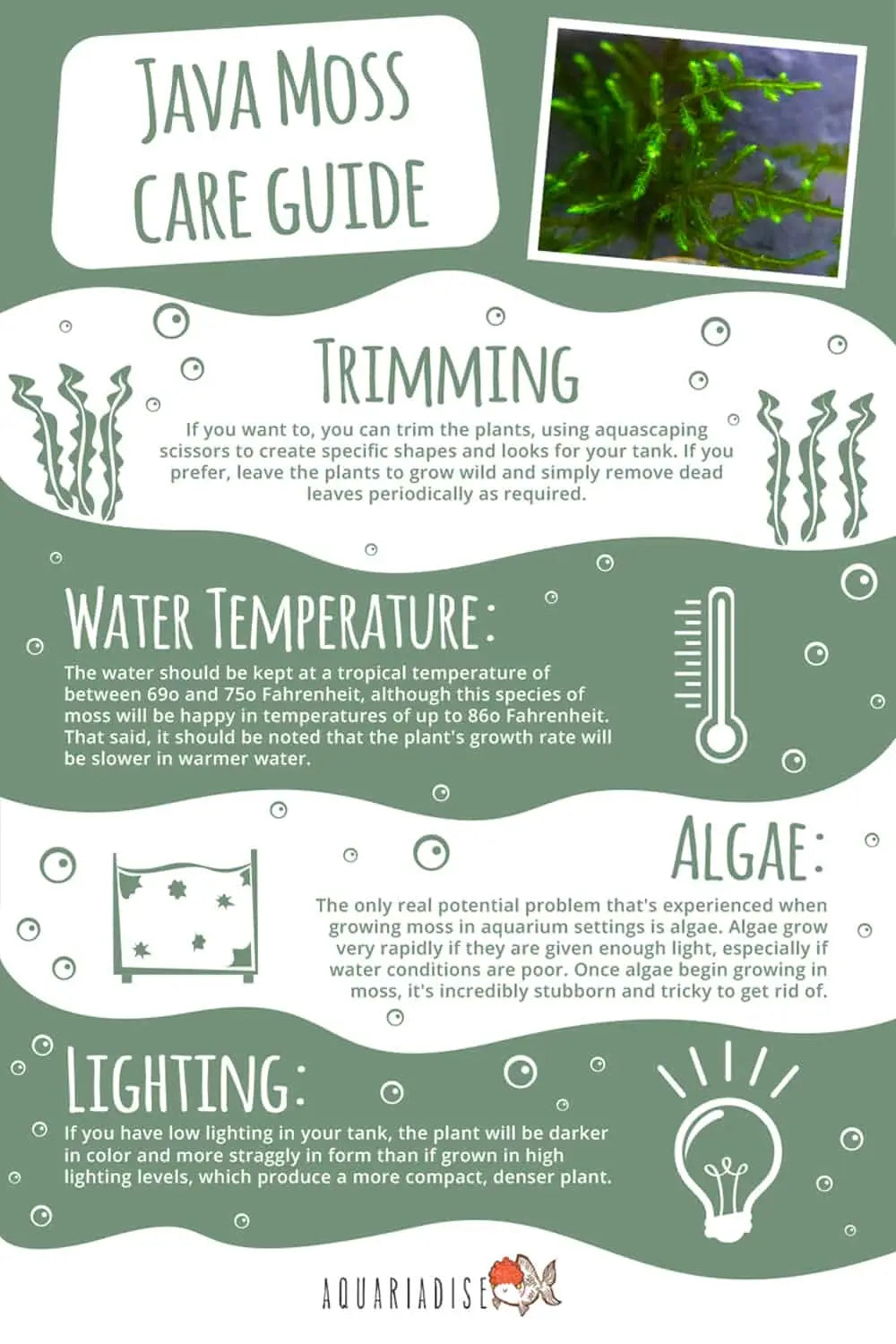
Trimming
Untrimmed Java Moss eventually becomes too thick — innermost layers die from lack of light, trapping decomposing matter that spikes ammonia and nitrate. Trim with sharp scissors, remove cuttings with a net before they scatter, and use them to propagate new growth. Never discard healthy Java Moss — it can be sold, traded, or used to seed new tanks.
Hair Algae
Java Moss under strong light is a common site for hair algae, which physically entangles with moss fronds and is nearly impossible to remove without pulling out both. Prevention is far more effective than treatment. Run lights for no more than 8 hours per day, avoid direct sunlight, and ensure nutrients aren't accumulating. Ramshorn Snails and Amano shrimp graze algae from moss surfaces constantly, providing meaningful biological control. If hair algae has established, reduce photoperiod to 6 hours for 2–3 weeks while increasing the snail and shrimp population.
Browning and Die-Back
Brown Java Moss is a symptom, not a disease. The most common causes, in order of frequency:
- Too little light: Inner layers die when the mat becomes too thick. Thin it out and trim to let light penetrate.
- Ammonia or nitrite spike: Test immediately. Brown moss with shrimp deaths almost always indicates a water quality problem.
- Temperature above 82°F: Heat melt. Reduce temperature, remove brown sections, and healthy portions will recover.
- New tank or transport stress: Newly introduced moss often browns at the edges as it adjusts to new parameters. Temporary — trim the brown portions and healthy growth continues.
- Allelopathy: Some fast-growing stem plants release compounds that inhibit moss growth when in direct contact. Keep Java Moss separated from aggressive stem plants.
Java Moss vs. Other Common Mosses
Java Moss
Taxiphyllum barbieri
Loose, irregular mats. Most tolerant of parameter swings. Best overall choice for shrimp breeding tanks. Grows 3–4 cm/month under medium light.
Christmas Moss
Vesicularia montagnei
Layered, frond-like branches resembling fir boughs. More structured appearance. Slightly more demanding — prefers moderate light and stable pH.
Weeping Moss
Vesicularia ferriei
Cascades downward with a pendulous habit. Striking on elevated wood or rock. Slower-growing, prefers cooler temperatures and moderate light.
Singapore Moss
Vesicularia dubyana
The original "Java Moss" of the hobby. Slower-growing, finer branches, more decorative. Rarer in the current trade but available from specialty sources.
Tankmates & Compatibility
Java Moss is compatible with virtually all dwarf shrimp and nano aquarium inhabitants. Neocaridina, Caridina, and specialty lines like Extreme Blue Bolts use it for cover and grazing. Ramshorn Snails graze its surfaces continuously. Assassin Snails patrol the perimeter. Peaceful nano fish — rasboras, ember tetras, pygmy corydoras, small guppies — shelter in the moss without harming it.
🚫 Avoid: Goldfish, large cichlids, koi, and most medium-to-large herbivorous fish will actively eat or uproot Java Moss. Crayfish destroy it within hours. Stick to nano-scale tankmates and the moss will thrive indefinitely.
Sourcing: Tissue Culture vs. Traditional
Tissue culture moss is grown in sterile gel medium and arrives completely free of algae spores, snail eggs, pest hitchhikers, and pathogens. This is the safest option for established tanks housing expensive Caridina shrimp. The tradeoff is a 1–2 week transition period as it adjusts from sterile air-grown conditions to submersed life.
Traditional loose moss is typically already submersed-grown and establishes faster. It is better value per gram and the most economical way to fill a large tank or build a moss wall. The caveat: it can carry hitchhikers — algae spores, tiny pest snails, duckweed. A brief dip in dilute hydrogen peroxide (3% solution, 10 ml per liter, 2–3 minutes, then rinse well) kills most hitchhikers without damaging the moss.
Shop the Essentials
Ready to Build the Perfect Shrimp Habitat?
Java Moss is the foundation. Add shrimp, botanicals, and hardscape — and you have everything a thriving colony needs.
Sources & Citations
- [1]Wikipedia contributors. Taxiphyllum barbieri. Taxonomy, Iwatsuki 1982 reclassification, dioecious biology, Vietnamese origin. en.wikipedia.org
- [2]Aquasabi GmbH. Taxiphyllum barbieri — Java moss product profile. Growth rate 3–4 cm/month; Benl 1969 introduction; naming history. aquasabi.com
- [3]Flowgrow Aquatic Plant Database. Taxiphyllum barbieri. Taxonomy controversy; Singapore Moss vs. Java Moss naming. flowgrow.de
- [4]Flip Aquatics. Moss in Fish Tank — must-have mosses and their benefits. Biofilm, shrimplet shelter, filtration function. flipaquatics.com
- [5]Superior Shrimp & Aquatics. Creating the Perfect Environment for Neocaridina Shrimp. superiorshrimpaquatics.com
- [6]Superior Shrimp & Aquatics. Assassin Snail Care Guide. superiorshrimpaquatics.com
- [7]Superior Shrimp & Aquatics. Lotus Pod Product Page. superiorshrimpaquatics.com
- [8]Superior Shrimp & Aquatics. Botanicals Collection. superiorshrimpaquatics.com