


The Perfect Neocaridina Environment: Complete Setup Guide
Water parameters, substrate, filtration, feeding, breeding, and maintenance — everything needed to build a tank where Neocaridina shrimp don't just survive, but thrive and reproduce.
Understanding Neocaridina davidi
Neocaridina davidi is native to streams and rivers of eastern China and northern Taiwan, where it inhabits clear, moderately hard freshwater with neutral to slightly acidic pH. Through decades of selective breeding in the aquarium trade, the species now spans a wide range of color morphs — all sharing identical care requirements despite their different appearances.
What makes Neocaridina particularly accessible is their genuine resilience. Unlike the sensitive Caridina bee and tiger species that demand RO water and narrow parameter windows, Neocaridina tolerate a meaningful range of conditions without immediate harm. This tolerance does not mean they are indestructible — it means mistakes are more survivable while you find your footing. The goal is still to optimize, not just to keep them alive.
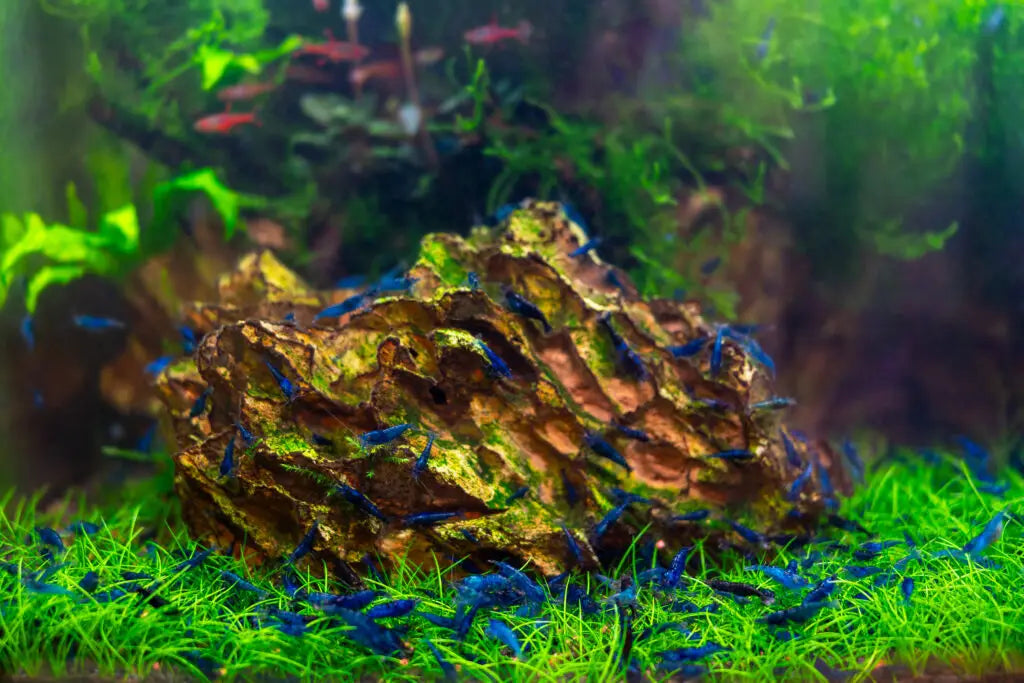
Blue Dream shrimp — one of the many color morphs of Neocaridina davidi, all sharing identical care requirements. Photo © Aquarium Nerd (aquariumnerd.com)
Common Color Morphs
All of the following are Neocaridina davidi — the same species with the same care needs. Never house different color morphs together if maintaining color purity matters; crossbreeding reverts offspring toward wild-type brown over successive generations.
Cherry / Fire Red
Red line. From translucent Cherry to opaque Painted Fire Red and Bloody Mary.
Blue Dream / Diamond
Blue line. From translucent Blue Velvet to opaque Blue Diamond.
Sunkist / Pumpkin
Orange line. Tangerine to deep pumpkin; also Blood Orange and Orange Back.
Yellow / Golden Back
Yellow line. Solid yellow body or yellow with a gold dorsal stripe.
Black Rose / Carbon Rili
Black line. Deep charcoal to opaque black; Carbon Rili shows banded patterning.
Jade / Green Jelly
Green line. Soft jade to vivid green; less common but visually distinctive.
Tank Setup
Tank Size
A minimum of 5 gallons supports a small starter colony, but 10–20 gallons is the practical sweet spot for most keepers. Larger water volumes dilute waste more slowly, buffer temperature and chemistry swings, and provide the stable baseline that Neocaridina need to breed consistently. The difference between a 5-gallon and a 20-gallon tank in terms of parameter stability is not trivial — a 20-gallon tank gives you time to catch and correct problems before they become critical.
Substrate
Substrate choice affects two things: water chemistry and color expression. Dark substrate — black sand, dark gravel, or black aquasoil — is strongly recommended for all Neocaridina color morphs. Research confirms shrimp actively suppress pigmentation on light-colored substrate as a physiological stress response, so pale or white substrate will visibly mute color even in high-grade individuals.[1] Substrate should also be fine-grained and non-abrasive — sharp edges can damage exoskeletons during molting and foraging. Aquasoil additionally provides a gentle nutrient base for live plants and, in inert variants, does not affect water chemistry.
Aquascaping & Cover
Peer-reviewed research on Neocaridina davidi (Santana et al., 2023) documented that shrimp spend up to 88.8% of daytime hours in shelter, with strong preference for moss and soft organic surfaces over bare rock or glass.[2] A bare tank is a stressed tank — behavioral abnormalities, reduced breeding, and suppressed color all follow from inadequate cover. Provide dense planting with Java Moss, Anubias, and Java Fern, and supplement with botanicals — Almond Leaves and Lotus Pods — which additionally generate the biofilm colonies shrimp graze continuously.
Filtration
A sponge filter is the correct choice for any Neocaridina tank. It provides biological filtration through beneficial bacteria colonizing the foam, creates gentle water movement, and poses no risk to shrimplets or adult shrimp. HOB or canister filters can work but require a pre-filter sponge over the intake to prevent shrimp from being pulled in. Avoid strong currents — Neocaridina are adapted to still or slow-moving water and stress under high flow, spending more time hiding and less time foraging and breeding.
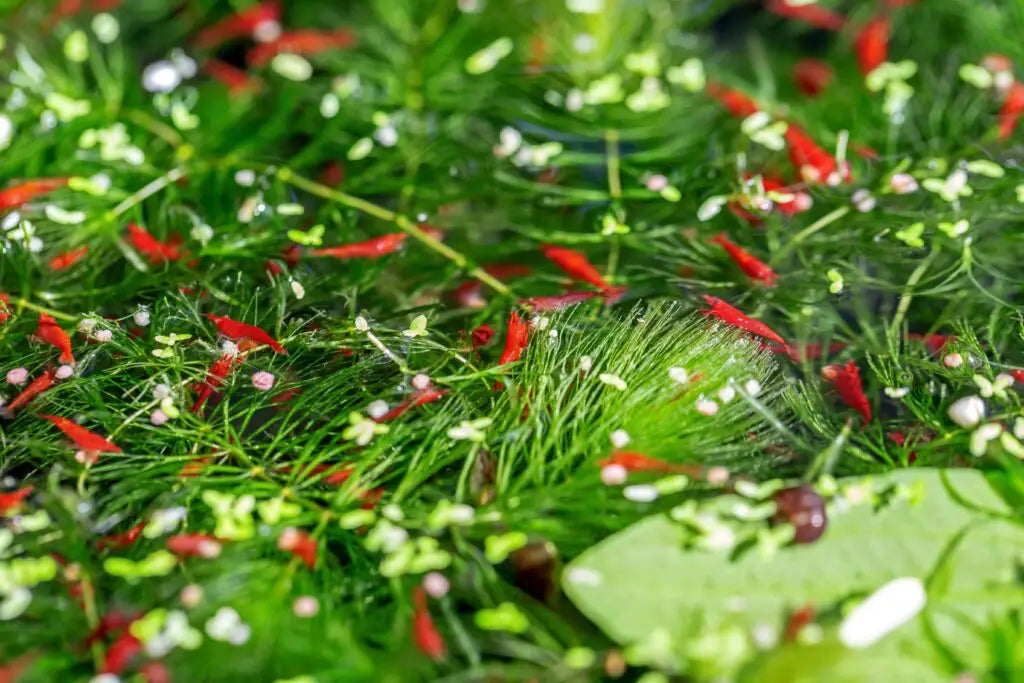
A Red Cherry shrimp grazing on plant surfaces — live plants provide the continuous biofilm supply that makes up the bulk of a healthy shrimp's diet. Photo © Aquarium Nerd (aquariumnerd.com)
Water Parameters: The Complete Reference
Parameter stability matters more than hitting exact numbers within the acceptable range. A tank that holds steady at pH 7.2 is far healthier for shrimp than one that swings between 6.8 and 7.5 daily. Test regularly, change water consistently, and avoid large sudden additions that shift chemistry quickly.
Full water parameter reference for Neocaridina davidi
| Parameter | Acceptable Range | Optimal Range | Notes |
|---|---|---|---|
| Temperature | 65–80°F (18–27°C) | 72–76°F (22–24°C) | Heater-less in temperate rooms; avoid above 82°F |
| pH | 6.5–8.0 | 6.8–7.5 | Stability critical; sudden swings cause molting failures |
| GH | 4–10 °dGH | 6–8 °dGH | Calcium + magnesium for exoskeleton; test with drops not strips |
| KH | 2–8 °dKH | 2–4 °dKH | Buffers pH between water changes; prevents overnight crashes |
| TDS | 100–300 ppm | 150–250 ppm | Quick mineral load indicator; use a reliable TDS meter |
| Ammonia | 0 ppm | 0 ppm | Zero tolerance; acutely toxic at any detectable level |
| Nitrite | 0 ppm | 0 ppm | Zero tolerance; indicates incomplete or disrupted nitrogen cycle |
| Nitrate | <40 ppm | <20 ppm | Weekly water changes + live plants keep this in range |
🧪 Use liquid test kits, not strips. API Master Test Kit is the standard recommendation for ammonia, nitrite, nitrate, and pH. For GH and KH specifically, a dedicated GH/KH drop-count test kit is significantly more accurate than strips. TDS meters provide a fast daily sanity check for overall mineral load but don't replace individual parameter tests.
The Nitrogen Cycle: Non-Negotiable
Before any shrimp enter a tank, the nitrogen cycle must be fully established. This is the process by which beneficial bacteria (primarily Nitrosomonas and Nitrobacter species) colonize the filter media and convert toxic ammonia (from waste and food) first to nitrite, then to the less toxic nitrate. A fully cycled tank converts ammonia and nitrite to 0 ppm within 24 hours of a waste event. This typically takes 4–6 weeks from scratch using an ammonia source. Shrimp added to an uncycled tank will die — ammonia poisoning is the single most common cause of new shrimp loss.
⚠️ Copper is lethal to all shrimp at any detectable concentration. Check every medication, plant fertilizer, and tap water conditioner for copper before use. Many common fish medications contain copper as the active ingredient. If treatment is necessary, remove all shrimp to a quarantine tank first.
Water Changes & Maintenance
A 20–30% weekly water change is the standard for Neocaridina tanks. This removes accumulated nitrates, replenishes minerals, and resets any gradual parameter drift before it becomes a problem. The most important rules for water changes:
Feeding
In a mature planted tank, Neocaridina shrimp graze continuously on biofilm, algae, and organic detritus — this natural feeding behavior is healthy and provides meaningful nutrition between scheduled feedings. Supplemental feeding ensures balanced nutrition and supports colony growth and breeding.
⚠️ Overfeeding is the most common cause of water quality decline in shrimp tanks. Feed once daily or every other day. If food remains after 2 hours, remove it immediately and reduce the next portion. Rotting food drives ammonia spikes faster than almost any other cause.
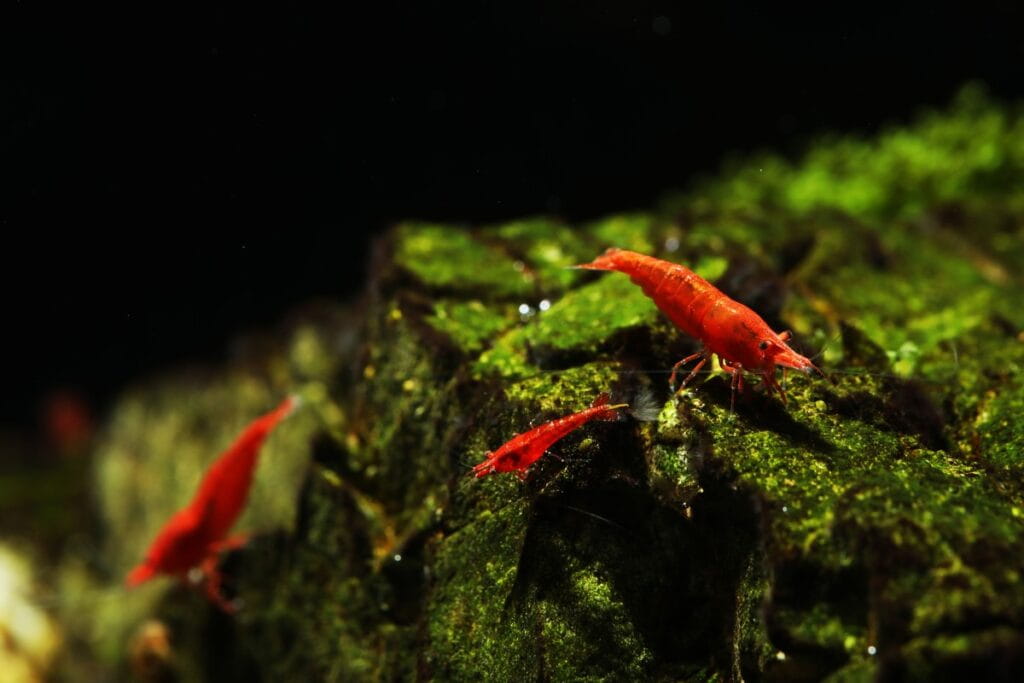
A Fire Red shrimp showing full opaque color — the result of a properly set up tank: dark substrate, stable parameters, dense planting, and low stress. Photo © Aquarium Nerd (aquariumnerd.com)
Breeding
Neocaridina breed readily when conditions are right — no special intervention is required beyond providing a stable, mature, well-planted tank. The breeding cycle is straightforward: a female molts, releases pheromones that trigger active male searching behavior, mates, then carries fertilized eggs in her pleopods for approximately 25–30 days before hatchlings emerge as fully formed miniature shrimp.
Additional Considerations
Tank Mates
The single rule: if a fish can fit a shrimp in its mouth, it will eventually eat that shrimp. Safe companions are limited to small, genuinely peaceful fish (Otocinclus catfish, Pygmy Corydoras, Chili Rasboras, Ember Tetras) and freshwater snails. Even fish sold as "shrimp safe" may predate shrimplets. The safest breeding colonies are shrimp-only tanks.
Stress Factors to Avoid
Neocaridina are sensitive to environmental stress even when water parameters test correctly. Keep tanks away from direct sunlight (causes rapid temperature swings and algae blooms), loud persistent noise or vibration (disturbs behavior), and sudden temperature changes from nearby heating or air conditioning vents. Shrimp that hide constantly in a tank with adequate cover and correct parameters are usually responding to vibration or light stress from the surrounding room.
Quarantine
Always quarantine new additions — whether plants, fish, or shrimp — for a minimum of one week before introducing them to an established colony. New plants can carry pest snails, parasites, and pathogens. New shrimp can carry disease organisms that only become apparent under stress. A simple sponge-filtered quarantine tank prevents the introduction of problems that can devastate a colony you have spent months building.
Shop Neocaridina & Supplies
Build the Environment, Then Add the Shrimp
Healthy, colony-ready Neocaridina in every color — shop by morph or browse the full collection.
Sources & Citations
- [1]Vaz-Serrano, J. et al. (2021). Substrate color and texture effects on behavior and coloration in Neocaridina davidi. Dark substrate preference; physiological pigmentation suppression on light substrate.
- [2]Santana, F. et al. (2023). Shelter preference and daily activity patterns in Neocaridina davidi: effects of sex and reproductive status. 88.8% daytime shelter use; moss and leaf litter preference; reduced activity and foraging in structurally bare tanks.
- [3]UF IFAS Extension (2020). Neocaridina davidi species profile. Water parameter requirements, nitrogen cycle dependency, reproductive biology. edis.ifas.ufl.edu