


Thai Micro Crab: Complete Care Guide
Limnopilos naiyanetri — one of the smallest fully aquatic freshwater crabs in the world, discovered in a single river in Thailand and still one of the hobby's most captivating nano inhabitants. Shop Thai Micro Crabs →
Species Overview & Natural History
Limnopilos naiyanetri was first scientifically described in 1991 by Christina Chuang and Peter Ng — the same year it was discovered. It is endemic to a single river: the Tha Chin River in Nakhon Pathom Province, Thailand, where wild individuals were found clinging to the roots of floating water hyacinths in slow-moving, plant-dense water. As of writing, no confirmed population has been found anywhere outside this river basin, making it one of the most geographically restricted aquarium species available.
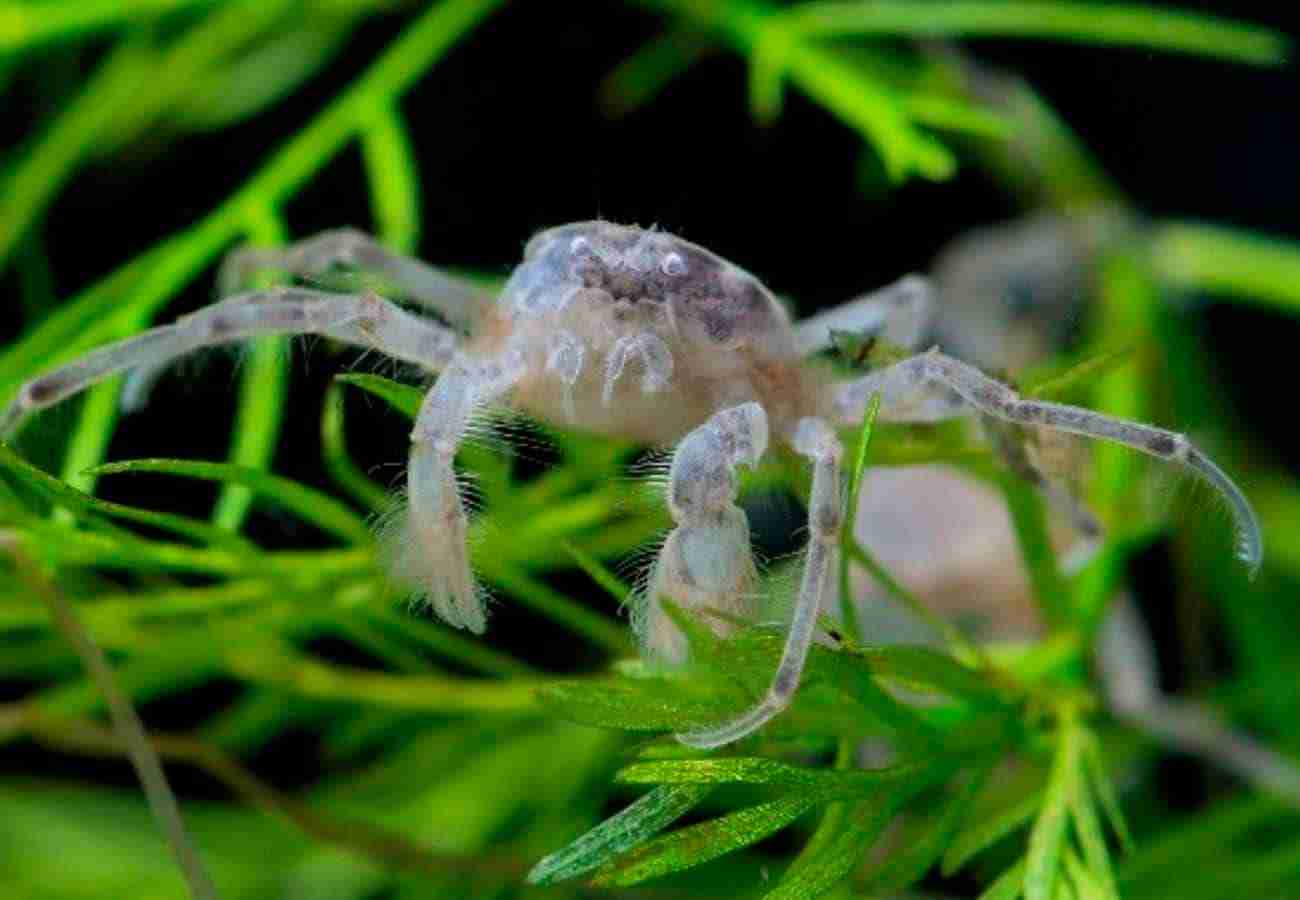
The species name honors Professor Phaibul Naiyanetr of Chulalongkorn University in Bangkok. The genus name Limnopilos — loosely translating to "freshwater hairy" — is a direct reference to the bristle-covered body that defines the species' appearance and feeding strategy. After a brief taxonomic detour into the genus Hymenicoides, the original genus assignment was validated in 2007 when researchers confirmed enough structural differences to warrant separation. The family Hymenosomatidae, to which Limnopilos belongs, contains the smallest known freshwater crabs in the world.
The species entered the aquarium trade in Germany in 2008 and has remained relatively niche ever since — partly because it is genuinely difficult to breed in captivity and partly because its small size and shy nature make it a poor fit for the mass market. That rarity is part of what makes finding and successfully keeping them rewarding. Shop Thai Micro Crabs at Superior Shrimp & Aquatics →
Water Parameters
Thai Micro Crabs are more sensitive to water quality than their small size might suggest. They should only be added to a fully cycled, established tank — never a new setup. Ammonia and nitrite must be at zero; nitrate should be kept below 20 ppm through regular water changes. Avoid copper medications in the crab tank and check the label, dose and invertebrate compatibility of every additive. Copper risk depends on exposure and water conditions; the mere presence of trace copper does not establish that a product is lethal or safe for this species.
Water parameter targets for Limnopilos naiyanetri
| Parameter | Range | Notes |
|---|---|---|
| Temperature | 70–82°F (21–28°C) | Optimal around 75–78°F. Stable is more important than exact value. |
| pH | 6.5–7.3 | Neutral is ideal. Low pH (<6.5) is not well tolerated — they evolved in a single neutral river. |
| GH | 6–15 dGH | Check the requirements of the particular shrimp species or variety; compatibility is not universal. |
| KH | 2–8 dKH | Some KH buffering is beneficial for carapace integrity during molting. |
| Ammonia / Nitrite | 0 ppm | Zero tolerance. Add only to fully cycled tanks. |
| Nitrate | <20 ppm | Keep low with consistent weekly water changes of 15–20%. |
| Copper | Avoid copper medication | Check exposure, product labeling and invertebrate compatibility. Trace copper alone does not determine toxicity. |
💧 Shrimp compatibility depends on shared conditions. Compare temperature, pH, GH and KH requirements for the particular shrimp and the crabs before combining them. Inert substrate with GH/KH remineralizer is commonly used for Neocaridina; buffering substrate with GH-only remineralizer is used for some Caridina. Those setups are not interchangeable, and a shrimp setup should not automatically be assumed suitable for Thai Micro Crabs. Combine animals only where their needs overlap, without abrupt parameter changes.
Feeding
Thai Micro Crabs are omnivorous opportunists that feed primarily through two mechanisms: passive filter feeding using their setae, and active scavenging across substrate, plant surfaces, moss, and biofilm. In a well-established planted tank with good biofilm development, they require remarkably little supplemental feeding — the tank itself feeds them. In less mature tanks, daily or every-other-day supplemental feeding is appropriate.
⚠️ Do not overfeed. Uneaten food in a nano tank degrades water quality rapidly. Thai Micro Crabs are small animals with small appetites. Feed sparingly — a piece of wafer no larger than a pea, two or three times per week in a mature tank, is typically sufficient. Remove any uneaten food after two hours.
Behavior & What to Expect
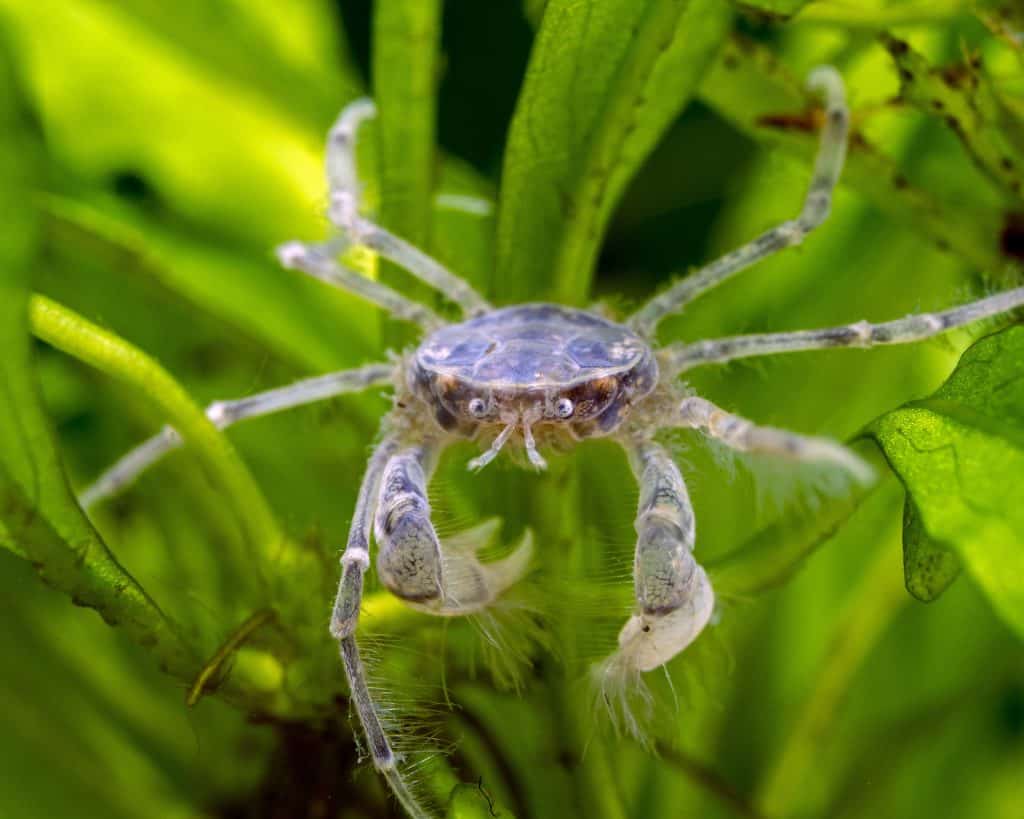
New keepers should be prepared for a species that hides most of the time, particularly during the day. Thai Micro Crabs are nocturnal — they are most active after lights out, foraging through moss and plant roots in the dark. During the day they tuck into dense vegetation, behind hardscape, or inside the floating plant root mass and stay almost completely still. This is normal and healthy behavior, not a sign of stress.
When they do emerge — typically at feeding time or in low light — their movement is deliberate and slow. They pick across surfaces methodically, pausing to filter-feed with their setae, then moving on. Watching a Thai Micro Crab actively graze on a Java Moss wall or hang from floating plant roots is genuinely absorbing once you tune your eyes to their scale. A red or dim night-viewing light allows observation of their after-dark activity without disrupting their behavior.
🦀 Molting. Like all crustaceans, Thai Micro Crabs shed their exoskeleton to grow. During and after a molt they are extremely vulnerable — the new carapace takes time to harden and they can be injured easily. Do not disturb a molting crab or the freshly shed exoskeleton (which the crab will eat for mineral recapture). Stable water parameters, particularly GH for calcium and mineral content, are critical to successful molting. A failed molt, where the crab cannot fully exit the old shell, is not a diagnosis of low GH by itself. Review water quality, recent changes, mineral balance and nutrition before adding minerals.
Tank Mates
Thai Micro Crabs are among the most defenseless animals in the hobby. They cannot outrun predators, their claws are decorative rather than defensive, and their small size makes them prey for almost any fish large enough to fit them in its mouth. Tank mate selection must be approached from the perspective of: what won't eat or stress a 1cm crab?
✅ Potential companions: assess each species
Neocaridina shrimp (Cherry, Blue Dream, etc.) Caridina shrimp (if parameters match) Ramshorn & Nerite snails Otocinclus catfish Pygmy Corydoras Chili Rasboras (well-fed) Ember Tetras Neon Tetras⚠️ Caution
Betta fish — personality-dependent; some are fine, others will pick at crabs Guppies — males may nip at thin crab legs Kuhli Loaches — generally safe but monitor; may disturb crabs at night Any fast, active nano fish — can stress crabs through constant activity❌ Avoid
Cichlids of any size Angelfish Goldfish Larger loaches (Clown, Yoyo) Pufferfish Gourami (most species) Any fish able or inclined to swallow, nip or harass a crab; a 3–4 cm size cutoff alone cannot establish safety🦐 Thai Micro Crabs with shrimp. Small shrimp can be suitable companions when their requirements overlap with the crabs' needs, but compatibility should be assessed for the particular species and tank. There are rare anecdotal reports of a crab seizing a shrimp — the golden rule with any crab is that if it can catch something it may try — but in practice Thai Micro Crabs almost never show predatory interest in healthy adult Neocaridina or Caridina shrimp. Exercise slightly more caution with shrimplets in a tank with many crabs.
Breeding
Breeding Thai Micro Crabs in captivity is one of the hobby's open challenges. Females have been observed becoming berried in aquariums — eggs start orange, shift to yellow, and finally grey as they develop, and a clutch can number around 70 larvae. The eggs are carried under the female's pleon (the abdominal flap) for several weeks of incubation. At this point, the challenge begins.
Unlike freshwater shrimp — whose young hatch as miniature versions of the adults — Thai Micro Crabs release free-swimming zoea larvae. These larvae are microscopic, require specific conditions to develop, and are believed by many researchers to need a different environment than the parents' tank to survive through their larval stages. Whether that means brackish water (as with many crab species), specific phytoplankton food sources, or some other undetermined factor is still not fully established. No reliable, repeatable breeding protocol has been documented in the aquarium hobby.
Health & Common Issues
No diseases are currently documented as specific to Limnopilos naiyanetri. Like other freshwater crustaceans, they may develop infections, but signs of illness should also prompt a check of water quality. Sluggishness, loss of appetite or unusual daytime exposure are nonspecific signs. Review water tests, recent changes, feeding and possible aggression rather than diagnosing a single cause from behavior alone.
Related Guides & Shop
One of the Hobby's Most Unique Nano Inhabitants
Thai Micro Crabs can complement shrimp colonies in mature planted tanks when water requirements overlap and all inhabitants can feed without harassment.
Sources & Citations
- [1]Chuang, C. & Ng, P.K.L. (1991). Preliminary descriptions of one new genus and three new species of hymenosomatid crabs from Southeast Asia (Crustacea: Decapoda: Brachyura). Original scientific description of Limnopilos naiyanetri; discovery location (Tha Chin River, Nakhon Pathom Province, Thailand).
- [2]Ng, P.K.L. (2007). On the taxonomy of the genus Hymenicoides Kemp, 1917 (Crustacea: Decapoda: Brachyura: Hymenosomatidae), with resurrection of Limnopilos Chuang & Ng, 1991, and descriptions of two new species. Validation of genus separation from Hymenicoides; structural differences justifying resurrection.
- [3]Patoka, J. et al. (2019). Invasive potential of pet-traded pill-box crabs from genus Limnopilos. Assessment of geographic restriction, reproductive biology, and larval development requirements relevant to captive breeding challenges.
- [4]Wikipedia contributors. (2025). Limnopilos naiyanetri. Wikipedia. Taxonomy history, aquarium parameters, ecological notes. en.wikipedia.org