


You will not be allowed to compare more than 4 products at a time
View compareJava moss (Taxiphyllum barbieri)
Java moss (Taxiphyllum barbieri)
<p>Earn%20[points_amount]%20when%20completing%20this%20purchase.</p>
Sub total:
$5.50Useful add-ons
Loading add-ons…


Description
Reviews
Description
Aquatic Plants
Java Moss
The most widely kept aquatic moss in the freshwater hobby -- a fast-spreading, virtually indestructible moss that attaches to any hardscape, tolerates any water chemistry, and provides unmatched biofilm surface area and shrimplet cover.
Fastest Spreading Aquatic Moss
Attaches to Any Hardscape
Tolerates Any Water Chemistry
Exceptional Biofilm Surface Area
Superb Shrimplet Shelter
No CO2 Required
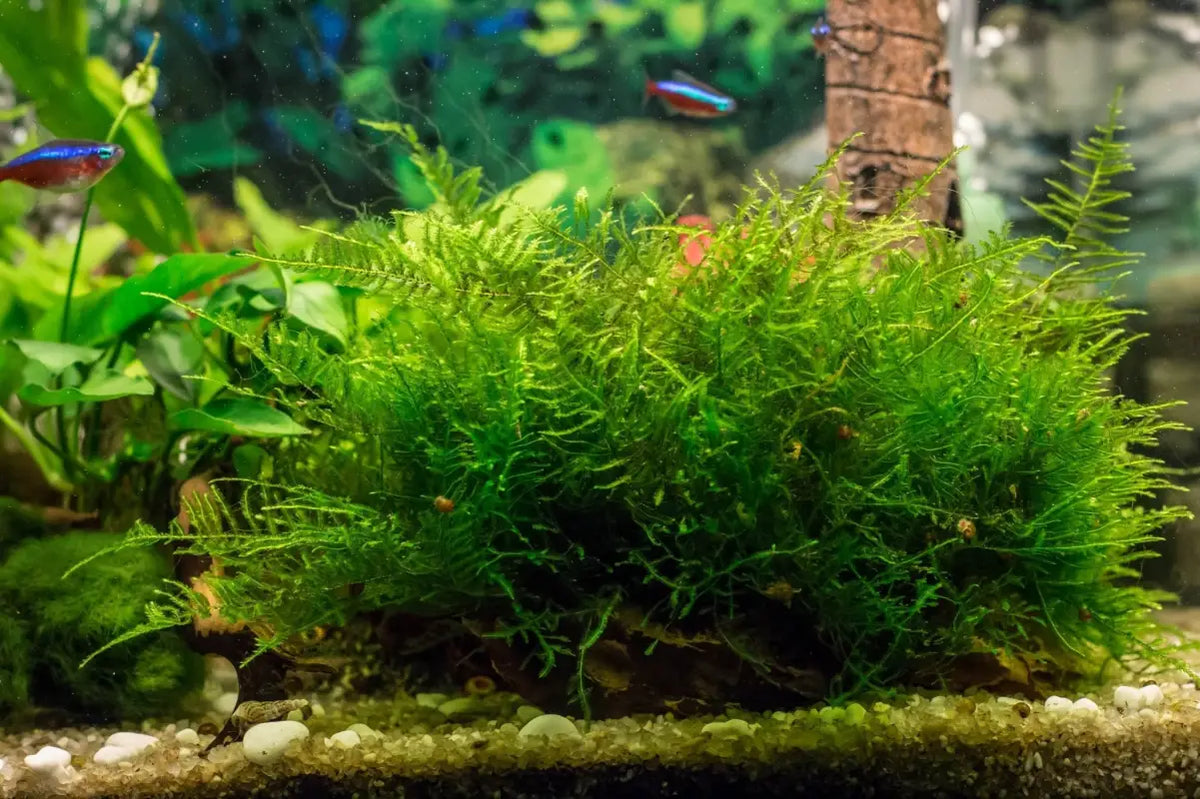
Java Moss (Taxiphyllum barbieri) is the most widely kept aquatic moss in the freshwater hobby and the single most recommended plant for shrimp tanks -- a fast-spreading, virtually indestructible moss that attaches to driftwood, stone, substrate, and any other available surface, tolerates water chemistry from soft and acidic to hard and alkaline, grows at any light level, and provides the dense, fine-textured biofilm surface area and physical shrimplet shelter that every shrimp keeper benefits from regardless of their shrimp species or tank style. It is the baseline against which every other aquatic moss is measured precisely because it outperforms every alternative on the practical criteria that matter most in a shrimp tank: ease of establishment, speed of spread, tolerance of variable conditions, and biofilm production. Fully safe with all Neocaridina, Caridina, and snails.
Not RequiredCO2
65-82FTemperature
Low-HighLighting
Growth, Coverage and Character
Fastest spreading aquatic moss -- covers hardscape and substrate edges within weeks -- Java Moss spreads laterally across any surface it contacts more quickly than any other moss in the catalog. A portion pressed against driftwood or scattered across substrate begins visibly spreading within two to three weeks and covers available surface area steadily with each passing week. In good conditions a 10x10cm piece of driftwood can be covered from a single initial attachment within six to eight weeks.
Attaches to any hardscape and develops firm hold over time -- Java Moss initially needs mechanical support -- cotton thread or super glue gel -- to make contact with a hardscape surface. Once contact is established, it develops a progressively firmer attachment over two to four weeks through its natural rhizoid attachment structures. Well-established Java Moss on driftwood holds firmly enough to resist typical flow and minor disturbance.
Tolerates the widest range of conditions of any moss in the catalog -- Java Moss grows in pH 5.5-8.0, in soft Caridina water and hard tap water alike, under lighting from very dim to very bright, and at temperatures from 15C to 30C. No parameter adjustment is required specifically for Java Moss -- it adapts to whatever conditions the rest of the tank requires. This tolerance is the primary practical reason it is universally recommended as a first plant for shrimp keepers at any experience level.
Dense fine-textured fronds develop rich biofilm across all surfaces -- the fine, branching frond structure of Java Moss develops a consistent biofilm coating across every frond surface. In a shrimp tank, every visible surface of the moss mass is continuously grazed by shrimp working across the frond tips, and the interior of a dense moss clump provides the richest biofilm per unit volume of any plant structure in the catalog. Shrimp and shrimplets disappear into dense Java Moss patches for extended foraging sessions.
Finest shrimplet shelter available -- frond spacing suits newborns precisely -- the gaps between Java Moss fronds are sized appropriately for newborn shrimplets to navigate freely while providing physical concealment from the open tank. Shrimplets spend the first several weeks of their lives primarily inside dense moss, emerging progressively as they grow. Dense Java Moss coverage significantly improves first-generation breeding survival rates versus tanks without fine-structure plant cover.
Requires periodic thinning once established -- Java Moss grows quickly enough to need thinning every four to six weeks in good conditions. Remove handfuls of the oldest, densest interior growth while leaving the actively spreading outer fronds in place. Thinned portions can be attached to new hardscape or distributed to other tanks.
How to Set It Up
Getting Started
1Secure to hardscape with cotton thread or super glue gel -- wrap a few loops of black cotton thread around the moss and the target hardscape surface, or press the moss against a small dot of gel super glue applied to the dry hardscape surface and hold for 30 seconds before submerging. The moss begins spreading from the attachment point within two to three weeks.
2Any water chemistry -- no adjustment needed -- Java Moss adapts to whatever parameters the rest of the tank requires. No special preparation is needed for Java Moss specifically.
3Low to high light -- adjusts growth rate but not success -- Java Moss grows more slowly under low light and more quickly under high, but performs successfully at every light level. Algae is more likely to establish inside the dense moss structure under high light -- moderate intensity is generally the most practical balance for long-term maintenance.
4Thin regularly once established to maintain open texture -- remove dense interior growth every four to six weeks to prevent the moss from becoming so thick that light and flow cannot penetrate to the interior layers. A thin outer layer with some interior openness produces more active shrimp grazing than an impenetrably dense mass.
Bonus Tip
A 10x15cm flat piece of driftwood covered entirely in established Java Moss, positioned horizontally as a midground element with the moss face visible from the front glass, is the single most productive shrimp observation surface you can create in a nano tank. The combination of the large moss-covered flat face, the horizontal position that presents the full surface to the viewer, and the density of biofilm on an established moss piece means that at almost any time of day, multiple shrimp are visible grazing across the surface simultaneously -- a more reliably active and more clearly observable foraging scene than any other plant arrangement at the same scale.
Browse more aquatic plants
→
Pair Java Moss with Anubias Nana, Christmas Moss, or Subwassertang for a complete planted shrimp setup. Browse our Aquatic Plants collection.
Reviews
A
The Java moss arrived in good shape and continues to look good and keep my shrimp busy. I thought the amount delivered made this a good value and a worthwhile purchase.
Thank you, Michael! We’re glad the Java moss arrived in good shape, is continuing to do well, and is keeping your shrimp busy. We appreciate you sharing that the portion felt like a good value and a worthwhile purchase.
M
It was fine except for all of the little damselfly larva!
Hey Micheal,
Hard to know if that came from us as they frequently pop up in peoples tanks and isn't uncommon for them to hitch a ride on plants. We don't have any in the tank this moss came from. I would verify that you have a lid on your tank as well as getting into the practice of quarantining things before putting them with your tank for all plants and critters from all places.
D
Alive, clean, and definitely was a lot
A
Plants arrived in exellent condition. Would buy again
Thank you, Antonio! We’re glad your Java moss arrived in excellent condition and appreciate you choosing Superior Shrimp & Aquatics. If you have any issues, please email us at support@superiorshrimpaquatics.com.
A
Nice size, still doing good in my tank!
Thank you for the great review! We’re happy to hear the Java moss arrived at a nice size and is doing well in your tank. If you have any issues, please email us at support@superiorshrimpaquatics.com.