


Bacterial Infections in Shrimp Tanks
How to recognize early warning signs, identify common pathogens, and treat effectively — before you lose your colony.
Why Shrimp Are Vulnerable
Bacteria are a natural and necessary part of any aquarium ecosystem. Beneficial nitrifying bacteria in your biofilter convert toxic ammonia to nitrite and then to nitrate — the foundation of a healthy tank. The danger lies with opportunistic pathogenic bacteria that are always present in small numbers and are held in check by healthy shrimp and stable water conditions.
Shrimp are invertebrates with relatively simple immune systems. Unlike vertebrates, they lack adaptive immunity — they cannot produce antibodies or mount a targeted immune response to a specific pathogen. Their defense is largely cellular and nonspecific, meaning when environmental stressors weaken it, all pathogens gain an equal advantage at once.
This is why most bacterial infections in shrimp tanks are secondary: the bacteria was likely already present, but a triggering event — a water parameter spike, a failed molt, a new introduction, or chronic overfeeding — created the conditions for it to overwhelm the colony. Treating only the bacteria without addressing the root stressor almost always leads to recurrence.[2]
⚠️ Not all sudden losses are bacterial. Copper contamination (from medications, piping, or some tap water sources), pesticide residue on new plants, ammonia spikes in an uncycled tank, and drastic pH swings can all produce rapid, identical-looking die-offs. Always test water first — ammonia, nitrite, nitrate, pH, and temperature — before assuming an infection.
Warning Signs & Symptoms
These changes warrant investigation, but they do not identify a pathogen or reliably mark a disease stage. Observe changes from normal behavior, record losses, test water quality and seek diagnostic help when symptoms persist or worsen.
Behavior and Appearance Changes
Changes to Investigate
Urgent Warning Signs

Common Pathogens to Know
The organisms below are discussed in aquatic-animal disease literature. The signs overlap with other illnesses and water-quality problems; this table cannot identify the cause of a dwarf-shrimp illness or select a treatment. Some cited evidence concerns fish rather than aquarium shrimp.
Examples from aquatic-animal disease literature; signs are not diagnostic and dwarf-shrimp transmission risks are not ranked.
| Pathogen | Typical Signs | Spread Risk | Key Notes |
|---|---|---|---|
| Aeromonas spp. | Reddening, rapid decline, hemorrhagic lesions, lethargy | Not established here | Found in freshwater environments; some species can cause disease. Its importance in a particular shrimp loss requires diagnosis. The marine-fish study cited here does not rank pathogens in freshwater shrimp tanks.[4] |
| Pseudomonas spp. | Gill damage, pale color, erratic swimming, surface ulcers | Not established here | Highly opportunistic; often follows physical injury, failed molts, or crowding stress. |
| Flavobacterium columnare (Columnaris) | White-gray patches, tissue fraying, saddle-shaped lesions | Not established here | Evidence cited here concerns rainbow trout. Water temperature and stocking density affected columnaris outcomes in that study.[5] |
| Mycobacterium spp. | Chronic wasting, hollow abdomen, gradual weight loss over weeks | Not established here | Slow-progressing and resistant to most antibiotics. Also a zoonotic risk to humans with open skin wounds. Wear gloves. |
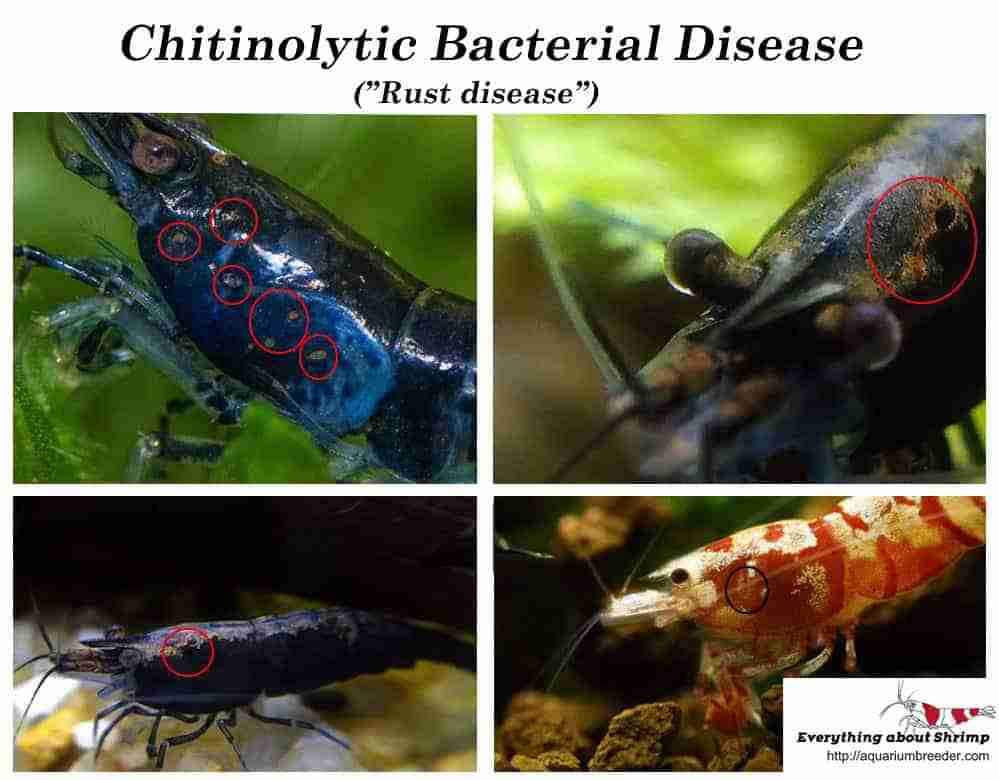
| Chitinolytic bacteria (Pseudomonas, Flavobacterium, Aeromonas, Vibrio) | Dark spot-like lesions on exoskeleton, erosion of carapace, progressing to internal spread | Not established here | Also called "rust disease" or "shell disease." Bacteria produce chitinase enzymes that break down the carapace. Most dangerous at molt. Treatment requires diagnosis; the fish evidence cited below does not establish a peroxide regimen for dwarf shrimp.[9] |
| Opportunistic gut bacteria | White/clear stringy feces, bloating, appetite loss | Not established here | White or stringy waste and appetite changes do not identify a bacterial cause or predict severity. Check diet and water quality and seek diagnosis if signs persist or animals decline. |
🧫 Zoonotic note: Mycobacterium marinum and some Aeromonas strains can infect humans through cuts or abrasions that come into contact with tank water. Always wash hands thoroughly after working in any aquarium. If you have open wounds or a compromised immune system, wear nitrile gloves.
Root Causes & Triggers
Pathogenic bacteria don't materialize suddenly — they exploit opportunity. The following are the most common conditions that allow bacterial populations to breach shrimp defenses. Addressing these is as important as treating the infection itself.
Poor Water Quality
Ammonia and nitrite can harm aquatic animals. The cited 2006 review describes nitrogen toxicity across aquatic species; it does not establish a universal 0.25 ppm ammonia threshold for immune suppression in aquarium shrimp. Ammonia toxicity varies with water conditions, including pH and temperature.[1] Test ammonia and nitrite when shrimp show signs of distress, and investigate detectable readings rather than using that number as a safe limit.
Species and breeding line matter. The Caridina column below refers to soft-water Bee-type shrimp, not the entire genus. Amano shrimp and Sulawesi Caridina have different water requirements. Most Bee and Crystal shrimp prefer softer, more acidic conditions, while Sulawesi species generally need higher pH, alkalinity and temperature. Confirm the requirements and current keeping conditions of your exact shrimp before adjusting the aquarium. Aqueon’s species-specific water guidance.
| Parameter | Neocaridina davidi | Bee-type Caridina | Notes |
|---|---|---|---|
| Ammonia | 0 ppm | 0 ppm | Any detectable amount is dangerous |
| Nitrite | 0 ppm | 0 ppm | As critical as ammonia |
| Nitrate | < 20 ppm | < 10 ppm | Lower is always better |
| pH | 6.8 – 7.8 | 5.5 – 6.8 | Match the species and breeding line; avoid abrupt changes |
| Temperature | 68 – 76°F | 65 – 74°F | Higher temps accelerate bacterial growth |
| GH | 6 – 8 °dGH | 4 – 6 °dGH | Low GH = failed molts = infection entry points |
Overfeeding & Organic Buildup
Uneaten food decomposes rapidly in a shrimp tank and creates pockets of high organic load — ideal breeding grounds for Aeromonas and anaerobic bacteria. Feed only what shrimp consume in 2–3 hours, remove uneaten food promptly with a turkey baster, and fast the tank entirely during active disease treatment.
Temperature Instability
Water temperature can influence bacterial disease outcomes. In a study of rainbow trout, mortality from columnaris was highest at 23°C under the normal rearing density tested, compared with the lower-temperature conditions. These fish results do not establish a universal 25°C threshold for disease in shrimp.[5] Keep aquarium conditions stable and appropriate for the species you keep.
Skipping Quarantine
Introducing new shrimp, plants, snails, or hardscape directly to a display tank is one of the most common ways new pathogens enter. A clinically healthy shrimp can carry bacterial loads in its gut or on its surface that only manifest under the stress of shipping and rehoming. A minimum 2–4 week quarantine period in a separate established tank is non-negotiable for disease management.
Molting Stress & Crowding
A shrimp in the post-molt window is acutely vulnerable — its new shell is soft, it's largely immobile, and its surface is an easier entry point for bacteria. Failed molts caused by low GH or KH create open wounds on the body. Overcrowding compounds all of these risks by elevating baseline stress hormones across the entire population.
How Vibrio Enters the Body
Research into Vibrio transmission in shrimp has identified several entry pathways. Vibrio species can produce collagenase and chitinase enzymes that actively dissolve the chitinous shell — they don't simply wait for a wound. They preferentially penetrate between the thin chitin segments of the abdomen, spread along connective tissue fibers in muscle, and can cross the intestinal wall directly into the hemolymph ("blood") of weakened shrimp. Contact with infected tissue can contribute to disease transmission, but eating a dead tank mate does not by itself diagnose overcrowding or inadequate feeding.[8] Remove dead animals promptly and investigate water quality, feeding and stocking conditions without assuming a single cause.
🔬 Germ counts matter: In healthy aquarium water, bacterial concentrations typically run 100,000–1,000,000 organisms per milliliter — versus roughly 10 per milliliter in drinking water. When organic load increases from uneaten food, waste, and dead animals, Vibrio populations can reach 500,000 colony-forming units per milliliter, creating an infection pressure that even healthy shrimp struggle to resist.[8]
Treatment Protocol
Speed and sequence matter. Moving directly to medication without addressing environmental factors is the most common treatment mistake — and the most common reason infections return. Work through these steps in order.
Hydrogen Peroxide (H₂O₂): Evidence and Safety
Hydrogen peroxide is a reactive oxidizer used in some fish treatments. The fish research cited below does not establish a safe, effective treatment for bacterial disease in Neocaridina or Caridina shrimp. Sensitivity depends on species, life stage, exposure and water conditions.[6]
⚠️ Do not assume peroxide is harmless once added. Breakdown varies with water conditions; UF/IFAS describes studies with measurable peroxide remaining after 24 hours. Do not treat erratic swimming after dosing as proof of safety or a normal response to ignore. Stop further dosing and seek aquatic veterinary advice if animals react adversely.
Tank Dosing (Water Column Treatment)
This guide does not provide a validated whole-tank peroxide dose for dwarf shrimp. Fish treatment rates cannot establish a shrimp regimen. Ask an aquatic veterinarian to assess the diagnosis, species and exact product before medicating.
Spot Treatment (Plants & Hardscape)
A small applied volume is not proof that direct exposure is safe for nearby shrimp. Do not apply peroxide to animals or use the former spot-treatment recipe as a treatment for shrimp disease.
Plant Dip (Before Tank Introduction)
The fish studies cited here do not validate a plant-dip recipe or guarantee removal of all pathogens and hitchhikers. Obtain plant-specific advice and product instructions before chemical treatment; keep any treatment separate from livestock.
💡 Product identity matters: FDA distinguishes the approved fish drug 35% PEROX-AID from other peroxide products. Pharmacy peroxide is not an interchangeable substitute. Read FDA's explanation of fish drug products.
Medications & Treatment Options
Treatment selection should match the severity of the infection and how confident you are in the diagnosis. Always remove carbon from filters before medicating. Start with the least invasive option appropriate to the situation.
🍂 Indian Almond Leaves
Indian Almond Leaves release plant compounds and may tint the water amber. Laboratory extract studies do not establish that whole leaves prevent or treat disease in dwarf-shrimp tanks, or that continuous use is harmless under all conditions. Monitor water quality and use amounts appropriate to the aquarium. Shop Indian Almond Leaves →
🌰 Alder Cones
Alder cones are used as aquarium botanicals. This guide does not provide evidence that combining them with Indian Almond Leaves produces a synergistic antibacterial effect or prevents disease. Monitor water quality rather than treating botanical additions as medication. Shop Botanicals →
🌿 API Melafix
API markets MELAFIX for bacterial infections in fish. Its published directions do not establish a half-label-dose treatment for shrimp. Do not improvise a reduced dose or assume a fish treatment will treat a shrimp infection. Ask the manufacturer or an aquatic veterinarian about your species and situation. API’s product directions.
💊 Seachem KanaPlex
KanaPlex is a kanamycin-based medication for ornamental fish. Do not dose it into water containing shrimp. Seachem instructs users to remove invertebrates before water treatment. Its guidance about medicated food concerns treating fish in a tank containing invertebrates; it is not a dosing protocol for feeding sick shrimp. Seek advice from an aquatic veterinarian before treating shrimp with antibiotics. Seachem’s compatibility guidance.
🔵 Seachem PolyGuard
Do not use PolyGuard in a shrimp aquarium. Seachem does not recommend this medication in tanks containing invertebrates or plants. It is not a shrimp-safe fallback when the cause of illness is uncertain. Read Seachem’s invertebrate safety guidance.
💉 Maracyn (Erythromycin)
Maracyn contains erythromycin. Fritz lists snails and other invertebrates as compatible, but its disease-treatment indications concern freshwater and saltwater fish. Compatibility does not establish effectiveness against an undiagnosed dwarf-shrimp illness. Fritz warns that treatment may inhibit nitrifying bacteria and recommends daily ammonia and nitrite monitoring. Ask an aquatic veterinarian about diagnosis and treatment for your shrimp rather than switching antibiotics solely because another treatment failed. Fritz’s current directions and compatibility information.
🧬 Antibiotic resistance: The cited review links heavy, unrestricted preventive antibiotic use in aquaculture with resistance and environmental impacts; it does not establish the leading cause of resistance in home aquariums. Avoid routine preventive antibiotics. If an aquatic veterinarian recommends treatment, follow the specified product, dose and duration, and contact them if animals worsen or react adversely rather than improvising a different antibiotic.[7]
Prevention & Long-Term Tank Health
Good husbandry supports shrimp health and can reduce avoidable stress and opportunities for disease transmission. It does not eliminate pathogens or guarantee that an outbreak will not occur.
Troubleshooting
Shop Health & Prevention Supplies
Need Help With a Sick Tank?
Our team keeps shrimp and knows what you're going through. Reach out — we're happy to help troubleshoot, recommend treatment options, or just talk through what you're seeing. And when you're ready to restock after an outbreak, we've got healthy, well-conditioned Neocaridina and Caridina shrimp ready to go.
Sources & Citations
- [1]Camargo, J.A. & Alonso, Á. (2006). Ecological and toxicological effects of inorganic nitrogen pollution in aquatic ecosystems. Environment International, 32(6), 831–849. Review of inorganic nitrogen toxicity across aquatic ecosystems; not a shrimp-specific 0.25 ppm immune-suppression threshold. doi.org/10.1016/j.envint.2006.05.002
- [2]Austin, B. & Austin, D.A. (2016). Bacterial Fish Pathogens: Disease of Farmed and Wild Fish (6th ed.). Springer. Opportunistic pathogen behavior, secondary infection mechanisms in crustaceans.
- [3]Tzuc, J.T. et al. (2014). Microbiota from Litopenaeus vannamei: digestive tract microbial community of Pacific white shrimp. SpringerPlus, 3(1), 280. Study of digestive bacteria and enzyme activity in Pacific white shrimp; not a diagnostic test for white feces in dwarf shrimp. doi.org/10.1186/2193-1801-3-280
- [4]Eddy, S.D. & Jones, S.H. (2002). Microbiology of summer flounder Paralichthys dentatus fingerling production at a marine fish hatchery. Aquaculture, 211(1–4), 9–28. Study of microbial communities during summer flounder production at a marine fish hatchery; not a ranking of pathogens in freshwater shrimp aquariums.
- [5]Suomalainen and colleagues (2005). Influence of rearing conditions on Flavobacterium columnare infection of rainbow trout, Oncorhynchus mykiss (Walbaum). Journal of Fish Diseases, 28(5), 271–277. Research on stocking density and temperature in rainbow trout. PubMed record. DOI: 10.1111/j.1365-2761.2005.00631.x.
- [6]Rach, J.J., Schreier, T.M., Howe, G.E. & Redman, S.D. (1997). Effect of Species, Life Stage, and Water Temperature on the Toxicity of Hydrogen Peroxide to Fish. The Progressive Fish-Culturist, 59, 41–46. This study concerns fish, not dwarf-shrimp safety. Study abstract. See also Yanong, R.P.E., Use of Hydrogen Peroxide in Finfish Aquaculture, UF/IFAS, for persistence and safety limitations. Additional hobbyist reading: Shrimpybusiness.com, Freshwater Shrimp Diseases & How to Treat Them. shrimpybusiness.com
- [7]Cabello, F.C. (2006). Heavy use of prophylactic antibiotics in aquaculture: a growing problem for human and animal health and for the environment. Environmental Microbiology, 8(7), 1137–1144. Review of heavy preventive antibiotic use, resistance and environmental impacts in aquaculture. doi.org/10.1111/j.1462-2920.2006.01054.x
- [8]Garnelio.de (2016). Shrimp die for no reason! #Shrimp diseases. Vibrio spp. transmission pathways, chitin-dissolving enzymes, organic load germ counts, immune-weakening factors. garnelio.de. See also video resources: YouTube — youtube.com/watch?v=KfRyMg1VarM; youtube.com/watch?v=T-UjbfGBJ7o; youtube.com/watch?v=9Z2k0N870KE
- [9]Shrimpybusiness.com (2023). Freshwater Shrimp Diseases & How to Treat Them. Chitinolytic bacterial disease (rust/shell disease), chitinase enzyme mechanism, H₂O₂ treatment protocol. shrimpybusiness.com. See also: AquariumBreeder.com. Understanding Dwarf Shrimp Diseases and Parasites. aquariumbreeder.com
- [10]Bhassu, S. et al. (2024). Microbes and pathogens associated with shrimps - implications and review of possible control strategies. Frontiers in Marine Science, 11, 1397708. Review of farmed-shrimp pathogens, including viral muscle disease; species differ from aquarium dwarf shrimp. doi.org/10.3389/fmars.2024.1397708