


How to Sex Neocaridina Shrimp: Male vs. Female Identification
Telling males from females is one of the most useful skills in shrimp keeping — essential for understanding your colony's composition, breeding progress, and whether the ratio is right. Here's how to do it reliably.
Why Sexing Matters
Knowing the sex ratio of your colony matters for two reasons: breeding success and colony health. A tank full of males will never produce eggs. A tank full of females is possible but unusual and results in a slowly aging colony. The ideal ratio for active breeding is roughly 2–3 females per male — enough males to ensure females encounter mating opportunities at every molt, but not so many that females are constantly harassed.
Sexing also helps you understand what you're seeing. A shrimp darting frantically around the tank isn't stressed — it's a male on the scent of a recently molted female releasing pheromones. A shrimp that's slightly rounder and slower than the others may be carrying eggs you haven't yet spotted. Reading these signs correctly transforms a tank full of "shrimp" into a community you can actually follow and understand.
Quick Reference: Male vs. Female at a Glance
All five physical markers compared side by side
| Feature | ♀ Female | ♂ Male |
|---|---|---|
| Body size | Larger — typically 25–35mm at maturity | Smaller — typically 18–25mm at maturity |
| Abdomen shape | Broader, rounder, more pronounced curve underneath | Narrower, more streamlined, flatter underside |
| Coloration | Often deeper, more opaque — especially when gravid | More vibrant, intense hue — brighter red, blue, or yellow |
| Saddle | Present — visible as a light patch behind the head under the carapace | Absent — never present |
| Eggs under abdomen | Present when berried — visible cluster of green or yellow-green eggs | Never present |
| Pleopods (swimmerets) | Longer, broader — designed to fan and hold eggs | Shorter, narrower — not used for egg carrying |
| Behavior | Less frantic; hides more when gravid; releases pheromones at molt | More active; frantic swimming when female molts |
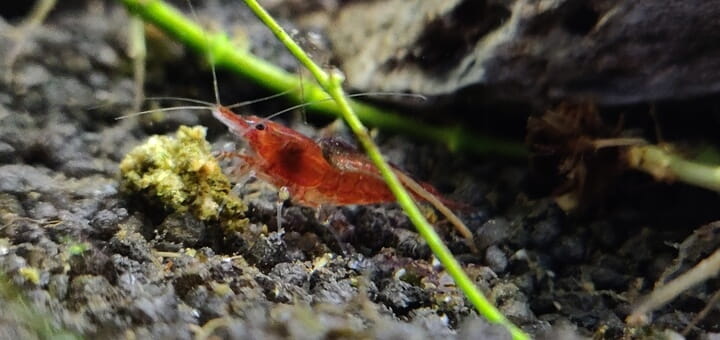
A male Red Cherry shrimp — note the slim, streamlined abdomen with a nearly straight underline. Photo © Shrimp Science (shrimpscience.com)
Physical Markers in Detail
Abdomen Shape & Body Size
♀ Female
Larger body — typically 25–35mm fully grown Broader abdomen — the underside curves outward more noticeably, creating the rounder silhouette that houses eggs Wider carapace — the shell section over the thorax appears slightly wider when viewed from above When gravid — the abdomen visibly swells as eggs develop, making the difference from males unmistakable♂ Male
Smaller body — typically 18–25mm fully grown Narrower abdomen — the underside is flatter and more streamlined with no outward curve Slimmer carapace — a more tapered, torpedo-like profile from above Consistent shape — body proportions don't change seasonally or with reproductive status🔍 Size difference is age-dependent. In juvenile shrimp under 10–12mm, males and females are nearly impossible to distinguish by size alone — they haven't yet developed the adult dimorphism. Wait until shrimp reach at least 15mm before relying on body size as a sexing marker. The saddle (below) is visible earlier and more reliable in young shrimp.
The Saddle
The saddle is the most reliable sexing marker and the one to learn first. It is a cluster of undeveloped, pre-fertilization eggs visible through the female's carapace in the area just behind and below the head. It appears as a roughly oval, yellowish or greenish-yellow translucent patch sitting in the upper body cavity. Under good lighting it is clearly visible through the semi-transparent shell.
Females develop their saddle before they are old enough to breed — meaning you can often sex shrimp before they have ever mated. The saddle remains present most of the time in mature females, disappearing briefly after a molt as the new reproductive cycle begins. If you see a saddle, it is definitively a female. Males never develop one.
🥚 Saddle → Berried: how fertilization works. When a female molts, she releases pheromones into the water that trigger the male mating frenzy. Males locate and mate with her in a brief window post-molt. She then moves her saddle eggs down to her pleopods under the abdomen — this is when she becomes "berried." The green or yellow-green egg cluster visible fanning beneath her tail is the same eggs from the saddle, now fertilized and incubating.
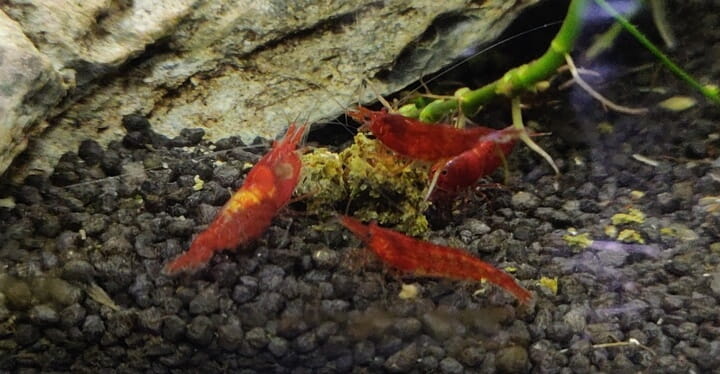
A saddled female — the yellowish patch behind the head is the saddle (pre-fertilization eggs visible through the carapace). Photo © Shrimp Science (shrimpscience.com)
Coloration
♀ Female Coloration
More opaque — the body pigment tends toward deeper, less transparent expression When gravid — may appear slightly darker or more muted as body resources go toward egg development Dorsal stripe — in Cherry Shrimp, a more defined red stripe along the back is often more visible in females Color varies by morph — in some morphs females are more vividly colored; in others the difference is subtle♂ Male Coloration
More transparent — slightly more see-through body, especially in lower-grade morphs More vivid hue — in red, blue, and yellow morphs, males often display brighter, cleaner color intensity Consistent color — not affected by reproductive status, so coloration stays stable throughout the year Less reliable marker — color dimorphism is the least consistent way to sex shrimp; use it to confirm, not as primary ID⚠️ Don't rely on color alone. Color dimorphism in Neocaridina is real but inconsistent — it varies significantly between morphs, grades, and individual shrimp. A particularly colorful individual is not necessarily female, and a pale one isn't necessarily male. Always confirm with abdomen shape and the saddle before drawing conclusions from color.
Pleopods (Swimmerets)
The pleopods are the small, feathery appendages on the underside of the abdomen — the ones you see a berried female fanning constantly to oxygenate her eggs. In females, they are noticeably longer and broader than in males, evolved specifically for the mechanical demands of holding, fanning, and protecting an egg clutch. In males they are shorter and narrower, serving primarily for swimming.
This difference becomes visible in adult shrimp under magnification or good lighting, particularly when the shrimp rests on the glass. A female's underside will show a more prominent fringe of pleopods even when not carrying eggs — while a male's underside will appear comparatively bare and streamlined.
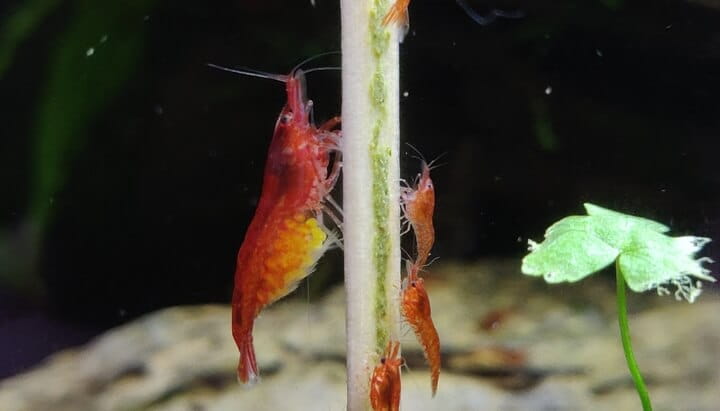
A berried female carrying fertilized eggs beneath her abdomen — the rounded belly and visible egg cluster make her unmistakably female. Photo © Shrimp Science (shrimpscience.com)
Behavioral Cues
The Mating Frenzy
When a female molts and releases pheromones, males enter an unmistakable state of frantic, rapid swimming — darting around the tank at high speed, up and down the glass, seemingly without direction. This behavior is often alarming to new keepers who assume something is wrong. Nothing is wrong. As the source document puts it perfectly: "If your shrimp are zipping around the tank like they dropped a $20 bill, they are looking for a female to mate with." Any shrimp engaging in this behavior is definitively male.
Berried Female Behavior
A female carrying eggs becomes noticeably more sedentary. She retreats to dense cover — moss, botanicals, plant clusters — and spends most of her time fanning her eggs with slow, rhythmic pleopod movements to maintain water flow and oxygen around the clutch. She will feed less actively and venture into open water less frequently. This sheltering behavior is normal and should not be disturbed — avoid large water changes, substrate disturbance, or adding new tank mates while females are visibly carrying eggs.
How Difficult Is Sexing at Each Life Stage?
Juvenile Neocaridina under 10–12mm are essentially impossible to sex reliably. The physical dimorphism hasn't developed, the saddle isn't visible, and coloration differences don't yet exist. Between 12–18mm the saddle begins to appear in females and abdomen shape starts to diverge — patient observation with good lighting is sufficient at this stage. By 20mm and above, all five physical markers are present and sexing takes seconds with practice.
Practical Tips for Sexing Your Colony
Related Guides & Shop
Ready to Build Your Colony?
All Neocaridina color morphs ship as unsexed mixed groups — the natural ratio gives you a good starting point to observe and adjust from.
Sources & Citations
- [1]Bouchon, D. et al. (1998). Reproductive biology and sexual dimorphism in Neocaridina species. Pleopod morphology differences; saddle egg cluster development in pre-mating females.
- [2]Santana, F. et al. (2023). Shelter preference and daily activity patterns in Neocaridina davidi: effects of sex and reproductive status. Behavioral differences between sexes; gravid female retreat behavior; male activity patterns during mating season.
- [3]UF IFAS Extension (2020). Neocaridina davidi species profile. Reproductive cycle, saddle-to-berried transition, egg incubation period. edis.ifas.ufl.edu