


Lotus Pod: The Pod with a Purpose
A sacred seed head becomes a miniature ecosystem — tannin source, biofilm station, and shrimp shelter, all in one slow-releasing botanical.
.JPG)
A fresh Nelumbo nucifera seed pod still on the plant — the same structure that, once dried, becomes the lotus pod used in botanical aquariums. The perforated, honeycombed chambers evolved to hold seeds above water; in the tank, those same chambers shelter shrimplets and colonize biofilm. Photo by Dinkum, CC0 (public domain), via Wikimedia Commons
Origins & Natural Ecology
The Sacred Lotus, Nelumbo nucifera Gaertn., is a perennial aquatic plant native to the floodplains, deltas, and shallow lakes of South and Southeast Asia. It is revered across Hindu and Buddhist traditions as a symbol of purity and renewal — an apt metaphor for a plant that rises spotless from murky sediment each morning. In China and India it has been used continuously in traditional medicine for over 400 years, with every part of the plant — rhizome, leaf, flower, and seed — documented for therapeutic applications.[1]
The perforated seed head forms after the flower is pollinated. Its woody, chambered architecture evolved to resist decay on the stalk and survive transport by water and animals. That durability is extraordinary even by botanical standards: radiocarbon-dated specimens have produced viable seedlings after roughly 1,300 years of dormancy in a dry lake bed in northeastern China — among the longest confirmed seed viability on record.[2,3] What makes this possible is the same lignin chemistry that makes pods so durable underwater in your tank.
Why Pods Last So Long
The pod's structural resilience comes from its cellulose-and-lignin matrix. Lignin is one of the most chemically resistant organic polymers in plant biology — the same compound that makes wood hard. Recent research on lotus-specific lignin biosynthesis pathways confirms that the fruit wall of N. nucifera is among its most heavily lignified tissues, which is why pods hold their shape for months underwater while softer botanicals like almond leaves decompose in weeks.[4,5] For the aquarist, this translates to a predictably long-lived structure: months of tannin release and biofilm habitat before the walls begin to soften.
🪷 The chemistry of color: N. nucifera tissues contain gallic acid, catechin, quercetin, and other hydrolysable tannins along with alkaloids and flavonoids.[1] These polyphenols are responsible for the amber water tint and the mild water chemistry effects that aquarists associate with the "blackwater" aesthetic.
What a Lotus Pod Does in Your Tank
In a shrimp or nano community aquarium, a lotus pod reliably performs three jobs simultaneously — and they reinforce each other.
1. Tannin & Humic Substance Release
As the pod soaks, polyphenolic compounds leach into the water column, producing the characteristic warm amber tint of a blackwater-style tank. These humic substances weakly chelate heavy metals, buffer toward mild acidity, and modulate microbial communities in the water. In low-KH tanks they produce a measurable, gradual pH reduction; in well-buffered water the chemistry effect is largely cosmetic while the biological effects persist.
Multiple peer-reviewed aquaculture studies have examined humic and fulvic acid supplementation in fish and shrimp systems. The direction of effect is consistent: reduced physiological stress indicators and improved immune function, even if exact dosages and species responses vary.[6,7,8]
Approximate tannin release from a single pod in a 10-gallon tank
| Days Submerged | Estimated Tannins (ppm) | pH Impact (low KH) | Water Color |
|---|---|---|---|
| 0 | 0 | None | Clear |
| 5 | ~5 | −0.1 | Barely tinted |
| 10 | ~15 | −0.2 to −0.3 | Light amber |
| 20 | ~25 | ~−0.4 | Warm amber |
| 30 | ~35+ | ~−0.5 | Rich tea |
⚠️ "Will this crash my pH?" In a well-buffered tank (KH 4+), the answer is almost certainly no. In very soft or RO water with minimal KH, add pods gradually and monitor pH over the first week. For a full parameter guide see the Neocaridina Environment Guide.
2. Biofilm Colonization — the Living Feeding Station
Within days of submersion, a pale fuzz appears on the inner walls of the pod. This early layer is a fungal-bacterial biofilm — the same type of microbial community that colonizes leaf litter and wood in natural shrimp streams. Over weeks, filamentous algae join the mix and the pod becomes a stable, mixed-microbe buffet that replenishes itself continuously.
Biofilm is not a secondary benefit — for shrimp, especially juveniles, it can represent a significant fraction of their total nutrition. Research on penaeid shrimp in aquaculture settings found that biofilm carbon and nitrogen contributed substantially to growth inputs when animals had access to colonized surfaces.[9,10] While ornamental species in small aquaria differ from commercial aquaculture systems, the biological principle is identical: a pod's inner chambers are not just shelter — they are a perpetual food source.
Approximate biofilm colonization over 8 weeks
| Week | Coverage | Texture | Shrimp Activity |
|---|---|---|---|
| 1 | ~15% | Light fuzz (fungal-bacterial) | Occasional grazing |
| 2 | ~35% | Fuzz expanding | Frequent grazing, juveniles hiding |
| 3 | ~55% | Fuzz + early algae filaments | Active grazing all surfaces |
| 4 | ~70% | Mixed biofilm | Constant occupancy |
| 6 | ~80% | Mature film, multi-layer | Pods become territorial landmarks |
| 8 | ~85% | Mature, stable | Shrimplets roosting overnight |
🔬 The "white fuzz" question: The pale growth that appears in the first week is normal biofilm, not mold overgrowth. It is edible, beneficial, and temporary in appearance. If it concerns you aesthetically, reposition the pod rather than scrubbing it — you would be removing exactly the food shrimp are seeking.
3. Structural Shelter for Shrimplets & Small Fish
Each chamber of a lotus pod is a vestibule — large enough for shrimplets and microfauna to enter, with outer rims presenting rugged grazing surfaces. Because the walls are lignified, the structure holds its shape for months, providing stable, long-term shelter that doesn't disappear in weeks like softer botanicals. Shrimplets gain refuge from the moment they hatch, and small fish like nano rasboras and ember tetras use the chambers as resting stations. The pod's naturally irregular profile also creates the "broken line of sight" that reduces aggression in community tanks.
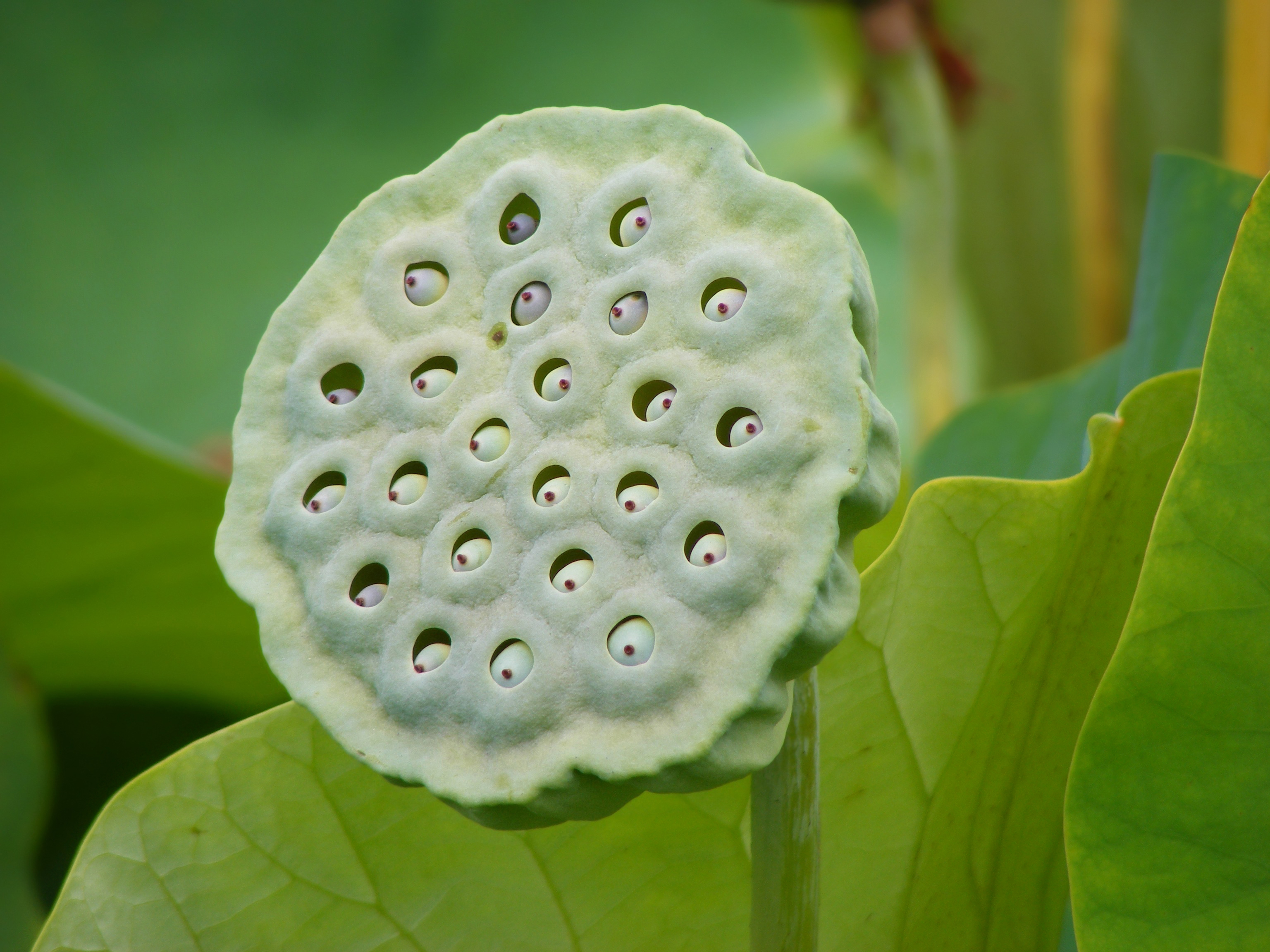
Macro view of the lotus pod's characteristic honeycomb architecture — each round chamber is roughly 8–15 mm across. Once the pod is submerged and surfaces are colonized by biofilm, these recesses become grazing stations and bolt-holes that shrimplets return to repeatedly throughout the day. Photo via Wikimedia Commons, CC BY-SA
Preparation Methods
There are three ways to add a lotus pod to your tank. Each approach changes tannin timing, mold risk, and how quickly it sinks — so the right method depends on what you want.
Preparation method comparison
| Method | Tannin Release | Mold Risk | Sinking | Best For |
|---|---|---|---|---|
| Raw drop-in | Slow, steady | Moderate | Floats 1–3 days | Gradual tint, patient keeper |
| Pre-soak 24h | Moderate, even | Low | Sinks faster | Balanced release, most use cases |
| Boil 10–15 min | Front-loaded spike | Very low | Sinks immediately | Instant amber water, display tanks |
For most shrimp tanks, a 24-hour pre-soak in dechlorinated water strikes the best balance — it clears loose tannins that would spike heavily at first submersion, reduces biofilm-triggering surface contamination, and helps the pod sink without the thermal shock of boiling. If you want rich amber water immediately and don't want to wait for the pod to waterlog, a short boil followed by a cool-water rinse achieves both goals.
Water Chemistry & the Humic Substance Story
Tannins are polyphenolic compounds — large, complex organic molecules that dissolve slowly into water from decomposing plant material. In the aquarium they do several things at once: they weakly acidify (tannic acid is a gentle acid), chelate trace metals by binding them into less bioavailable forms, and contribute dissolved organic carbon that feeds microbial communities.
The practical effect depends almost entirely on your starting water chemistry. In hard, well-buffered tap water (KH 6+), pods produce beautiful color with negligible pH change — the carbonate system absorbs the acid load. In soft water or RO with minimal buffering, tannins accumulate and produce a measurable, gradual pH reduction over weeks. Neither outcome is harmful when managed intentionally — many Caridina species actively prefer the mild acidity and reduced hardness that botanical blackwater tanks provide.
💧 Removing tannins: If the tint becomes more intense than desired, activated carbon and products like Seachem Purigen will clear the water rapidly. Water changes alone work more slowly but avoid stripping other beneficial dissolved organics. Never use carbon in a blackwater setup you're actively maintaining — it will undo the chemistry intentionally built up over weeks.
The Three Phases of a Pod in Your Tank
A lotus pod doesn't behave the same in week one as it does in month four. Understanding its lifecycle helps you set appropriate expectations — and know when it's time to replace it.
- Tannin phase (weeks 1–4): Water takes on a warm tea color. Shrimplets begin using the chambers as hideaways. Tannin release is at its highest, pH in soft tanks may begin shifting. This is when the pod is doing its most active chemistry work.
- Grazing-station phase (weeks 3–10): Robust biofilm and algae filaments establish on inner walls. Tannin release slows. The pod becomes a stable biological asset — shrimp visit it constantly, juveniles use it for overnight roosting, snails graze the outer surfaces. This is the pod at its most ecologically productive.
- Softening phase (months 3–6): The rim gives slightly to pressure. Pieces may begin to chip. Tannin release has largely concluded. The pod is structurally declining but still provides shelter and some biofilm. When walls begin to collapse, replace with a fresh pod or allow fragments to settle into the detrital layer.

A dried lotus seedhead — the pale, lightweight form aquarists add to their tanks. At this stage the lignified tissues are fully desiccated and buoyant; a 30–60 minute boil or multi-day soak waterloads them enough to sink and begin leaching tannins into the water column. Photo © Gail Hampshire, CC BY 2.0, via Wikimedia Commons / Flickr
Botanical Pairing & Aquascape Context
Lotus pods work best as part of a layered botanical system, not in isolation. Different botanicals release tannins at different rates and offer different physical structures — combining them creates a richer, more naturalistic chemistry profile and more varied micro-habitats.
🪷 Lotus Pod
Slow, steady multi-month tannin release. Long-lived 3D shelter. Best for structure and sustained biofilm habitat.
🍂 Almond Leaves
Faster, higher-surface-area tannin source. Breaks down in 2–4 weeks. Releases antimicrobial compounds. Best for rapid blackwater tint and shrimp foraging.
🌲 Casuarina Cones
Slower release, spiky geometry ideal for nano scapes. Tannin-dense but small footprint. Best for detail work and smaller tanks.
🪵 Driftwood
Very slow, years-long tannin release. Provides anchor point for moss and rhizome plants. Best for structural permanence and blackwater baseline chemistry.
Stagger your additions: place driftwood and a lotus pod as permanent features, rotate almond leaves every 3–4 weeks as they decompose, and use casuarina cones in foreground arrangements. The layered release schedule means your tank's tannin level stays relatively stable rather than spiking after each addition.
Tankmates & Placement
Lotus pods are compatible with all dwarf shrimp and nano tank inhabitants. For new keepers, Neocaridina shrimp pair perfectly — they're hardier and forgiving of parameter variation while benefiting enormously from the shelter and biofilm a pod provides. For advanced keepers intentionally running soft, lightly acidic water, Caridina species including Blue Bolts and Extreme Blue Bolts are a natural fit — they evolved in the tannic forest streams that botanical tanks replicate.
Ramshorn Snails graze biofilm from the pod's outer surfaces continuously, supplementing their diet while keeping algae from overwhelming the structure. If a nuisance snail population develops elsewhere in the tank, Assassin Snails provide clean biological control without affecting the pod or the shrimp.
For placement, position pods near driftwood or stone so water flow eddies around them and chemical cues linger in the surrounding water. Avoid placing them directly under a strong filter outlet — turbulent flow interferes with biofilm establishment. A calmer mid-tank position maximizes colonization and makes the pod a natural gathering point for your shrimp.
Troubleshooting
- Pod is floating — Normal for 1–3 days after a raw drop-in. Weight it with a small stone or piece of driftwood, or pre-soak in dechlorinated water overnight. Boiling eliminates floating entirely.
- White fuzz on day 3–5 — Normal fungal-bacterial biofilm, not mold overgrowth. Edible and beneficial for shrimp. Reposition the pod to a less visible spot rather than scrubbing — you would be removing the food your shrimp are seeking. It fades within a week as shrimp graze it down.
- Water is too dark — Run activated carbon or Seachem Purigen for 24–48 hours, or perform a 30% water change. Remove the pod temporarily if tannin release continues beyond what you want. Color clears within a day or two of carbon filtration.
- pH dipped in soft water — Increase water change frequency, raise KH slightly with a carbonate buffer, or reduce the number of active pods. See the Neocaridina Environment Guide for detailed KH and buffering guidance.
- Pod is crumbling at month 4+ — Natural end-of-life softening. Allow fragments to settle into the detrital layer where they continue contributing organics, or remove them during the next water change and add a fresh pod.
A Note on Sourcing
Dried lotus pods are a natural byproduct of Nelumbo nucifera cultivation — the seed head that remains after the seeds have ripened and been harvested. Sourcing from reputable specialty vendors ensures the pods are pesticide-free, properly dried, and not treated with dyes or preservatives that could harm invertebrates. Our pods are sourced for aquarium use specifically — clean, untreated, and ready to use after a brief preparation step.
Shop the Essentials
Build a Habitat, Not Just a Tank
A Lotus Pod is the beginning — add botanicals, hardscape, and shrimp to create a living ecosystem that runs itself.
Sources & Citations
- [1]Paudel, K. R. et al. (2015). Phytochemical profile and biological activity of Nelumbo nucifera. Evidence-Based Complementary and Alternative Medicine. Tannins, flavonoids, alkaloids, traditional medicine uses. onlinelibrary.wiley.com
- [2]Shen-Miller, J. (2002). Sacred lotus, the long-living fruits of China Antique. Seed Science Research. Seed viability ~1,300 years. cambridge.org
- [3]Shen-Miller, J. et al. (2013). Centuries-old viable lotus seeds — radiocarbon-dated ~1,300-year germination. andyczaja.com (PDF)
- [4]Cheng, L. et al. (2022). Lignin synthesis pathways in Nelumbo nucifera. International Journal of Molecular Sciences. Mechanical resilience of lotus tissues. mdpi.com
- [5]Zhao, S. et al. (2024). NnHCT1 and lignin enhancement in lotus fruit wall. Carbohydrate Polymers. sciencedirect.com
- [6]Mungkung, R. et al. (2023). Humic acids and early fish development. Animals (open-access). pH/hardness interactions of humic acids. pmc.ncbi.nlm.nih.gov
- [7]Lieke, T. et al. (2021). Phenol-rich fulvic acid reduces stress and boosts immunity. Scientific Reports. pmc.ncbi.nlm.nih.gov
- [8]Frontiers in Marine Science (2022). Sodium humate improves growth and immunity in shrimp aquaculture. frontiersin.org
- [9]Abreu, P. C. et al. (2007). Importance of biofilm as food source for shrimp. Journal of Experimental Marine Biology and Ecology. sciencedirect.com
- [10]Thompson, F. L. et al. (2002). Biofilm for water quality and nourishment in aquaculture. Aquaculture. sciencedirect.com