

Detritus Worms in Your Aquarium: What They Are & What To Do
Tiny worms appearing in your shrimp tank aren't necessarily bad news — but a population explosion is always a signal. Here's what detritus worms actually are, the role they play, and how to bring numbers back under control.
What Are Detritus Worms?
Detritus worms — most commonly Lumbriculus variegatus and related aquatic oligochaete species — are small, segmented freshwater worms in the same broader class as earthworms. They are not flatworms (planaria), not parasites, and not harmful to shrimp, fish, or snails. In the wild they are found in shallow, slow-moving water where organic matter accumulates: ponds, marshes, stream edges, and the sediment layer of healthy freshwater ecosystems.
In appearance they are slender and cylindrical, typically 1–2cm long, ranging in color from pale cream or white to light reddish-brown depending on species and diet. They move with a characteristic undulating motion — not the flat, gliding movement of planaria, and not the rapid darting of copepods. Under magnification the segmented body is clearly visible.
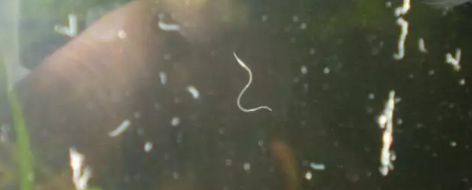
Detritus worms in a typical freshwater aquarium — thin, pale, and segmented. Photo © Aquarium Science (aquariumscience.org)
Detritus worms vs. other common tank worms at a glance
| Feature | Detritus Worms | Planaria | Nematodes (Roundworms) |
|---|---|---|---|
| Shape | Segmented, cylindrical | Flat, arrowhead-shaped head | Very thin, hair-like, unsegmented |
| Size | 1–2cm | 0.5–1.5cm | Under 1mm — barely visible |
| Color | Cream to reddish-brown | White, brown, or rust-red | Transparent to white |
| Movement | Undulating, worm-like | Gliding, smooth | Thrashing, erratic |
| Location | Substrate, water column | Glass, substrate, open water | Substrate, biofilm |
| Harmful to shrimp? | No | Yes — can attack shrimp | Generally no |
| Root cause | Excess organic waste | Overfeeding, poor maintenance | Overfeeding, new plants/substrate |
🪱 Not planaria. The most important identification to make is whether you're looking at detritus worms or planaria. Planaria have a distinctive triangular or arrowhead-shaped head and a smooth, gliding movement — they are flatworms and genuinely dangerous to shrimp. Detritus worms are round in cross-section, visibly segmented, and move with a wriggling motion. If in doubt, check the head shape under magnification.
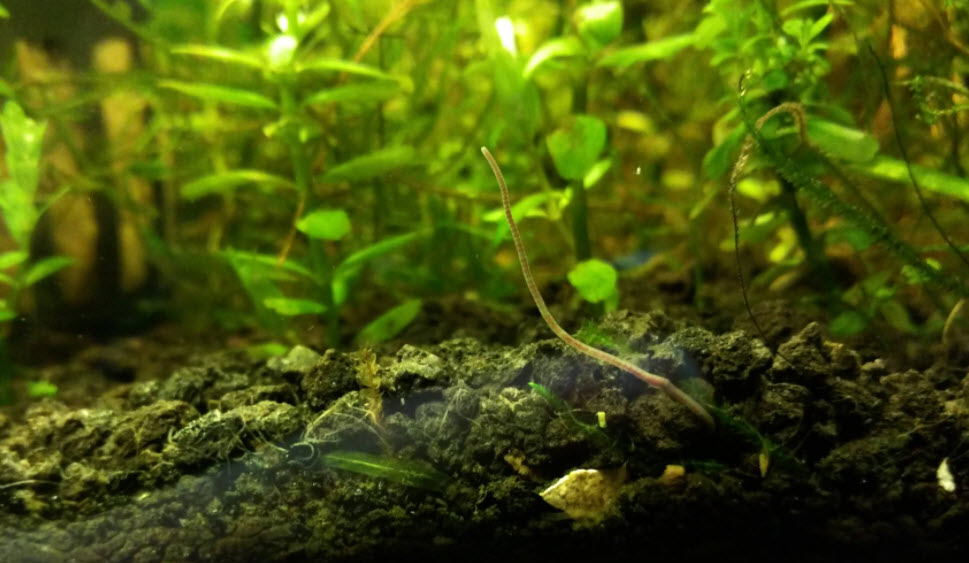
Both large reddish-brown and small white detritus worm varieties visible together — a good illustration of how varied they can look. Photo © Aquarium Science (aquariumscience.org)
Biology & Reproduction
Detritus worms possess a hydrostatic skeleton — a fluid-filled body cavity that gives them their characteristic flexibility and allows them to move through substrate gaps and organic debris that rigid-bodied organisms couldn't navigate. This is exactly what makes them effective decomposers: they can access and process organic matter in tight spaces.
Reproduction is primarily asexual, which explains why populations can expand so rapidly when conditions favor them. Individual worms reproduce by fragmentation — a single worm divides into two viable organisms — or by spontaneous fission where the division happens internally before separation. Sexual reproduction also occurs, with pairs exchanging sperm and depositing fertilized eggs in small cocoons in the substrate. The combination of asexual fragmentation and sexual reproduction means that once a population is established and food is abundant, numbers can double quickly without any additional introduction from outside.
This reproductive strategy is both the reason they colonize tanks readily and the reason population explosions happen fast — a small founding population encountering a rich organic substrate can become a visible infestation within weeks.
The Role They Play in a Healthy Tank
A small, stable population of detritus worms is genuinely beneficial. They occupy an important ecological niche — the same one they fill in natural freshwater ecosystems — and their presence in modest numbers is a sign of a biologically active substrate rather than a problem.
🧹 Organic Waste Processing
Detritus worms consume uneaten food, decaying plant matter, fish and shrimp waste, and other organic debris before it fully breaks down into ammonia. By mechanically breaking waste into smaller particles, they accelerate processing by beneficial bacteria and reduce the ammonia load on the nitrogen cycle.
🌱 Nutrient Cycling
As they metabolize organic matter, detritus worms release nitrogen and phosphorus back into the water column in plant-available forms. In a planted tank, this contributes to the nutrient supply that feeds live plants — the same plants that then uptake nitrate and improve water quality.
🦐 Live Food Source
Shrimp, small fish, and other tank inhabitants will actively hunt and consume detritus worms. They are nutritious live food — high in protein and naturally present. In a shrimp tank with no other predators, shrimp will graze on worms they encounter during foraging.
📊 Ecosystem Indicator
Detritus worm populations function as a biological indicator — stable low numbers suggest a balanced tank; a sudden explosion signals excess organic input. Monitoring their numbers is a useful passive check on feeding amounts and maintenance frequency.
What Causes a Population Explosion?
Detritus worm populations are self-regulating when organic waste stays within the capacity of the tank's decomposition system. When organic input consistently exceeds what bacteria and existing decomposers can process, the worms find abundant food and reproduce rapidly. The causes are almost always one or more of the following:

Worms emerging into the water column — a sign that oxygen levels in the substrate have dropped or the population has outgrown available food. Photo © PetMeDaily (petmedaily.com), CC BY-SA 4.0
Are They Harmful to Shrimp?
No. Detritus worms do not prey on shrimp, do not damage eggs, and do not compete meaningfully for resources. They occupy the decomposer niche — below shrimp in the food chain — and shrimp actively eat them when encountered. A tank with a moderate detritus worm population and healthy shrimp is not a problem tank; it is a biologically active one.
The concern with a large population is indirect: the same conditions that sustain a worm explosion also degrade water quality. An overloaded organic substrate raises ammonia as waste breaks down, reduces oxygen in the substrate layer, and can drive nitrate accumulation. The worms themselves aren't the danger — the underlying cause of their numbers is.
🦐 Shrimp will eat them. In a shrimp-only tank, a healthy colony of Neocaridina or Caridina will actively graze on detritus worms encountered during foraging. This natural predation keeps small populations in check. A worm explosion that outpaces shrimp predation is a clear signal that organic load needs to be reduced at the source.
How to Reduce Detritus Worm Populations
The correct approach addresses the root cause — organic load — rather than trying to eliminate the worms directly. Treating for worms without fixing overfeeding or poor maintenance will result in the population recovering within weeks.
⚠️ Do not use chemical treatments in a shrimp tank. Many products marketed for worm control contain compounds toxic to shrimp and invertebrates at doses safe for fish. Detritus worms are not harmful — there is no justification for chemical risk in a shrimp tank. Population control through organic load reduction is always the correct approach and produces lasting results.
Prevention: Keeping Numbers Low Long-Term
Related Guides & Shop
A Clean Tank Starts With the Right Crew
Ramshorn Snails, healthy shrimp, and a good maintenance routine are the most effective detritus management system available.
Sources & Citations
- [1]Brinkhurst, R.O. & Jamieson, B.G.M. (1971). Aquatic Oligochaeta of the World. Oliver & Boyd. Taxonomy, reproductive biology, and ecological roles of Lumbriculus variegatus and related oligochaete species in freshwater environments.
- [2]Covich, A.P. et al. (1999). The role of benthic invertebrate species in freshwater ecosystems. BioScience, 49(2): 119–127. Detritivore contributions to nutrient cycling, organic matter processing, and ecosystem health indicators.
- [3]Wetzel, R.G. (2001). Limnology: Lake and River Ecosystems. Academic Press. Decomposition dynamics, detrital food webs, and oligochaete population regulation in freshwater sediments.