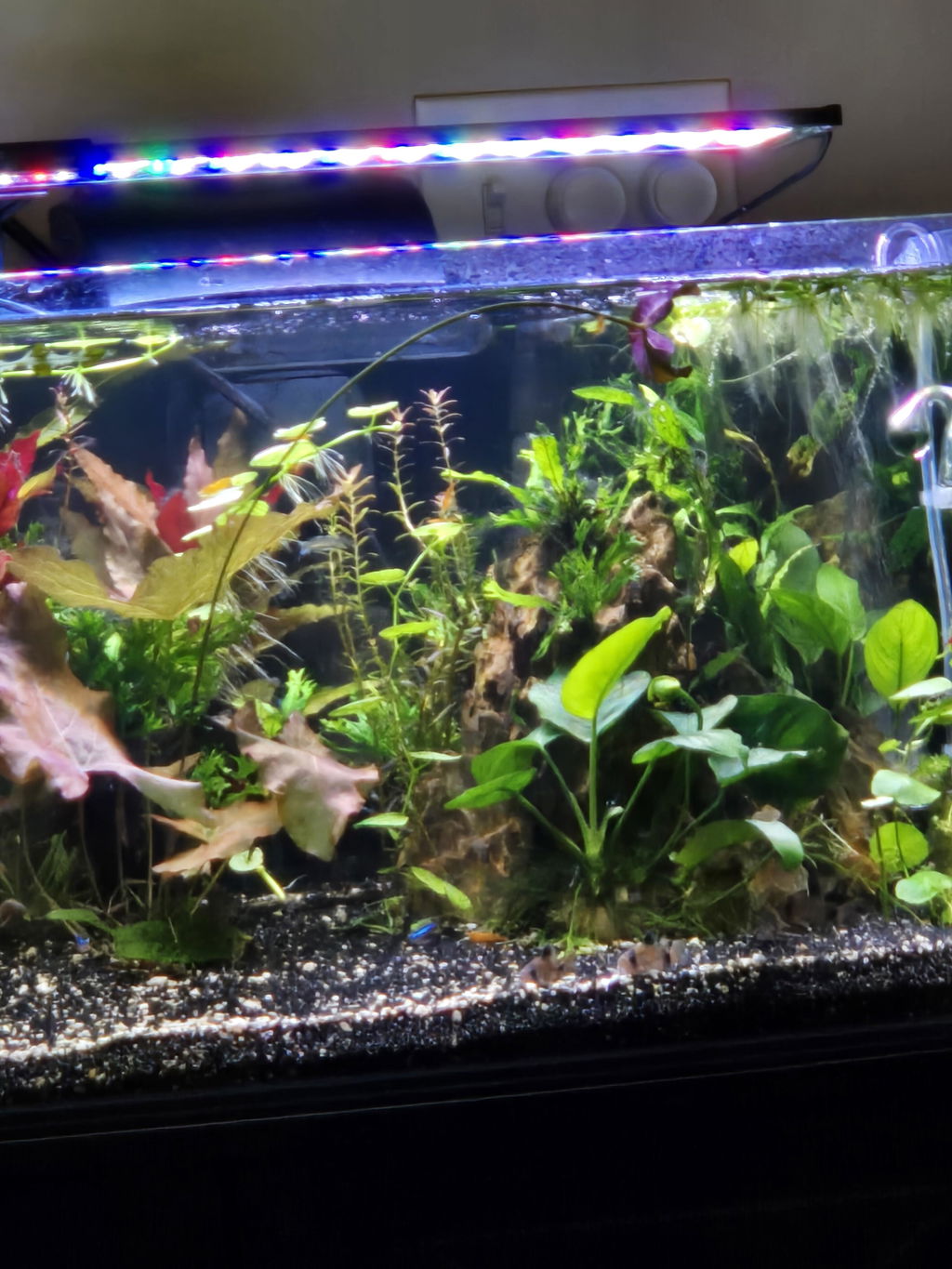
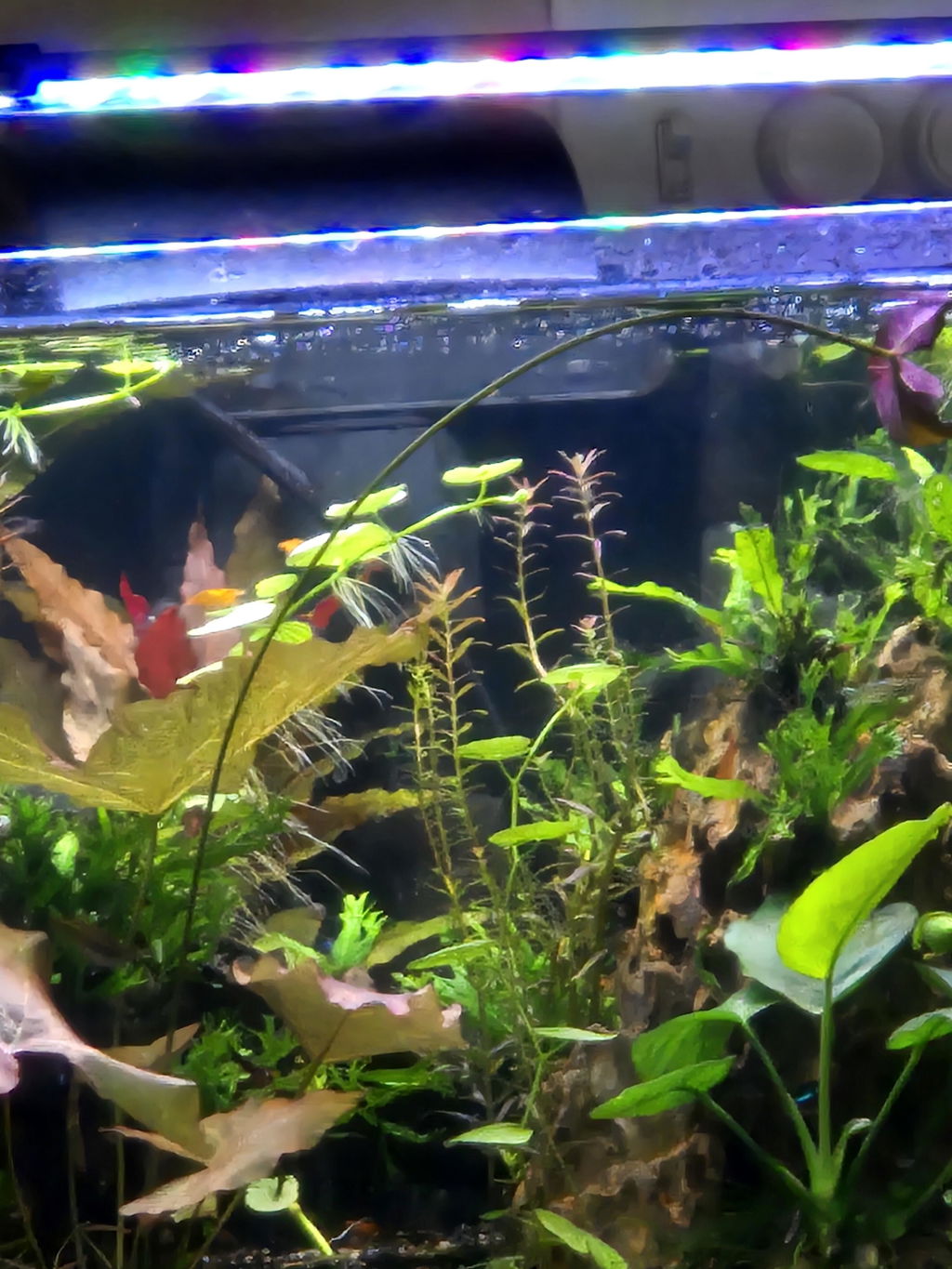
Spotted Blue-Eye (Pseudomugil gertrudae), also known as the Spotted Blue-Eye or Gertrude's Rainbowfish, is a tiny, ethereally beautiful nano rainbowfish native to shallow, slow-moving streams, pools, and vegetated swamps in Northern Australia and Papua New Guinea. The body is translucent to pale silver-white with subtle warm tints, giving the fish an almost luminous quality, and the eyes are a vivid, clearly visible blue. The fins -- particularly the dorsal and anal fins of adult males -- are elaborately developed into broad, spotted fan-like structures edged in black and yellow that the males spread and display continuously when competing for female attention. This constant displaying behaviour, combined with the fish's small size and delicate colouration, makes a well-kept group of Spotted Blue-Eyes one of the most visually engaging nano tank inhabitants available. They require a mature, densely planted tank, a group of 8 or more, and small food. One of the most shrimp-compatible fish in the hobby due to their tiny mouth size.
4.5–7.5pH
1–10GH (dGH)
72–82°FTemperature
1.2 inMax Size
Appearance & Display Behaviour
Fan Fins, Blue Eyes & Constant Displaying
Translucent body with vivid blue eyes -- the colouration is subtle but striking at close range. The body of P. gertrudae is pale and translucent, allowing internal structures to be faintly visible through the body wall. Subtle silver, turquoise, and yellow tints are present, particularly in males, and the iridescence shifts as the fish moves through different light angles. The blue eyes are the most immediately striking colour element and are clearly visible from across the tank.
Elaborately patterned fan-like fins on adult males -- spread continuously during display. Male Spotted Blue-Eyes develop distinctly enlarged dorsal and anal fins patterned with spots and edged in black and yellow. These fins are spread and held erect continuously as males display to rivals and potential mates, creating a constant visual spectacle of fin-fanning and colour-intensifying behaviour that smaller-finned fish cannot replicate. The displaying is not aggressive -- it is performative and fascinating to observe.
Keep in groups of 8 or more -- timid and pale in small numbers. In groups below 6 Spotted Blue-Eyes are shy, hide frequently, and show faded colour. In a group of 8 or more they emerge confidently, display continuously, and show their full colouration. A school of 10 to 15 in a well-planted blackwater setup is the minimum for the full display behaviour the species is known for.
Requires a biologically mature, densely planted tank -- sensitive to water quality fluctuations. This species is not suitable for a new or cycling aquarium. It requires stable, established water chemistry and will decline quickly in response to ammonia spikes, nitrite, or significant pH shifts. A tank running for at least 3 months before introduction is recommended. Dense fine-leaved planting, floating plants to diffuse light, and driftwood to add tannins create the ideal environment.
Shrimp Compatibility
Among the Most Shrimp-Safe Fish Available
Tiny mouth -- adult Neocaridina and Caridina shrimp are completely safe. The mouths of Spotted Blue-Eyes are so small that adult shrimp of any size are entirely beyond what the fish can consume. Only the very smallest newly hatched shrimplets in their first few days of life are at any risk. In a planted tank with moss and fine-leaved plants, shrimplet survival alongside Spotted Blue-Eyes is very high. This makes them one of the most genuinely shrimp-safe fish available.
Parameter overlap with both Neocaridina and Caridina is excellent. P. gertrudae tolerates pH 4.5 to 7.5 and soft to moderately soft water, spanning both the Neocaridina and Caridina parameter ranges. The fish performs well in tannin-stained water, aligning particularly naturally with a Caridina blackwater setup. Avoid mixing with other Pseudomugil species in breeding tanks as hybridisation is possible.
Keeper's NoteA group of 12 Spotted Blue-Eyes in a 15-gallon blackwater planted tank with Almond Leaves, Java Moss, fine dark substrate, and a colony of Crystal Red or Neocaridina shrimp is one of the most elegant and most visually sophisticated nano tank setups achievable in the freshwater hobby. The constant displaying of the male fins, the translucent bodies catching light, and the shrimp moving below create a living display that rewards close observation indefinitely. Feed small foods twice daily and maintain stable water quality -- this species repays careful husbandry with outstanding long-term colour and behaviour.
🐠
Browse more freshwater fishBrowse our full Freshwater Fish collection.
→