Freshwater Fish
Peppered Cory
A classic, hardy bottom-dwelling catfish with a speckled grey-green and black pattern. One of the most peaceful and useful substrate cleaners in the freshwater hobby and a reliable companion for shrimp tanks.
Peppered Corydoras (Corydoras paleatus) are one of the most widely kept and longest-established freshwater aquarium fish in the hobby, with a history in the aquarium trade stretching back over a century. They have a distinctive speckled grey-green and black body with bony armoured plates rather than scales, a pair of sensitive barbels used to probe the substrate for food, and a peaceful, sociable temperament that makes them compatible with virtually every non-aggressive freshwater species. As bottom dwellers they occupy the substrate layer of the tank continuously, sifting through sand and fine gravel for food particles and incidentally aerating the top layer of substrate as they go. They are one of the coolest-tolerant Corydoras species, thriving at temperatures that overlap well with Neocaridina shrimp, making them a practical and aesthetically complementary addition to a planted shrimp tank.
6.0–7.5pH
2–15GH (dGH)
64–77°FTemperature
2.5 inMax Size
Appearance & Behaviour
Armoured, Active, and Social
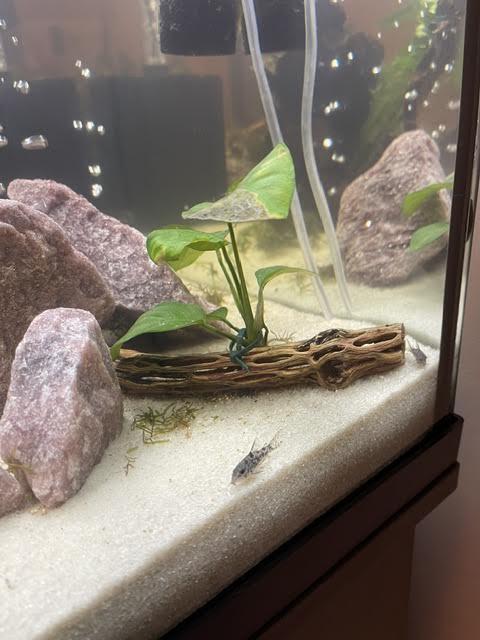
Speckled grey-green and black pattern across bony armoured plates. The Peppered Cory's colouration is a mottled, irregular arrangement of dark olive-green, grey, and black that reads as naturalistic and earthy rather than vivid. Each fish has a slightly unique distribution of markings. The bony scute plates covering the body give it a texture clearly distinct from scaled fish, and the downward-facing barbels and flattened underside are characteristic of all Corydoras. Males are noticeably slimmer than females; mature females have a distinctly broader, rounder abdomen visible from above.
Social and group-dependent -- keep in groups of 4 or more. Peppered Cories are shoaling fish and show stress, reduced activity, and loss of appetite when kept singly or in pairs. In a group of 4 or more they are confident, actively foraging, and frequently visible. Groups of 6 produce the most natural and engaging shoaling behaviour. They should never be kept as a single specimen.
Active substrate foragers -- sift continuously through sand and fine substrate for food particles. Peppered Cories forage by pushing their sensitive barbels through the substrate surface and rooting through the top layer for food. This behaviour incidentally aerates the substrate and disturbs settled detritus, keeping it in suspension where it can be removed by filtration. Fine sand is strongly preferred over coarse gravel, which can damage the delicate barbels over time and cause barbel erosion.
Breathe atmospheric air -- will periodically dart to the surface. Like all Corydoras, Peppered Cories supplement gill respiration by periodically darting to the water surface to gulp air, which they absorb through a modified section of intestine. This is entirely normal behaviour and not a sign of oxygen deficiency. The frequency of surface dashes increases in warmer, lower-oxygen water.
One of the coolest-tolerant Corydoras species -- thrives at Neocaridina temperatures. Most tropical Corydoras species require 74 to 80°F and struggle at the cooler end of the Neocaridina range. Peppered Cories are native to southern Brazil and Argentina where water temperatures are seasonally cool, and they thrive at 64 to 77°F. This makes them one of the very few Corydoras species that can be kept comfortably alongside Neocaridina shrimp at 68 to 74°F without a temperature compromise.
Shrimp Compatibility
Peaceful but Large Enough to Matter
Adult Neocaridina shrimp are safe -- shrimplets are at moderate risk. Peppered Cories are not predatory fish in any aggressive sense, but they are active substrate foragers and will consume shrimplets and small juvenile shrimp encountered during foraging. Adult Neocaridina shrimp at full size are too large to be targeted and are generally ignored. The risk to shrimplets is real but manageable in a well-planted tank with dense moss and fine-leaved ground cover.
Fine sand substrate benefits both Cories and shrimp. Peppered Cories need fine sand to protect their barbels from abrasion and to forage naturally. Fine sand is also the preferred substrate for many shrimp keepers. The two species share the same substrate preference, which means no compromise is required on substrate type in a mixed tank.
Sponge filter recommended -- protects both Cory barbels and shrimplets. A sponge filter produces no intake suction risk for shrimplets and provides the gentle, well-oxygenated flow that Corydoras appreciate. The combination of sponge filtration, fine sand substrate, and dense planting creates ideal conditions for both species simultaneously.
Do not keep with Caridina shrimp. Peppered Cories prefer pH above 6.0 and harder water than Caridina tanks provide. The temperature overlap with Caridina is also less ideal. For Caridina setups, Chili Rasboras or a fish-free approach are better options.
Keeper's NoteA group of 6 Peppered Cories in a planted Neocaridina tank on fine black sand is one of the most practically useful and visually cohesive mixed-species combinations available at the nano to mid-size tank scale. The Cories work the substrate layer continuously, the shrimp work the hardscape and plant surfaces, and neither species competes with the other for the same space or food. The naturalistic speckled colouration of the Cories integrates with a planted aquascape without drawing the eye away from the shrimp, and the group shoaling behaviour adds a mid-size animal presence that a shrimp-only tank lacks. Keep the planting dense, use fine sand, and run a sponge filter for best results with both species.
🐠
Browse more freshwater fishBrowse our full Freshwater Fish collection.
→