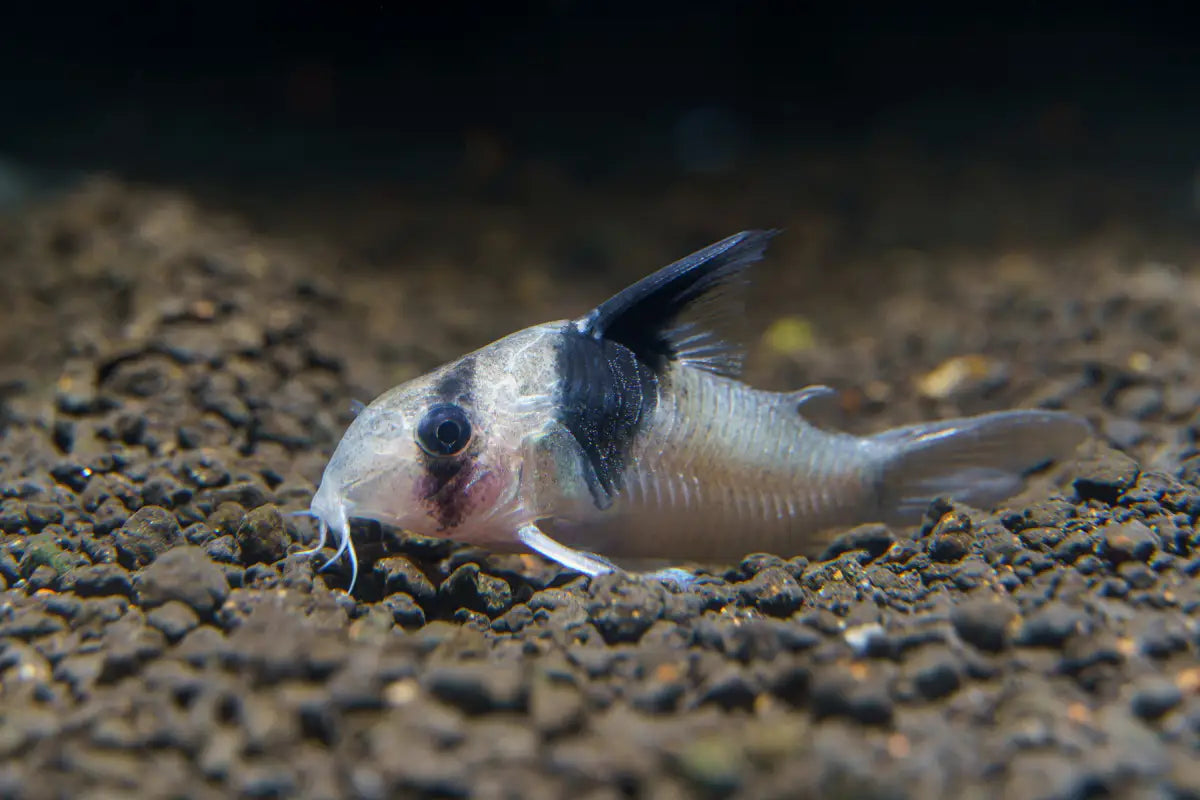
Panda Corydoras (Corydoras panda) are a small, visually distinctive bottom-dwelling catfish native to the cool, clear Ucayali River system in Peru. The common name comes from the three bold black markings on an otherwise pale white to cream body -- a black eye mask, a black dorsal fin spot, and a black patch at the base of the tail -- which closely resemble the colouring pattern of a giant panda. This clean, high-contrast two-colour pattern makes Panda Cories one of the most immediately recognisable and most visually striking Corydoras species available, and they are consistently popular for that reason. Like all Corydoras they are peaceful, social, substrate-foraging catfish that occupy the bottom layer of the tank and are safe with the vast majority of community tank inhabitants. They prefer cool, clean, well-oxygenated water and are sensitive to poor water quality and elevated temperatures. Keep in groups of 4 or more on fine sand substrate.
6.0–7.5pH
2–12GH (dGH)
64–75°FTemperature
2 inMax Size
Appearance & Behaviour
The Panda Pattern
Pale white to cream body with three bold black markings -- eye mask, dorsal spot, and tail base. The three black markings of the Panda Cory are consistent between individuals and clearly defined against the pale base colour, giving the species a clean, graphic quality that distinguishes it immediately from the mottled or banded patterns of most other Corydoras. The eye mask is the most prominent feature, giving the fish an expressive, almost cartoonish face at close range. The combination of the pale body and bold black markings makes Panda Cories particularly visible in a planted tank, even in low-light conditions where more uniformly coloured fish become harder to see.
Smaller and more delicate than Peppered Cories -- reaching approximately 2 inches at maturity. Panda Cories are among the smaller Corydoras species at full size, which makes them particularly well-suited to nano and mid-size planted tanks where a larger Cory species would feel visually heavy. Their smaller size also means their bioload is proportionally lower, which is a practical advantage in a carefully managed shrimp tank.
Social and group-dependent -- keep in groups of 4 or more, 6 preferred. Panda Cories are shoaling fish and show significantly reduced activity, hiding behaviour, and stress indicators when kept singly or in pairs. In a group of 6 they are active, visible, and forage confidently across the full substrate surface. Like the Peppered Cory they should never be kept as a single specimen.
Sensitive to water quality and elevated temperature -- more demanding than Peppered Cories. Panda Cories originate from clear, fast-flowing Andean foothill streams and are more sensitive to elevated nitrates, ammonia spikes, and temperatures above 75°F than the hardier Peppered Cory. They are not a beginner fish in the sense of tolerating poor conditions -- they require a cycled, well-maintained tank with consistent water changes and stable parameters. Temperature above 77°F causes chronic stress and shortened lifespan. This sensitivity makes them well-suited to the stable, clean conditions of a well-run shrimp tank.
Fine sand substrate is essential -- coarse gravel causes barbel erosion. The sensitive downward-facing barbels of Panda Cories are prone to bacterial infection and physical erosion on coarse or sharp substrates. Fine sand is not optional for long-term Panda Cory health. Eroded or shortened barbels in an established tank are a reliable sign of inappropriate substrate or poor water quality.
Shrimp Compatibility
Peaceful but Active Foragers
Adult Neocaridina shrimp are safe -- shrimplets are at moderate risk. Panda Cories are not aggressive hunters but they are thorough substrate foragers and will consume shrimplets encountered during foraging. Adult Neocaridina at full size are too large to be targeted. Dense planting with Java Moss, Subwassertang, and fine-leaved foreground plants provides the shrimplet cover needed to maintain a breeding colony alongside a Cory group.
Shared preference for fine sand, cool water, and clean conditions makes them ideal mixed-tank companions. The conditions that keep Panda Cories healthy -- fine sand, 68 to 74°F, low nitrates, stable parameters, good flow -- are the same conditions that produce the best shrimp health and colour. There is no compromise required on tank setup when keeping both species together in a well-run planted tank.
The pale body and black markings of Panda Cories contrast vividly with red and orange Neocaridina. A group of Panda Cories foraging across dark sand in a tank with Fire Red Cherry or Sunkist shrimp produces a warm-cool, light-dark contrast at the substrate level that reads as visually intentional. The white-and-black of the Cories and the vivid reds and oranges of the shrimp share the substrate layer without competing for it.
Not recommended for Caridina setups. Panda Cories prefer pH above 6.0 and moderately soft water. Active substrate Caridina tanks running very low pH and KH are not ideal for long-term Panda Cory health.
Keeper's NotePanda Cories are the most visually striking Corydoras species for a shrimp tank context -- the pale body and bold black markings create a clear visual contrast against dark substrate and brightly coloured shrimp that the more subdued Peppered Cory cannot match. A group of 6 on black sand with a colony of Fire Red Cherry Shrimp and dense green planting is a display that works at every viewing distance -- the Cories are visible and interesting up close, and the collective movement of the group across the substrate reads as clean and naturalistic from across the room. Keep the water cool, clean, and stable, and this combination rewards long-term.
🐠
Browse more freshwater fishBrowse our full Freshwater Fish collection.
→