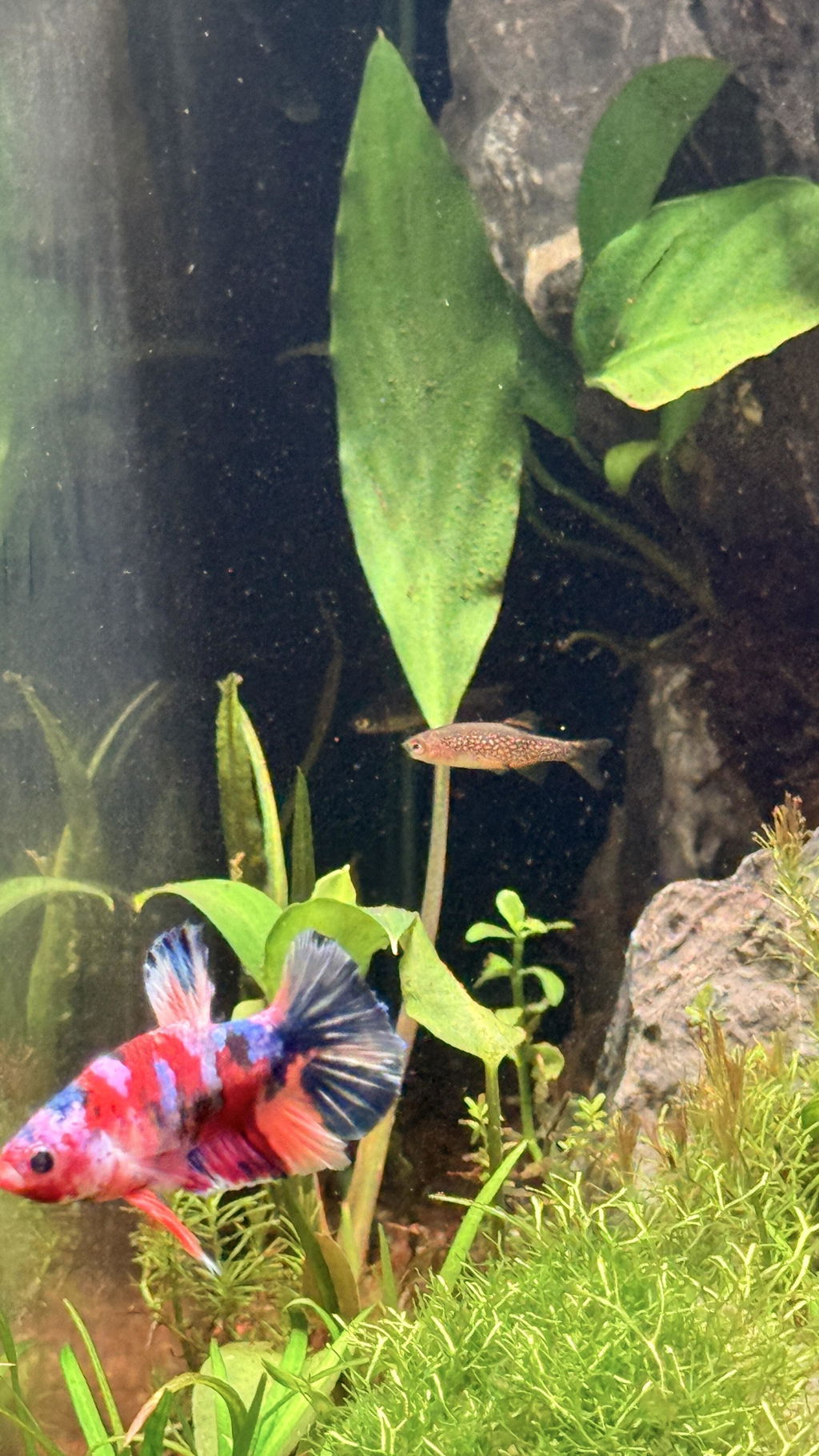
Celestial Pearl Danios (Danio margaritatus), also known as Galaxy Rasboras, are a small, densely patterned nano fish discovered in Myanmar in 2006 and immediately recognised as one of the most visually striking freshwater fish available at their size. The body is a deep blue-green covered in irregular white to cream pearl spots -- the pattern that gives the species both its common names -- with vivid red-orange finnage that creates a warm-cool contrast that is remarkable for a fish reaching only 1 inch at maturity. In a heavily planted nano tank with dark substrate a small group of Celestial Pearl Danios produces more visual impact per fish than almost any other species available at a comparable price point. They are peaceful, somewhat timid, and best kept in groups with adequate plant cover.
6.5–7.5pH
4–12GH (dGH)
72–78°FTemperature
1 inMax Size
Appearance
Pearl Spots & Red Fins
Deep blue-green body covered in white pearl spots with vivid red-orange fins. The combination of the spotted body and the contrasting warm fin colour makes the Celestial Pearl Danio one of the most complex and detailed colour patterns available in any nano fish. Up close the pearl spots are clearly individual and irregular, each with a slightly different size and spacing from the next. The red-orange of the fins has a translucent quality that catches light as the fish moves. Males are more intensely coloured than females and develop their best colouration when in the presence of rival males.
Males colour up most vividly in the presence of other males and when actively displaying. A group with a reasonable male-to-female ratio (roughly 1:2 or 1:3) produces the best sustained colour from the males as they display continuously. All-male groups can result in aggression; all-female groups produce less vivid colour. Mixed groups in a spacious planted tank with adequate visual breaks between territories produce the best combination of colour and peaceful behaviour.
Shrimp Compatibility
Can They Be Kept with Shrimp?
Adult Neocaridina shrimp are generally safe -- shrimplets are at significant risk. Celestial Pearl Danios are small but active hunters of anything that fits in their mouths, and shrimplets are an ideal prey size. In a tank with dense Java Moss, Subwassertang, or other fine-leaved planting, shrimplet survival improves significantly, but predation should be expected and the colony growth rate will be slower than in a fish-free setup. Adult shrimp at 2cm or more are generally ignored.
Dense planting is not optional in a mixed CPD and shrimp tank -- it is what makes coexistence viable. The more surface area and interior volume available from mosses and fine-leaved plants, the more shrimplets survive to adulthood. A sparsely planted tank with CPDs will see very low shrimplet survival regardless of group size. A heavily planted tank with multiple moss clusters, Subwassertang, and foreground grass can support a functioning mixed colony.
Parameter overlap with Neocaridina is good. CPDs prefer pH 6.5 to 7.5 and moderate temperatures of 72 to 78°F, which sits comfortably within the Neocaridina range. The lower end of the CPD temperature range overlaps with the Neocaridina preference. Aim for 74 to 76°F as a compromise that suits both species well.
Keeper's NoteCelestial Pearl Danios on dark substrate with Java Moss and Bucephalandra in a 10-gallon tank is one of the most visually complete nano planted tank setups available. The pearl spotting and red fins of the fish, the deep green of the plants, and the movement of a shrimp colony at the substrate level together create a layered display that reads as intentional and sophisticated from every viewing angle. Keep the school at 8 to 12 fish, plant densely, and let the tank mature for 3 months before adding the CPDs for best results.
🐠
Browse more freshwater fishBrowse our full Freshwater Fish collection.
→