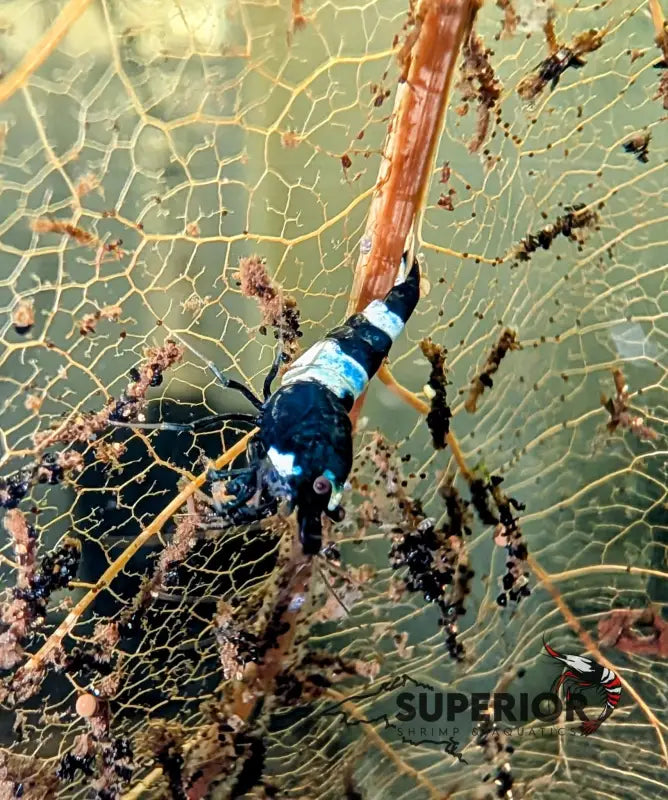
Black King Kong shrimp are the solid-black counterpart to Red King Kong -- a Bee shrimp Caridina selectively bred to produce full-body opaque black colouration with no white banding, no white patches, and no transparency anywhere on the body. Where Crystal Black Caridina carry the classic black-and-white banded pattern, Black King Kong carries black throughout -- a dense, deeply saturated, fully opaque black that reads as an intense visual block rather than a patterned animal. The colour depth that defines the best specimens is the result of sustained selective breeding pressure -- genuinely impressive and immediately distinguishable from lower-grade black Bee shrimp at a glance. Care requirements are identical to Red King Kong and represent the narrowest parameter window in the catalog: soft, acidic, ultra-low-KH water maintained with RO remineralisation, active aquasoil, and the experienced keeper instincts to read early warning signs before losses occur. Recommended only for keepers with established Caridina experience. Safe with all snails.
5.8-6.8pH
3-6GH
0-2KH
68-74FTemperature
What to Expect
Colour, Demands and Behaviour
Full-body opaque black -- the solid-colour pinnacle of the black Bee line -- in the best specimens the black colouration is dense and fully opaque across every part of the body -- legs, tail fan, rostrum, and body -- with no areas of reduced pigmentation, no transparency, and no white anywhere. This degree of colour opacity distinguishes Black King Kong from Crystal Black shrimp at the patterned end of the spectrum and from lower-grade solid-black Bee shrimp that carry partial white areas or incomplete opacity. The colour at its best is a deep, matte-to-slightly-lustrous black that reads as a solid block.
Colour depth is parameter-responsive -- optimal conditions produce the most opaque black -- like Red King Kong, Black King Kong colouration is most fully expressed in water at the optimal end of its parameter range: pH 6.0-6.5, GH 4-5, KH 0-1, temperature 70-72F. Parameters within the survivable range but toward the edges produce less opaque, less saturated black -- shrimp that appear more translucent or that show partial white areas under the body. Maintaining truly optimal rather than merely adequate parameters is what separates stunning Black King Kong from ordinary ones.
Behaviour identical to all healthy Caridina in settled conditions -- in a well-established tank at optimal parameters, Black King Kong graze continuously across all surfaces, compete actively at food drops, and move freely throughout the day. A tank of healthy, settled Black King Kong is one of the most visually striking Caridina setups available -- the solid black animals on white or pale sand, or against the green of moss, read immediately and dramatically from across the room.
Requires tightest parameter control in the catalog -- identical to Red King Kong -- KH must be maintained at 0-2 with near-zero being optimal, pH must be stable within a narrow range, and parameter stability across water changes is more important than parameter perfection at any single point in time. Requires RO or extremely low-TDS source water, Caridina-specific remineralisation mineral, and active aquasoil contributing to low pH maintenance.
Not recommended for beginners or new Caridina keepers -- the combination of narrow parameter tolerance, high sensitivity to instability, significant cost per animal, and the experience required to interpret early warning signs before losses occur makes Black King Kong unsuitable as a first Caridina. Keepers who have successfully maintained and bred Crystal Black or Bee shrimp for at least 6-12 months have the foundational experience to give Black King Kong the best chance of success.
Breeds in freshwater -- clutch health reflects parameter stability -- females carry egg clutches for 4-6 weeks and release fully formed shrimplets directly into the tank. Clutch size, hatching success, and shrimplet survival are all directly responsive to parameter stability -- any instability during the brooding period risks clutch failure. In genuinely optimal stable conditions, healthy females breed consistently and the colony grows steadily.
How to Set It Up
Getting Started
1Establish and verify parameters for two weeks before introduction -- run the tank at target parameters -- pH 6.0-6.5, GH 4-5, KH 0-1, temperature 70-72F -- for a minimum of two weeks before introduction, testing daily to confirm stability. Use RO water remineralised with Caridina-specific mineral and active aquasoil substrate.
2Drip acclimate over 90-120 minutes minimum -- use slow drip acclimation at one drop per second over 90-120 minutes. Black King Kong are as sensitive to acclimation stress as Red King Kong -- never use the float-and-pour transfer method.
3Maximise moss coverage and biofilm surfaces -- dense Taiwan Moss, Java Moss, or Flame Moss provides essential shrimplet shelter and continuous biofilm foraging surfaces. Establish moss growth before introducing shrimp so the surfaces are biofilm-rich from the first day.
4Feed sparingly with Caridina-specific food and remove uneaten portions -- feed small amounts of high-quality Caridina food every 1-2 days. Remove uneaten food within 2-3 hours to prevent water quality impact in the low-KH, low-buffering environment that Black King Kong require.
Bonus TipBlack King Kong shrimp on white or very pale sand substrate with a background of bright green moss -- Taiwan Moss or Christmas Moss -- creates the single most visually striking contrast achievable in the Caridina section of the catalog. The dense opaque black of the shrimp against the bright white-pale sand and the vivid green of the moss is a three-element composition where every element maximises the visual impact of the others simultaneously. The contrast is immediate at any distance and photographs with an immediacy and clarity that no other substrate-shrimp-plant combination in the catalog approaches.
🦐
Browse more Caridina shrimpPair Black King Kong with Red King Kong, Crystal Red, or Crystal Black for a complete advanced Caridina setup. Browse our Caridina Shrimp collection.
→