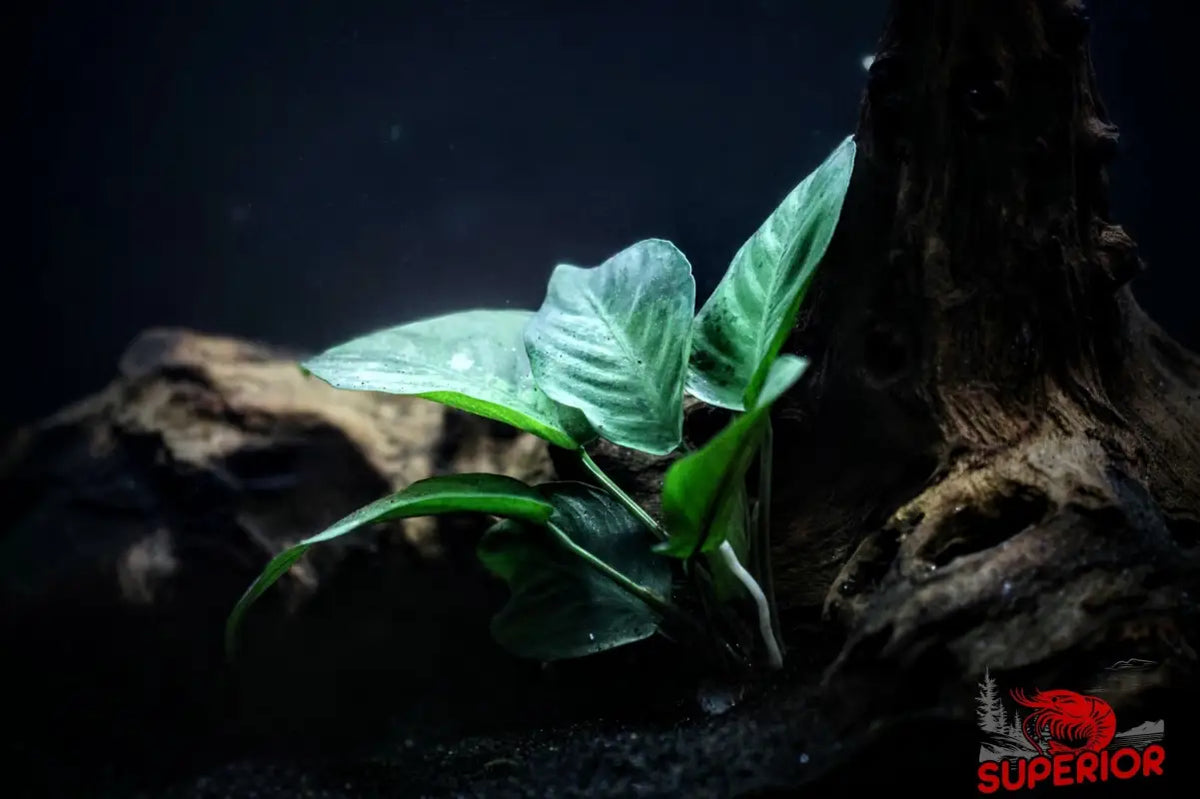
Anubias Barteri 'Round Leaf' is a variety of Anubias barteri selected for its distinctly round, broad leaf form — leaves that approach a true circle in outline rather than the elongated oval-to-heart shape of standard barteri, carried on short petioles that hold them close to the rhizome and give the plant a compact, low, clearly structured appearance. The round leaf form is the most graphically distinctive of any Anubias in the catalog — each leaf reads as a bold, circular shape from across the tank rather than a general green mass, and a group of Round Leaf on driftwood presents a series of clearly formed, overlapping circles that creates a visual rhythm no other leaf shape in the catalog produces. The leaf surface is smooth, the colour is the same deep, consistent green as all barteri varieties, and care requirements are identical to all other Anubias — attach to hardscape, never bury the rhizome, low to medium light, and consistent liquid fertilisation. Fully safe with all Neocaridina, Caridina, and snails.
Not RequiredCO₂
72–82°FTemperature
Low–MedLighting
What to Expect
Form, Growth & Visual Character
Distinctly round to broadly oval leaves — the clearest leaf shape in the Anubias catalog — the defining quality of Round Leaf versus other barteri varieties is the circularity of the leaf outline — more clearly round than the elongated oval of standard barteri, rounder than the lanceolate form of Minima, and with a different roundness quality than the slightly heart-shaped base that standard barteri sometimes produces. Each leaf is a bold, clearly formed circle or broad oval that the eye resolves as a distinct shape rather than reading as generic green foliage.
Short petioles hold leaves close and compact — low, structured profile — unlike some barteri forms that produce longer petioles holding leaves at varying heights and angles, Round Leaf typically produces shorter petioles that hold the round leaves relatively close to the rhizome and to each other. The result is a more compact, lower, clearly structured plant profile — a group of Round Leaf reads as an organised arrangement of overlapping circles rather than a loose, spreading rosette.
Smooth leaf surface with deep consistent green — the leaf surface is smooth rather than textured, allowing the clean circular outline of each leaf to read without surface distraction. The deep, rich green is consistent across all mature leaves and holds reliably under the low to medium light conditions that Anubias prefers — it does not pale or yellow with age under adequate fertilisation.
Slow growth — each new round leaf a visible addition to the arrangement — Anubias adds one leaf at a time over weeks. Because Round Leaf leaves are distinctly round and individually clearly defined, each new leaf is a visible compositional addition to the arrangement rather than a gradual fill of an indistinct mass. A well-established Round Leaf specimen with 10–15 mature leaves presents as an intentional arrangement of circular forms that strengthens with each new leaf added.
Biofilm on smooth round leaf surfaces — visible shrimp grazing — the broad, smooth, clearly bounded upper surfaces of Round Leaf leaves develop biofilm that shrimp graze across. Because the leaves are round and smooth, individual shrimp are completely visible on the leaf surface from the front of the tank — the combination of bold round leaf shape and visible shrimp grazing is particularly appealing in display tanks where shrimp observation is part of the intent.
How to Set It Up
Getting Started
1Attach to broad, horizontally oriented driftwood that suits the round leaf scale — Round Leaf reads most effectively on broad, flat driftwood surfaces where the circular leaves have room to spread out and the individual leaf shapes are visible from the front without crowding. On thin, vertical driftwood the round leaves can overlap excessively and obscure each other — broader hardscape surfaces give each leaf space to read as a distinct form.
2Never bury the rhizome — attach to hardscape only — secure with cotton thread or super glue gel. Position the rhizome horizontally on the hardscape surface with leaves pointing upward and roots descending into hardscape crevices or hanging free. The round leaves should be oriented to face the primary viewing angle.
3Low to medium light — avoid high light that promotes algae on smooth leaves — smooth leaf surfaces under high light are particularly vulnerable to green spot algae accumulation on Anubias. Position Round Leaf in moderate light — naturally shaded by taller background plants or floating plant cover — and allow shrimp to maintain the leaf surfaces naturally.
4Fertilise consistently with balanced liquid formula including iron — two to three doses per week of comprehensive liquid fertiliser. Iron maintains the depth and richness of the green that makes the bold round leaf shape read most clearly. Pale, iron-deficient leaves lose visual impact — the graphic quality of the round form is most effective when the green is deep and saturated.
💡 Bonus Tip
Round Leaf mounted low on a piece of driftwood — with the rhizome attached near the base so leaves spread upward and outward at substrate level — directly in front of or below a group of taller Anubias barteri standard form creates the most natural-looking within-species layered Anubias arrangement. The clearly round leaves of Round Leaf in the foreground position contrast with the elongated oval leaves of standard barteri rising behind, creating a front-to-back depth and leaf-scale variation within a single genus that requires no other plants to read as a complete, composed midground feature.
🌿
Browse more aquatic plantsPair Round Leaf with Anubias Minima, Wrinkled, Bucephalandra, or Java Fern for a complete hardscape planting. Browse our Aquatic Plants collection.
→