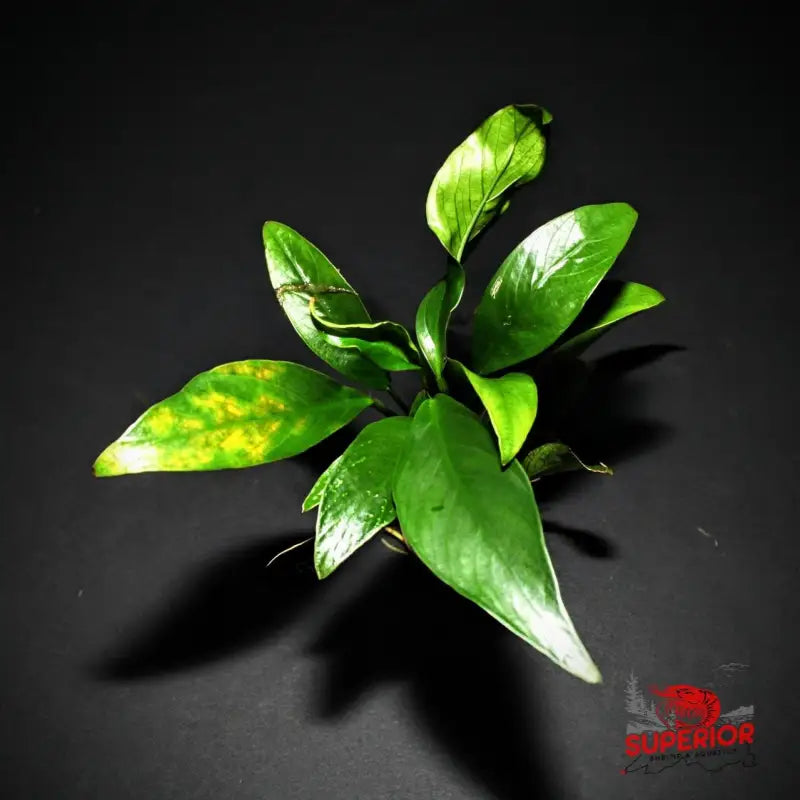
Anubias Barteri ('Congensis') | Aquatic Plants – Superior Shrimp & Aquatics
Skip to content

15% OFF STORE WIDE! ENDS MARCH 15TH

Sign In

Anubias Barteri ('Congensis')

Anubias Barteri ('Congensis')

Regular price $8.00
Regular price Sale price $8.00
Sold out
Shipping calculated at checkout.
Amount: Rhizome

Sub total:

$8.00
View full details
Description
Anubias Barteri 'Congensis' – Superior Shrimp & Aquatics
Aquatic Plants

Anubias Barteri 'Congensis'

Long, narrow, deeply ridged leaves with a prominent central vein — the most structurally distinctive leaf form in the Anubias catalog and the boldest midground statement without CO₂.

Long Narrow Ridged Leaves Prominent Central Vein Bold Midground Presence Rhizome — Do Not Bury No CO₂ Required Low to Medium Light

Anubias barteri var. 'Congensis' is the most structurally distinctive leaf form in the Anubias catalog — a variety whose long, narrow leaves are characterised not just by their elongated shape but by deeply impressed lateral venation that runs from the prominent central vein outward to the leaf margins, creating a strongly ridged, almost corrugated surface texture that no other Anubias variety replicates. Where Afzelii is tall and lance-shaped with smooth surfaces, Congensis is bold and textural — the deep venation casting visible shadow across the leaf surface under directional light and giving each leaf a physical depth and presence that reads from across the tank. The leaves are substantial — broader at the midpoint than Afzelii and carrying more surface mass per leaf — making a mature Congensis specimen one of the most visually impactful low-tech plants available at midground scale. Like all Anubias, it grows from a rhizome that must never be buried, attaches to driftwood and stone, and is fully safe with all Neocaridina, Caridina shrimp, and snails.

Not Required CO₂
72–82°F Temperature
Low–Med Lighting

Appearance & Growth Over Time

Deeply impressed lateral venation across long, narrow leaves — the defining characteristic of Congensis is its venation — lateral veins that run visibly and deeply from the central midrib outward to the leaf margins, creating a corrugated, ridged surface that is substantially more three-dimensional than the comparatively smooth surfaces of other Anubias varieties. The venation is most pronounced on mature, fully developed leaves and creates shadow lines across the leaf surface under any directional lighting — making the leaf look more detailed and sculptural than smooth-surfaced varieties of equivalent size. Broader and more substantial than Afzelii at similar length — while both Afzelii and Congensis produce long, elongated leaves, Congensis leaves are broader at the midpoint and carry more visual mass per leaf — a heavier, more substantial presence that makes individual leaves read more boldly than the finer, more elegant lance shape of Afzelii. A mature Congensis leaf at full size is one of the largest and most structurally impressive individual leaves in the Anubias catalog, approached in presence only by full-sized barteri. Venation casts visible shadow under directional or side lighting — the deeply impressed lateral veins of Congensis catch light at low angles in a way that flat or shallowly veined leaves do not. Under side lighting or lighting that hits the leaf at an angle, each lateral vein casts a fine shadow line across the surface — the same raking light effect that brings out three-dimensional texture in Crocodile Buce, applied to the vascular structure of an Anubias leaf. Overhead lighting flattens this effect; angled or side-positioned lighting reveals it fully. Accumulates substantial biofilm across a large, textured surface — the broad, ridged leaves of Congensis accumulate biofilm extensively — both across the general leaf surface and within the grooves of the lateral venation, where organic material collects and biofilm develops in sheltered micro-channels. Shrimp and snails work across the Congensis leaf surface thoroughly and visibly, the ridged texture making the foraging behavior more varied and engaging to observe than on a flat leaf of equivalent area. Slow, deliberate growth with long-lived, substantial leaves — Congensis grows at the unhurried pace characteristic of all Anubias, adding one substantial leaf at a time over weeks. The size and physical presence of individual leaves means that even a small established plant with five or six mature leaves makes a meaningful visual statement in the midground — the scale of each leaf carries more weight than the equivalent leaf count would on a smaller-leafed variety. Individual leaves persist for months to years under stable conditions. Rhizome must remain fully above substrate at all times — the horizontal connecting stem must never be buried, pushed into substrate, or covered by accumulated debris. Burial causes irreversible rot that spreads through the plant. Attach to driftwood or stone with cotton thread or super glue gel, keeping the entire rhizome exposed and accessible to open water circulation.

Getting Started

1 Attach to driftwood or stone — never plant in substrate — secure the rhizome to driftwood or porous rock with cotton thread or a small amount of super glue gel. Super glue gel sets quickly on wet surfaces and holds the rhizome in contact with hardscape while roots grip independently over the following weeks. Position the rhizome so the long leaves have room to extend outward and upward — Congensis needs more clearance around the planting site than compact varieties like Nana.
2 Position with open midground space and consider lighting angle — place Congensis in the midground on a piece of driftwood or stone where the long leaves have unobstructed space to develop to full size without being crowded from above or the sides. If your tank has any side lighting or front-angled lighting, orient the leaf face toward that light source — the deeply impressed venation reads most dramatically under light that strikes the leaf at an angle rather than directly overhead, and positioning the plant to take advantage of this reveals the full sculptural quality of the leaf surface.
3 Low to medium light with a consistent photoperiod — Congensis thrives under the same conditions as all Anubias barteri varieties: low to medium light at a consistent 8–10 hour photoperiod. The large leaf surface is susceptible to algae accumulation under excessive light intensity or inconsistent lighting schedules — the most reliable long-term maintenance approach is moderate light intensity held steady rather than high intensity with variation. The deeply textured leaf surface makes algae growth more visually disruptive on Congensis than on smooth-surfaced varieties, making consistent photoperiod discipline particularly worthwhile.
4 Dose liquid fertilizer consistently, with iron — as an epiphyte feeding through its leaves from the water column, Congensis benefits from regular liquid fertilization covering macros, micros, and iron. Consistent iron supplementation supports the deep, saturated green of the large established leaves and the full development of venation depth on new growth. Underfed specimens produce new leaves that are smaller and paler than those grown under regular fertilization, with less pronounced venation that reduces the distinctive textural quality of the variety.
💡 Bonus Tip

Congensis placed on the same piece of driftwood as Anubias Nana at the base creates the most dramatic within-genus scale contrast in the Anubias catalog — the large, heavily veined, corrugated surface of a mature Congensis leaf against the small, smooth, rounded leaves of Nana makes both plants read more clearly than they do independently. The contrast works because the leaf form and surface character are maximally different while the genus, color, and care requirements are identical — the eye reads the difference as a deliberate pairing rather than mismatched plants.

🌿
Browse more aquatic plants

Pair Congensis with Anubias Nana, Afzelii, or Bucephalandra for a complete low-tech hardscape planting. Browse our Aquatic Plants collection.

Before placing your order, please review our 📋 DOA Policy 🚚 Shipping Info
Reviews

Customer Reviews

Be the first to write a review
0%
(0)
0%
(0)
0%
(0)
0%
(0)
0%
(0)
Home Shop
Wishlist
Log in