


Assassin Snail: A Quiet Hunter Worth Knowing
Complete care and breeding guide for Anentome helena — the hobby's most effective biological snail control, and a genuinely fascinating carnivore.
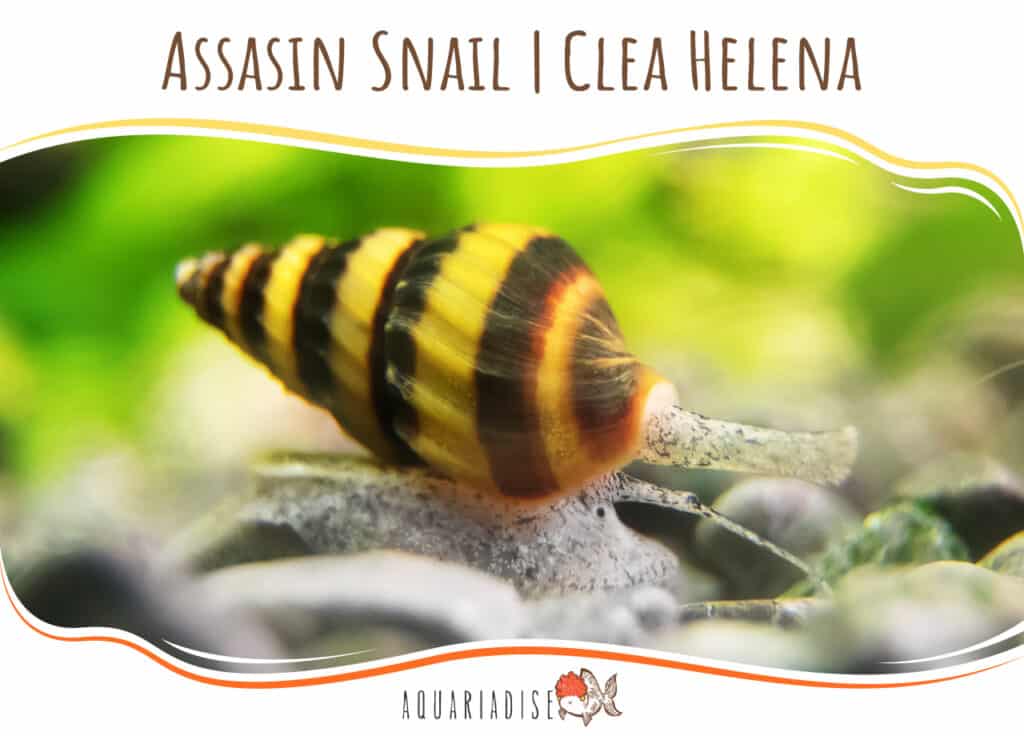
Anentome helena in the aquarium — the characteristic yellow-and-dark-brown banded shell earns this species its alternate common name, the bumblebee snail. The siphon, visible extending from the aperture, is used for chemosensory detection of prey rather than aerial respiration. Photo © Aquariadise (aquariadise.com)
Names, Origins & What That Shell Is Really Saying
You will encounter this animal primarily as Anentome helena, though older aquarium literature uses Clea helena, the name first applied by von dem Busch in 1847. Modern phylogenetic analysis places it within family Nassariidae, subfamily Anentominae — making it one of only a small number of nassarids that have fully adapted to freshwater life after a long marine evolutionary history.[3]
Its native range spans Southeast Asia: Malaysia, Thailand, Indonesia (notably Lake Toba on Sumatra), Cambodia, Vietnam, and Laos. In the wild it inhabits streams, ponds, canals, and ditches with sandy or muddy substrates — an unusually broad habitat tolerance that explains its hardiness in captivity.
A 2017 molecular study by Strong, Galindo, and Kantor revealed that what the trade calls A. helena likely encompasses a previously unrecognized radiation of look-alike species.[3] If two snails from different exporters don't quite match in banding or shell proportion, cryptic speciation is the probable explanation — not a bad batch. The practical implication: when importing stock, consistency within a single source matters more than visual matching across sources.
🐚 The anatomy of an ambush predator: The banded conical shell, closing operculum, chemosensory siphon, and extendable proboscis are not ornamental — they are a toolkit built for locating, pursuing, and consuming prey. The siphon tastes dissolved chemicals in the water column; the proboscis delivers the killing strike and extracts soft tissue from the prey's shell.

Close-up of an Anentome helena shell (1.6 cm specimen) showing the conical profile, strong axial ribbing, and the characteristic dark brown banding on a pale yellowish ground. The operculum — the hard "trapdoor" sealing the aperture — is visible and intact; a missing or damaged operculum on a living snail is an indicator of stress or injury. Photo © Wikimedia Commons, CC BY-SA 3.0
Size, Shell & Physical Traits
Adults typically grow to 18–32 mm (0.7–1.25 inches), though aquarium specimens tend toward the lower end of this range, as food availability is the primary driver of final size.[25] The shell is conical, tightly wound with 5–6 whorls, and features the distinctive dark brown and yellow-bronze banding that earns it the alternative common name "Bumblebee Snail." Some individuals present with fully brown, unbanded shells — a natural morph, not a sign of poor health.
The operculum — the hard, trapdoor-like plate that seals the shell opening — is a reliable health indicator. A visible, firm operculum held near the foot when the snail is active signals good condition. A snail that cannot close its operculum or that hangs limp from its shell is under acute stress and should prompt a water quality check immediately.
The apical portion of the shell (the pointed tip) is commonly worn smooth on older specimens — normal erosion, not disease. Shell banding intensity can fade in very soft, acidic water where calcium carbonate is slowly dissolving from the outer shell layers.
Sex, Dimorphism & the Honest Way to Tell
Anentome helena is gonochoric — individuals are either male or female and cannot self-fertilize, unlike the hermaphroditic ramshorns and pond snails it typically preys upon.[2] This is one reason assassin snail populations grow slowly and manageably: breeding requires both sexes to be present and to find each other.
External sexing is reliably impossible by visual inspection — size, shell shape, and color provide no useful signal.[2,27] The responsible approach is statistical: begin with a cohort of five or more individuals and let probability supply a workable sex ratio. Behavior then confirms what appearance cannot — you will observe prolonged pairing (males mounting females for many hours) followed, days later, by the appearance of single square or rectangular egg capsules on hard surfaces.
Courtship & Egg Deposition
Mating is unhurried and often continues for 8–12 hours. The male positions himself over the female and fertilizes internally. Females then deposit eggs individually in small, square-to-rectangular translucent capsules, typically on wood, rock, glass, or the base of plants — one capsule per session, often laid in short rows of a few capsules over consecutive days.[2,27] Each capsule contains a single yellow egg. Unlike pond or ramshorn snails, there are no mass egg clutches — reproduction is measured almost by design.
Development & Incubation
Development is direct — there is no free-swimming larval phase. Embryos develop within the capsule and hatch as fully formed miniature snails. In a controlled captive study at 25°C (77°F), hatching occurred at 52 ± 6 days, and hatchlings measured approximately 3 mm — already shaped like adults in miniature.[1] Warmer temperatures (within the safe range) shorten incubation; cooler temperatures extend it significantly. Think in weeks, not days, and resist the urge to disturb capsules.
The Buried Nursery
Immediately after hatching, juveniles disappear into the substrate and spend weeks to months in a cryptic, sand-dwelling phase. This is normal behavior, not a sign of hatching failure. Research and husbandry notes both confirm burying as characteristic for this species — what looks like a failed hatch is almost always a bustling, invisible nursery living just beneath the surface.[4,29] Subadults emerge as if from nowhere once they reach roughly 8 mm, and begin their exploratory surface-hunting phase.
Water Chemistry
Stability with a gentle alkaline lean is the guiding principle. Assassin snails are not air-breathers — unlike apple snails or ramshorns, they depend entirely on dissolved oxygen and require adequate water circulation. This distinguishes them from most hobby snails and means they perform poorly in stagnant, oxygen-depleted conditions.
Water parameter reference table
| Parameter | Recommended Range | Acceptable Extremes | Notes |
|---|---|---|---|
| Temperature | 72–82°F (22–28°C) | 68–86°F | Mid-70s to low-80s support activity and breeding |
| pH | 7.2–8.2 | 6.8–8.4 | Alkalinity protects shells; avoid acidic dips |
| GH | 8–20 °dGH | 6–25 | Calcium and magnesium for shell mineralization |
| KH | 4–12 °dKH | 3–14 | Buffers pH; prevents shell pitting and etching |
| TDS | 180–400 ppm | 140–500 | Broad tolerance; consistency matters most |
| Ammonia / Nitrite | 0 ppm | 0 ppm | Snails are sensitive; aim for zero at all times |
| Nitrate | <30 ppm | <50 ppm | Plants and regular water changes help |
For a full explanation of KH, GH, and why these parameters matter for all invertebrates, see the Neocaridina Environment Guide — the chemistry translates directly.
Shell Chemistry: Why pH and KH Matter So Much
Assassin snail shells are calcium carbonate structures. As pH drops, carbonate ions become less available and the shell's outer layers begin to dissolve — producing the chalky white pitting and etching seen on snails kept in acidic or poorly buffered water.[7,8,9] Old damage cannot be repaired, but correcting KH and ensuring adequate calcium intake (via water hardness or dietary calcium) protects new shell growth going forward.
🚫 Copper is lethal — without exception. EPA freshwater criteria place chronic copper toxicity thresholds well within the range of many untreated tap water sources and virtually all copper-based fish medications.[6] Check every medication's ingredient list before dosing any tank containing snails or shrimp. A single standard dose of copper-based medication in a snail tank can cause mass mortality within hours.
Habitat Design
Sand is not optional décor — it is survival infrastructure. Juveniles require fine substrate to disappear into after hatching, and adults use it for camouflage and ambush. A sand or smooth fine-gravel zone covering at least part of the tank floor is non-negotiable for successful breeding and natural behavior.
- Substrate: Fine sand preferred. Adults half-bury themselves while hunting; juveniles live entirely below the surface for months.
- Hardscape: Rough textured stone, driftwood, and botanicals provide egg-deposition sites and biofilm-covered surfaces for supplemental grazing. Browse the Hardscape Collection for driftwood and stone.
- Botanicals: Lotus Pods create ideal micro-caves and ambush positions. Aquarium Botanicals add texture, tannins, and varied surface area.
- Flow: Gentle to moderate, broken by wood and plants. Assassin snails hunt chemically — flow distributes dissolved cues from prey, but turbulence disrupts their detection. A sponge filter or gentle canister output is ideal.
- Lighting: Irrelevant to the snails. They are least active at midday and most active at dawn, dusk, and when food cues are detected regardless of light level.
Diet, Ethics & the Prey Preference Paradox
Anentome helena is an obligate carnivore specializing in gastropod prey. As biological pest control, it targets small nuisance species — Ramshorn Snails, bladder snails, trumpet snails, and pond snails — with patient efficiency. But "biological control" is a starting point, not an ending one. When the pest population collapses, assassins still need protein.
A 2022 study on predator individuality found a neat paradox in assassin snail behavior: populations behave as generalist predators, but individuals often specialize — one animal consistently targeting ramshorns while another in the same tank works exclusively through the trumpet snail population, even when both prey types are equally available.[4] This individual prey preference is stable over time and may reflect early experience. It helps explain the common observation that two snails in the same tank clear different prey species at different rates.
Supplemental Feeding
Once the pest population is under control, offer sinking carnivore pellets, shrimp wafers, or small pieces of frozen protein (bloodworm, brine shrimp) from the Food & Supplements Collection on a regular schedule. A well-fed assassin snail that isn't hungry is far less likely to investigate large ornamental snails or the occasional freshly molted shrimp.
🗡️ The gang-up risk: Assassin snails can and will cooperate to take down snails considerably larger than themselves — including large Mystery or Apple snails — especially when hungry. If you are keeping large ornamental snails alongside assassins, consistent feeding is not a recommendation; it is a requirement.
An assassin snail foraging across the substrate — note the extended proboscis, the retractile feeding organ used to probe for prey. In the absence of snail prey, they will scavenge worm fragments, bloodworm, and other meaty foods from the bottom. Sand substrate supports their natural burrowing behavior and reduces shell wear. Photo © Aquariadise (aquariadise.com)
Compatibility with Shrimp & Fish
Assassin snails are broadly compatible with both Neocaridina and Caridina shrimp, provided two conditions are met: the snails are fed consistently, and the tank offers sufficient plant cover, driftwood, and Java Moss for shrimp to shelter in during molts. A freshly molted shrimp lying exposed on open substrate is genuinely at risk — not because assassins prefer shrimp, but because a soft, immobile animal registers as easy prey to a carnivore that hunts by smell.
They ignore aquatic plants entirely and coexist peacefully with virtually all community fish that do not actively prey on snails. Avoid housing assassins with loaches (Botia species), pufferfish, or large cichlids — these fish will attack and stress the snails even if they cannot always defeat them, shortening lifespans significantly.
Home Breeding: A Recipe That Works
Breeding assassin snails in captivity is achievable but requires patience. The slow reproduction rate that makes them non-invasive in the hobby also means you should not expect rapid population growth. At 25°C, the entire cycle from egg deposition to visible juvenile is roughly 9–12 weeks when incubation plus early buried juvenile phase are combined.
- Start with a cohort, not a pair. Five or more individuals is the minimum to statistically ensure both sexes are represented. Larger groups (8–10) reduce the variance further.[26]
- Provide sand and rough hardscape. Both are essential for natural behavior — sand for the buried juvenile phase; textured wood and stone for egg deposition.
- Hold temperature in the upper range of comfort (78–82°F). Warmer temperatures shorten incubation from 52 days toward the lower end of the ±6-day range.
- Maintain gently alkaline pH and adequate KH. Shell quality in hatchlings reflects water chemistry during development.
- Maintain a controlled prey snail presence. A small, self-sustaining ramshorn colony in a separate vessel provides an on-demand food supply without overwhelming the main tank.
- Do not disturb egg capsules or over-clean the substrate. The buried nursery survives only if it is left undisturbed.
🥚 Patience is the key variable. The buried juvenile phase lasts until hatchlings reach approximately 8 mm — which can take months at cooler temperatures. A tank that produced capsules six weeks ago but shows no juveniles is almost certainly harboring an invisible nursery beneath the sand. Resist the urge to intervene.
Responsibility, Spread & the Ethics of Biological Control
The same hunting efficiency that makes assassin snails so effective in aquaria makes them ecologically risky if released into open water. Singapore documented the first confirmed non-native establishment of A. helena in 2016, and the pathway was almost certainly aquarium release or disposal.[5] A species that can dismantle entire gastropod communities in an enclosed tank can do comparable damage to native mollusks in open freshwater systems.
The ethics are straightforward: a predator introduced to solve a problem remains your responsibility after the problem is solved. Rehome excess individuals to other aquarists, return them to the vendor, or humanely euthanize — never release into drains, ponds, or waterways. The taxonomy note from Strong et al. (2017) reinforces this: the trade's A. helena is likely a complex of cryptic species.[3] Moving undescribed taxa around carelessly is how invasion records get written.
Troubleshooting
- Chalky, pitted, or eroding shell — Almost always a calcium or pH problem. Test KH and pH; if either is low, raise KH with a carbonate buffer and ensure GH is in range. Old damage is permanent, but correcting the chemistry protects new growth from further erosion.[7,8,9]
- Lethargy or inactivity in a previously active colony — The two most common causes are hunger and suboptimal temperature. Check that the feeding schedule is consistent and that temperature is in the mid-to-upper safe range. If both are fine, test for ammonia and nitrite — even a brief spike causes prolonged behavioral suppression in snails.
- Egg capsules visible but no juveniles appearing — Almost always a matter of time and temperature. At 25°C incubation is ~52 days; at cooler temperatures it can stretch to 10+ weeks. After hatching, juveniles spend months buried. What looks like a failed hatch is almost always a healthy nursery you cannot see.[1,29]
- Sudden mass mortality after treatment — Almost certainly copper. Check the ingredient list of every medication used in the past 72 hours. Copper is acutely toxic to all mollusks at concentrations far below those that affect fish.[6] Always quarantine treatments away from any tank housing snails or shrimp.
- Assassins ignoring the pest snails — Likely overfed or individual prey preference. Some individuals are selective hunters.[4] Reduce supplemental feeding for a few days to increase hunting motivation. If individuals consistently ignore one prey species, supplement with other protein sources rather than expecting a behavioral change.
Shop the Essentials
Ready to Recruit Your Cleanup Crew?
Start with a cohort of five or more, give them sand to disappear into, and let biology handle the rest.
Sources & Citations
- [1]Coelho, A. R., Dinis, M. T., & Reis, J. (2013). Effect of diet and stocking densities on life history traits of Clea helena reared in captivity. Hatching ≈52 ± 6 days at 25°C; direct development; hatchling size ~3 mm. cabidigitallibrary.org
- [2]Australian Museum — Freshwater Molluscs Key. Anentome helena: separate sexes; single egg per square capsule; habitat notes; Nassariidae/Anentominae placement. keys.lucidcentral.org
- [3]Strong, E. E., Galindo, L. A., & Kantor, Y. I. (2017). Quid est Clea helena? Evidence for a previously unrecognized radiation of assassin snails. PeerJ 5:e3638. Species-complex insight; Anentominae in Nassariidae. pmc.ncbi.nlm.nih.gov
- [4]Berkhout, B. W., Morozov, A. Y., et al. (2022). Assassin snails as a model for individual specialization within generalist predators. PLoS ONE 17:e0264996. Population-level generalism; individual prey preference; burying behavior. pmc.ncbi.nlm.nih.gov
- [5]Ng, T. H. et al. (2016). First non-native establishment of the carnivorous assassin snail Anentome helena in Singapore. BioInvasions Records 5(3). reabic.net
- [6]U.S. EPA (2007). Aquatic Life Ambient Freshwater Quality Criteria — Copper (Revision). Copper toxicity to aquatic invertebrates. epa.gov
- [7]Økland, J. (1992). Effects of acidic water on freshwater snails. Hydrobiologia. Field evidence linking low pH and snail absence; calcium context. pubmed.ncbi.nlm.nih.gov
- [8]Ewald, M. L. et al. (2009). Acute physiological responses of freshwater snails to low pH. Shell-buffering costs at acidity. sciencedirect.com
- [9]Smithsonian Ocean Portal. Ocean acidification overview — calcium carbonate dissolution mechanism. ocean.si.edu
- [10]Newell & Bourne (2015). The "assassin" snail Clea (Anentome) helena as a model for developmental and environmental physiology. Notes on burying behavior and egg capsules. researchgate.net