


Amazon Sword: The Anchor Plant
Complete care guide for Echinodorus grisebachii — the most forgiving, most ecological, and most iconic background plant in the freshwater hobby.
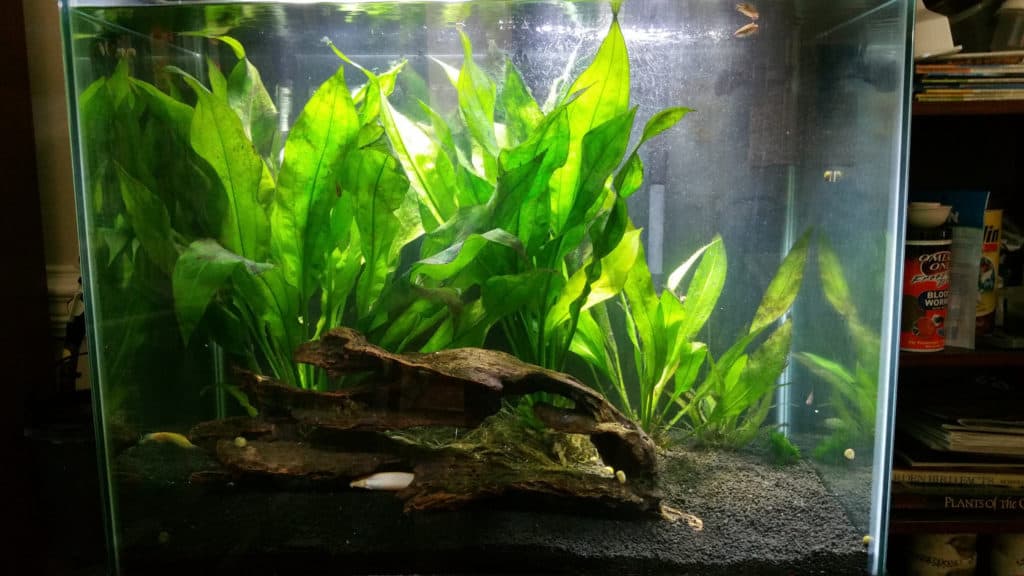
Echinodorus bleheri as a background specimen in a planted aquarium — the broad, bright-green leaves arch outward from a dense central rosette. A single mature plant can fill 30–40 cm of horizontal space and arch well above 40 cm in height, making placement and regular pruning both important from day one. Photo © Aquariadise (aquariadise.com)
Taxonomy: One Name, a Complicated History
The name "Amazon Sword" covers a group of closely related plants that have spent decades being renamed, lumped, and split by botanists. The most important development came from DNA analysis published in Kew Bulletin Vol. 63 (2008), which demonstrated that the three forms most commonly sold in the hobby — previously called Echinodorus amazonicus, Echinodorus bleherae, and Echinodorus grisebachii — are all the same species: Echinodorus grisebachii.[1,2]
A subsequent revision (Christenhusz & Byng) went further, moving the genus itself to Aquarius, making the current botanical name Aquarius grisebachii. The aquarium trade has not widely adopted this and continues using Echinodorus — which is accurate enough for practical purposes.[3]
The genus name comes from Greek: echius (rough husk) and doros (leathern bottle), referring to the prickly seed heads. grisebachii honors August Heinrich Grisebach, a 19th-century German botanist who classified many New World plants. The cultivar name 'Bleherae' honors Heiko Bleher, who introduced that broad-leaved form to European aquaristics.
🌱 Why you'll still see three names on shop labels: Although DNA evidence consolidated them into one species, the three forms — 'Amazonicus' (narrow leaf), 'Bleherae' (broad leaf), and 'Parviflorus' (smaller, darker) — are recognizably different in appearance and tolerate slightly different conditions. The trade retains the old names as cultivar identifiers, not species names. They are all E. grisebachii.[1,2]
The Three Common Variants
Understanding which form you have helps set accurate expectations for tank size, water preferences, and growth habit. All three are amphibious — they grow submersed most of the year in the wild, and only produce aerial leaves and flower stalks during seasonal dry periods when water levels drop.[2]
Narrow Sword
E. g. 'Amazonicus'
Narrow, lance-shaped leaves. Prefers softer water. Height 40–50 cm submersed. Originally from Brazilian Amazon (Rondônia, Pará). Introduced to the trade in 1938. Young leaves show distinctive dark brown veining.
Broadleaf Sword
E. g. 'Bleherae'
Wide leaves (3–6 cm). Tolerates harder water. Can exceed 60 cm and produce 50+ leaves in mature rosettes. The most common form in current trade worldwide. Exact origin unclear — possibly Amazonia.
Small Sword
E. g. 'Parviflorus'
Shorter, darker leaves with reddish veining on new growth. More compact — suitable for midground use in larger tanks. Holds shape better in lower light than the other two forms.
Growth Form & Biology
Echinodorus grisebachii is a rosette plant in the family Alismataceae — the same family as arrowheads and water plantains. It grows from a central crown, producing leaves radially in a spiral pattern. Roots are extensive and fibrous rather than a single taproot, spreading outward as much as downward through the substrate in search of nutrients.
The plant is genuinely amphibious: in its natural habitat along the Amazon River Basin and throughout tropical America (Brazil to Costa Rica, plus Cuba), water levels fluctuate seasonally. During the wet season, plants grow fully submersed. As waters recede in the dry season, they transition to emersed growth with aerial leaves and produce flower stalks. In the aquarium, where water level is constant, the plant remains in submersed growth mode indefinitely — which is exactly what we want.[2,3]
Emersed vs. Submersed Leaf Forms
Most Amazon Swords sold in shops are emersed-grown — produced out of water in nurseries for efficiency. These plants have shorter, stiffer leaves with longer petioles. When placed in a tank, they will drop their emersed leaves over the first two to four weeks and replace them with longer, more flexible submersed leaves with shorter petioles. This transition is completely normal and expected — do not interpret leaf loss during the first month as failure. The new submersed leaves will be noticeably different and significantly more elegant.
Water Parameters & Light
Water parameter reference table
| Parameter | Ideal Range | Tolerance | Notes |
|---|---|---|---|
| Temperature | 72–82°F (22–28°C) | 65–86°F | 18–30°C tolerated; 22–26°C optimal |
| pH | 6.5–7.5 | 6.0–8.0 | 'Bleherae' tolerates harder water than 'Amazonicus' |
| GH | 5–12 °dGH | 2–20 | 'Amazonicus' prefers softer; 'Bleherae' handles harder |
| KH | 3–8 °dKH | 1–12 | Moderate buffer; stable pH important |
| Ammonia / Nitrite | 0 ppm | 0 ppm | Standard; brief spikes cause melt on new leaves |
| Nitrate | 10–30 ppm | 5–50 ppm | Moderate nitrate supports growth; too low slows it |
| Lighting | Medium (50–80 lm/L) | Low–high | Full-spectrum 5000–7000K; 10–12 hr photoperiod |
| CO₂ | Optional | Not required | Accelerates growth and leaf density significantly |
For a detailed explanation of KH, GH, and pH interactions relevant to all freshwater planted tanks, see the Neocaridina Environment Guide.
💡 A note on CO₂: Amazon Swords grow without CO₂ injection — this is one of their best qualities. But CO₂ at 20–30 ppm produces noticeably denser, more vigorous growth and reduces the incidence of algae on leaves by ensuring the plant is outcompeting algae for nutrients. If you already run CO₂ for other plants, the Sword will respond well. If you don't, it will still grow — just more slowly.
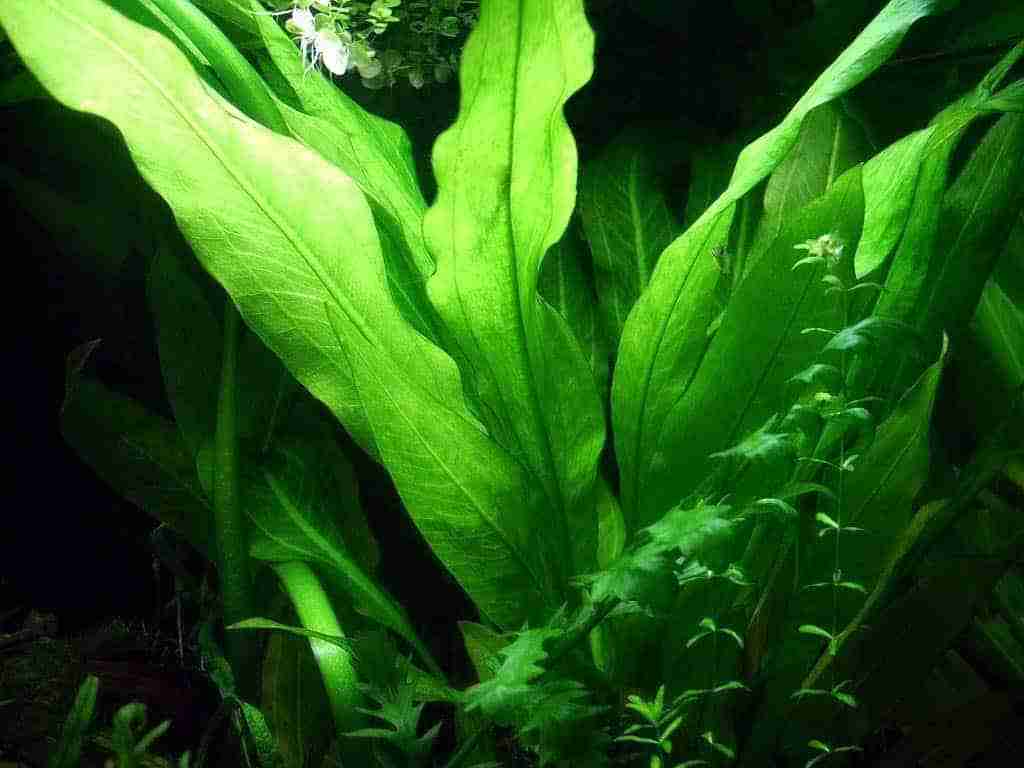
A tall, well-established Echinodorus specimen showing the characteristic rosette growth pattern — leaves emerge from a central crown and radiate outward on long petioles. Note the prominently veined, lanceolate blades and the clean substrate line at the base: burying the crown is the single most common planting mistake and reliably causes melt and rot. Photo © Aquarium Breeder (aquariumbreeder.com)
Substrate & Planting
Amazon Swords are heavy root feeders — the single most important thing you can do for them is provide adequate substrate depth. A minimum of 4 inches is recommended; roots in the right conditions spread laterally as much as the leaf span above. In a nutrient-rich aquarium soil this translates directly into faster growth, darker leaves, and a more compact rosette. In inert substrates (plain sand, gravel), root tabs inserted near the crown every 4–6 weeks supply the iron, potassium, and nitrogen the plant cannot source from water alone.
- Substrate depth: 4 inches minimum. Shallower substrate stunts root development and limits maximum size.
- Crown placement: Keep the crown (where leaves meet roots) at or slightly above the substrate surface. Burying the crown causes rot.
- Position in tank: Midground in large tanks (29+ gallons); background or centerpiece in smaller setups. A mature 'Bleherae' rosette can span 60+ cm across — plan accordingly.
- Securing a new plant: If fish or flow threatens to dislodge it before roots anchor, weight the base loosely with a small stone until rhizoids take hold — usually 2–3 weeks.
⚠️ New plant leaf loss is normal. Emersed-grown plants (most shop stock) will shed their terrestrial leaves over the first 2–4 weeks as they produce submersed growth. This is not a sign of poor health — it is the plant completing a normal morphological transition. Do not remove the plant during this phase.
Fertilization
Nutrient deficiencies show up on the leaves as predictable color signals once you know what to look for. Addressing them early prevents permanent leaf damage and keeps the plant's energy directed toward new growth.
Nutrient deficiency identification guide
| Symptom | Most Likely Deficiency | Fix |
|---|---|---|
| Yellowing new leaves (youngest leaves first) | Iron | Root tabs; iron-containing liquid fertilizer |
| Yellowing old leaves (older leaves first) | Nitrogen or potassium | Root tabs; nitrogen-containing liquid fertilizer |
| Brown leaf tips | Magnesium or potassium | Magnesium supplement; comprehensive fertilizer |
| Pale, washed-out overall color | General nutrient poverty | Root tabs + liquid fertilizer; improve substrate |
| Stunted new growth, distorted leaves | Calcium or CO₂ limitation | Raise GH; consider CO₂ supplementation |
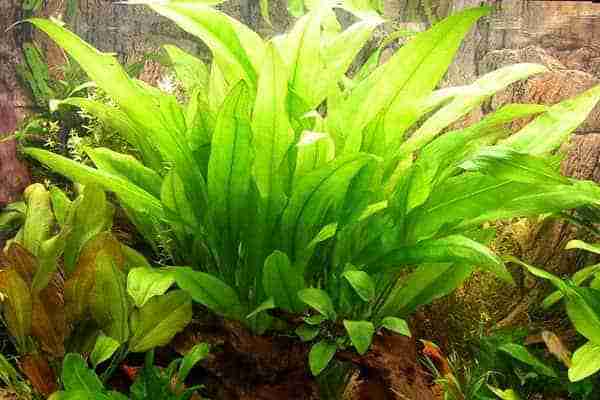
A mature, heavily-established Echinodorus rosette — older specimens can produce 20+ leaves simultaneously and develop an impressive root mass that anchors deep into the substrate. This growth stage is when runner production and adventitious plantlet formation are most prolific, and regular removal of the oldest outer leaves keeps the plant vigorous. Photo © Aquarium Breeder (aquariumbreeder.com)
Propagation via Adventitious Plantlets
One of the Amazon Sword's most practical traits is spontaneous propagation. When the plant produces an inflorescence stalk — a long stem that arches out from the crown — small plantlets form at intervals along it. In submersed conditions the stalk does not flower but instead produces these daughter plants directly. Once each plantlet has developed at least 3–4 leaves and visible root nubs, it can be detached and planted independently.
- Leave the youngest plantlets: Work from the tip of the stalk inward, taking the outermost (oldest) plantlets first and leaving younger ones to mature.
- Do not rush separation: A plantlet with only 1–2 leaves and no visible roots will struggle. Wait until you can see white root nubs at the base.
- Anchor new plants: Young swords have minimal root mass. A small stone resting against the base holds them in place while roots establish over 2–3 weeks.
- CO₂ helps juvenile establishment: A brief increase in CO₂ during the first few weeks after planting a daughter plant accelerates the transition from runner-dependent to self-sustaining.
Amazon Sword with Shrimp & Fish
Amazon Swords are fully compatible with all dwarf shrimp. Neocaridina and Caridina species including Blue Bolts use the broad leaves as grazing surfaces — biofilm and microalgae colonize the underside of mature leaves continuously, creating a perpetual foraging site. Shrimplets use the dense leaf structure for shelter during their most vulnerable early weeks.
Ramshorn Snails and other cleanup crew members graze leaf surfaces without damaging the plant, supplementing shrimp grazing and reducing algae buildup. Angelfish are famous for selecting broad Amazon Sword leaves as spawning sites — a relationship so common it's practically part of the plant's ecological identity in the hobby.
Avoid housing Amazon Swords with goldfish, large herbivorous cichlids, or most plecos — these fish will actively eat or uproot the plant. Common plecos (as opposed to smaller bristlenose plecos) are especially destructive, rasping into the leaves rather than grazing the surface.
Aquascaping with Amazon Swords
The Amazon Sword's strong visual presence gives it a specific role in the aquascape: it anchors and provides scale. Its bold, upright rosette creates a natural focal point that smaller-leaved plants like Java Moss and stem plants benefit from contrasting against. Some effective approaches:
- Background anchor: A single large 'Bleherae' in the rear center creates a layered depth effect. Pair with driftwood from the Hardscape Collection and low foreground plants.
- South American biotope: Combine with hardscape stones and driftwood, botanicals, and a dark substrate for a naturalistic Amazon floodplain setup. The Sword is an authentic component of this ecosystem.
- Shrimp colony anchor: Position the Sword in the midground of a shrimp tank. The leaf understories become dense with biofilm; the stem structure provides shrimplets with a multilevel refuge that Java Moss alone doesn't replicate.
Troubleshooting
- Yellowing leaves on a newly planted sword — Most likely the normal emersed-to-submersed transition, not a deficiency. Wait 3–4 weeks and assess only the new submersed growth. If new leaves also yellow, add root tabs and check lighting duration.
- All leaves yellowing on an established plant — Nutrient starvation. Insert root tabs within 5 cm of the crown. If growth doesn't resume within 3 weeks, add a comprehensive liquid fertilizer. Check that substrate depth is at least 4 inches — shallow substrate limits nutrient uptake even when fertilizers are present.
- Brown or transparent patches on leaves — Physical damage (fish, flow, snails rasping too aggressively) or localized nutrient burn from a root tab placed too close to the root mass. Trim damaged leaves at the base; reposition root tabs to 5–8 cm from the crown.
- Algae covering the broad leaves — Reduce photoperiod to 8 hours and check for nutrient imbalance. A plant growing vigorously outcompetes leaf algae naturally; algae on leaves often signals the plant is growing slowly due to low nutrients or insufficient light. Add Ramshorn Snails as supplemental algae grazers on leaf surfaces.
- Plant not growing after months in the tank — Usually substrate depth, light, or nutrient limitations — often all three together. Confirm 4+ inch substrate depth, increase photoperiod to 10–12 hours with a quality full-spectrum LED, and begin a root tab regimen. CO₂ injection is the single biggest growth accelerant if the above are already in order.
- Crown rotting at the base — Crown was buried too deep. Replant immediately with the crown at or above substrate level. Trim any rotting tissue with clean scissors before replanting.
Shop the Essentials
Plant the Foundation of Your Aquascape
Add shrimp, hardscape, and a quality substrate — and the Amazon Sword does the rest.
Sources & Citations
- [1]Lehtonen, S. & Myllys, L. (2008). Cladistic analysis of Echinodorus (Alismataceae): simultaneous analysis of molecular and morphological data. Kew Bulletin Vol. 63: 525–563. DNA evidence consolidating E. amazonicus, E. bleherae, and E. grisebachii as one species.
- [2]Aquasabi GmbH. Echinodorus grisebachii 'Bleherae' and 'Amazonicus' profile pages. Variant descriptions, leaf dimensions, amphibious growth habit, trade history. aquasabi.com
- [3]Wikipedia contributors. Echinodorus. Genus taxonomy, Alismataceae placement, Aquarius grisebachii reclassification. en.wikipedia.org
- [4]Tropical Fish Hobbyist Magazine. Echinodorus grisebachii species profile. Variant height differences; water tolerance by form. tfhmagazine.com
- [5]Superior Shrimp & Aquatics. Creating the Perfect Environment for Neocaridina Shrimp. superiorshrimpaquatics.com
- [6]Superior Shrimp & Aquatics. Java Moss Complete Guide. superiorshrimpaquatics.com