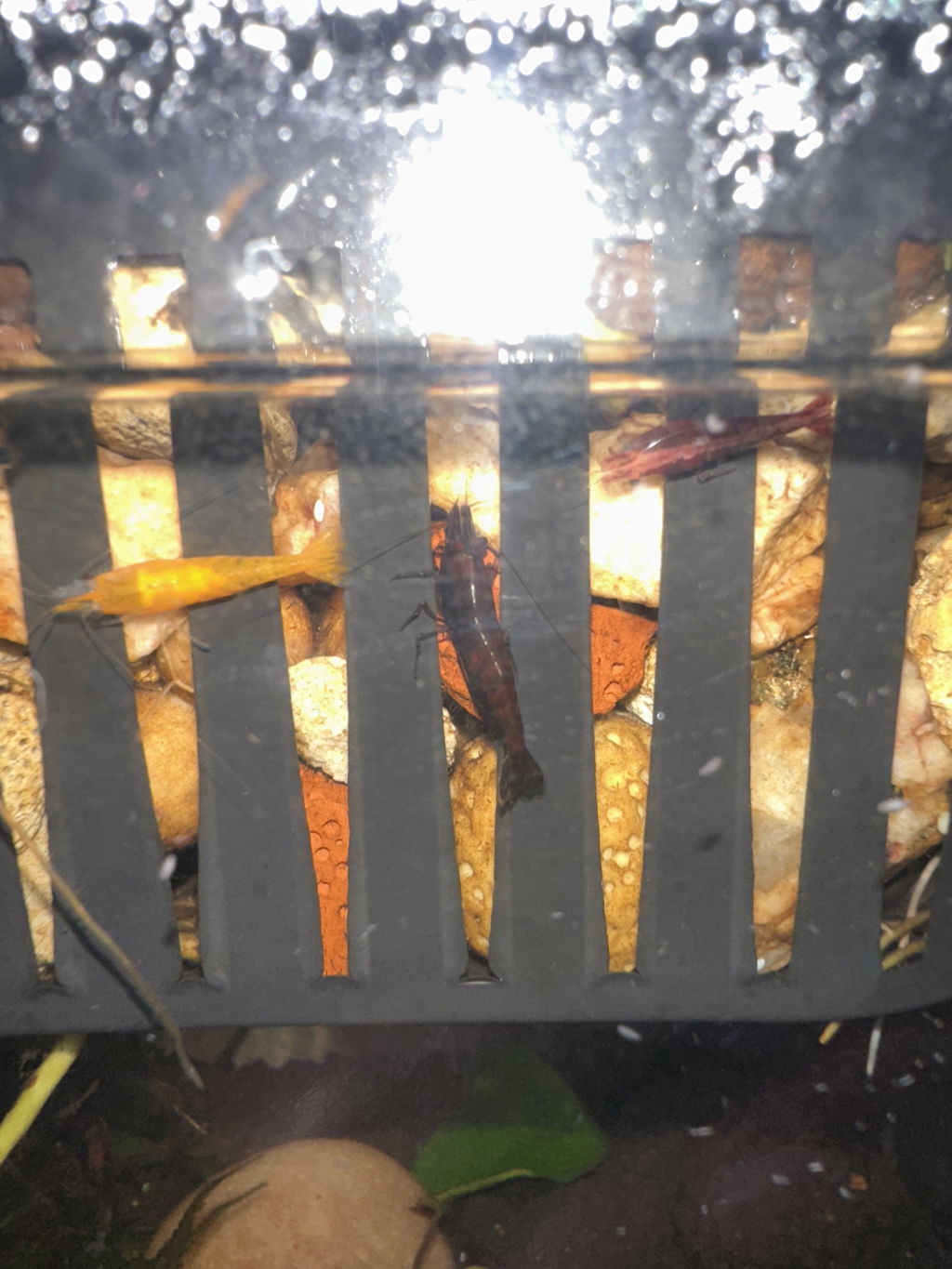
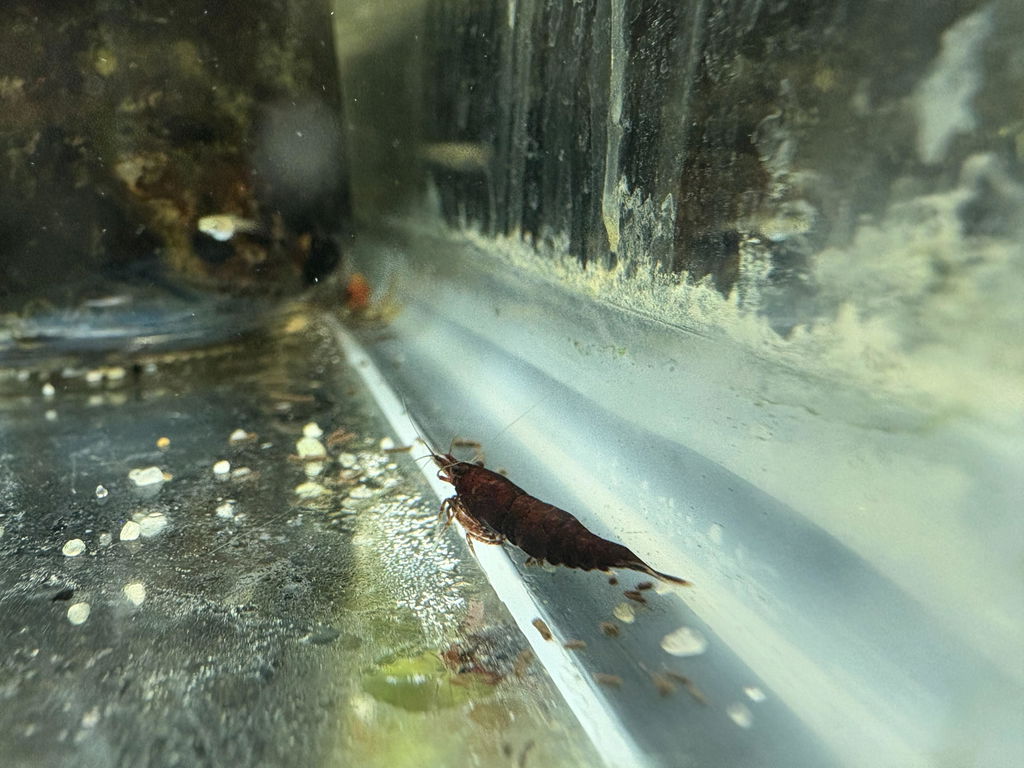
Red Onyx Shrimp are a selectively bred Neocaridina line that combines deep red, black, and areas of reduced pigmentation in a marbled, irregular pattern that gives each individual a darker and more complex colour character than the solid red morphs in the catalog. Where Bloody Mary and Dark Bloody Mary carry an even, opaque red across the full body, Red Onyx introduces dark marbling and black pigment zones that break up the solid colour and give the animal a multi-toned, gemstone-like appearance -- the deep red of the Bloody Mary line overlaid with dark banding and mottling that varies between individuals, producing a colony where each animal shares the same colour vocabulary but arranges it differently. The combination of vivid red, near-black marbling, and the slight translucency between pigment zones where the body tissue shows through creates a visual depth in each individual that single-colour morphs cannot achieve. Hardy, beginner friendly, and breeding freely in freshwater in the same conditions as any other Neocaridina. Do not house with other Neocaridina colour variants to preserve colour quality across generations.
6.8-7.8pH
6-14GH
2-8KH
65-78FTemperature
What to Expect
Colour, Pattern and Behaviour
Deep red body with black marbling -- multi-toned and complex -- the defining characteristic of Red Onyx versus solid red Neocaridina is the dark marbling that overlays the red base body. The black or near-black pigment zones appear as irregular patches, streaks, or banding across the carapace and abdomen in a distribution that differs between individuals. The result is a shrimp that reads as darker and more visually complex than solid Bloody Mary at a glance -- the black marbling absorbs light where the solid red reflects it, creating contrast within a single animal.
Translucent windows between pigment zones add depth -- in areas between dense red and black pigment zones, the body tissue appears slightly translucent -- the internal organs or the lighter tissue beneath the pigment layer showing through in a way that adds a third tonal element to the pattern. This translucency is not a colour deficiency but a structural quality of the pattern that contributes to the gemstone or onyx-like visual character the line is named for.
Individual variation across the colony -- no two identically marked -- the irregular distribution of red and black pigment means each individual in a Red Onyx colony carries a unique pattern. The colony reads as visually varied at the individual level rather than uniform -- a quality shared with Koi pattern Neocaridina but in a more restrained, darker, and more sophisticated colour palette.
Colour deepens with selective breeding across generations -- as with all selectively bred Neocaridina, the depth of the red, the intensity of the black marbling, and the overall complexity of the pattern improve progressively with each generation produced under stable conditions. Selecting the most intensely coloured and most clearly marbled individuals as breeding stock moves the colony toward deeper, more vivid expressions of the Red Onyx pattern over successive generations.
Dark substrate maximises colour contrast and depth of field -- the red-and-black pattern reads most dramatically against dark substrate. On pale substrate the red tones blend with the background and the dark marbling loses the contrast it has against the red body -- the full depth of the pattern is only visible when the shrimp is seen against a dark background.
Beginner friendly -- full Neocaridina hardiness and tolerance -- Red Onyx carry no additional fragility from their enhanced colour selection. They are as hardy and parameter-tolerant as any other Neocaridina and fully appropriate for beginner keepers setting up a first shrimp tank.
How to Set It Up
Getting Started
1Dark substrate and established biofilm before introduction -- black aquasoil or dark sand, pH 7.0-7.4, GH 6-8, KH 3-5, temperature 72-75F. Run for at least one week before introduction, test daily to confirm stability.
2Drip acclimate over 45-60 minutes -- float the bag for 15 minutes to temperature-equalise, then drip tank water at one drop per second for 45-60 minutes before release.
3Dense moss and floating plant cover from day one -- Java Moss, Flame Moss, or Christmas Moss provides biofilm foraging and shrimplet shelter from the first breeding cycle. Floating plant cover reduces surface light intensity and provides additional cover at the water surface.
4Feed varied diet and select darkest-marbled offspring as breeders -- varied feeding -- comprehensive staple food, occasional blanched vegetables, biofilm -- supports colour development. When the colony produces offspring, observe developing juveniles and identify individuals with the most pronounced marbling contrast as candidates for the next breeding generation.
Bonus TipRed Onyx shrimp alongside Blue Diamond or Blue Velvet Neocaridina in adjacent tanks creates a warm-cool display pairing where the dark, complex red-and-black of the Red Onyx contrasts with the cool, even blue of the Blue Diamond. The multi-toned complexity of the Red Onyx pattern reads as more visually layered than the solid red morphs when viewed against a solid blue reference -- the marbling and depth of the Onyx pattern is more apparent by comparison.
🦐
Browse more Neocaridina shrimpPair Red Onyx with Blue Diamond, Dark Bloody Mary, or other Neocaridina for a display colony. Browse our Neocaridina Shrimp collection.
→