Orange Juice ‘Rotala Rotundifolia’ | Aquatic Plants – Superior Shrimp & Aquatics
Skip to content

15% OFF STORE WIDE! ENDS MARCH 15TH

Sign In

Orange Juice (‘Rotala Rotundifolia 'Orange Juice’)

Orange Juice (‘Rotala Rotundifolia 'Orange Juice’)

Regular price $8.00
Regular price Sale price $8.00
Sold out
Shipping calculated at checkout.
Amount: Bunch

Sub total:

$8.00
View full details
Description
Rotala 'Orange Juice' – Superior Shrimp & Aquatics
Aquatic Plants

Rotala 'Orange Juice'

A warm orange-to-amber stem plant that delivers vivid color in low-tech conditions — one of the most accessible colored stem plants available without CO₂.

Warm Orange-Amber Coloration Stem Plant — Plant in Substrate CO₂ Enhances but Not Required Medium to High Light Fast Growing Shrimp Safe

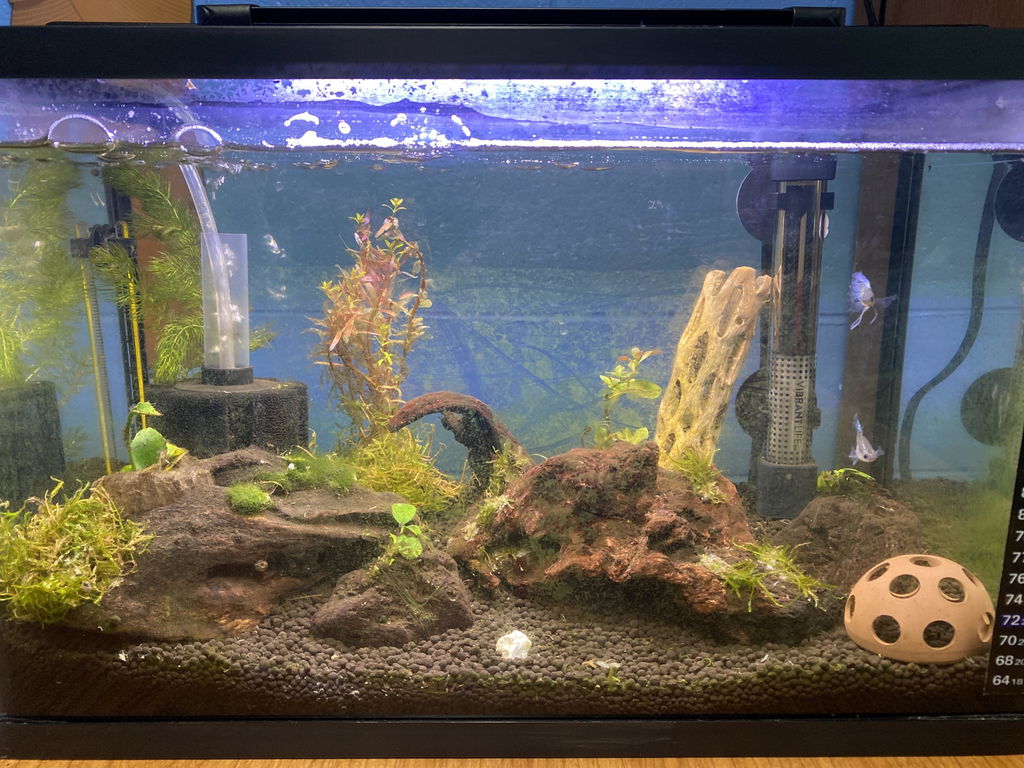
Rotala rotundifolia 'Orange Juice' is a cultivar selected for warm orange-to-amber coloration that expresses more readily and at lower light intensities than most colored Rotala varieties — making it one of the most accessible genuinely warm-toned stem plants available to planted tank keepers who are not running CO₂. The small, rounded leaves sit in whorls along slim upright stems and shift from green-orange in lower light to rich, saturated amber-orange under brighter conditions and with iron supplementation, producing a warm color accent in the midground or background that stands in direct contrast to the greens, teals, and blue-tinged plants that dominate most low-tech plant collections. It grows readily from cuttings, fills in quickly when planted in groups, and responds to trimming by branching and bushing out rather than simply continuing to grow taller — giving the keeper meaningful control over the plant's shape over time. Fully safe with all Neocaridina and Caridina shrimp.

Enhances CO₂
72–82°F Temperature
Med–High Lighting

Growth & Color Over Time

Warm orange-to-amber color that responds to light and iron — 'Orange Juice' expresses its characteristic warm tone across a spectrum from green-orange in lower or newer-growth conditions to deep, saturated amber-orange under medium-high light with consistent iron dosing. Unlike many red and orange Rotala varieties that require CO₂ to color up meaningfully, 'Orange Juice' produces visible, attractive warm tones under medium light without CO₂ — the color is present and real even in low-tech conditions, simply more vivid and consistent with improved parameters. Small rounded leaves in whorls along slender upright stems — the leaves are small and broadly oval, arranged in opposite pairs or loose whorls that give the stem a delicate, fine-textured appearance when viewed as a group. The slim stems and small leaf size mean a group of 'Orange Juice' stems planted together reads as a soft, textured mass of warm color rather than a collection of individual bold plants — a quality that integrates well into midground and background positions without dominating. Faster growth rate than most epiphytes — requires active trimming — as a stem plant, 'Orange Juice' grows from the tips upward and puts on noticeable length over days to weeks under good conditions. Unlike the slow-growing rhizome plants that dominate the rest of this catalog, Rotala requires regular trimming to maintain shape and prevent the lower stems from losing leaves as light is shaded out by upper growth. Trimming is the primary ongoing maintenance task and also the mechanism for shaping and densifying the planting over time. Cuttings root readily and propagate the planting — trimmed stem sections can be replanted directly into the substrate immediately after cutting, where they root within days and resume upward growth. Each trimming session is also a propagation opportunity — a single initial bunch of stems becomes a progressively denser, wider planting over successive trim-and-replant cycles without purchasing additional plants. Lower stems left in place after trimming typically branch and produce two or more new shoot tips from the cut point. Iron and micronutrient supplementation deepens color expression — the orange coloration of 'Orange Juice' is most vivid and most consistent when iron and micronutrients are available in the water column. In tanks with no liquid fertilization routine, the plant may remain in the green-orange range even under good light. Adding a balanced liquid fertilizer with iron two to three times per week produces a noticeable shift toward the deeper amber-orange end of the color spectrum within weeks of starting supplementation. Plant in groups for maximum visual impact — a single stem of 'Orange Juice' is easy to overlook; a group of seven to twelve stems planted together creates a warm, cohesive color block that reads clearly from across the tank and provides the kind of structural midground or background presence that makes a planted layout feel composed. The warm amber-orange of the group provides the most contrast against cool-toned greens, blues, and teals — position adjacent to or behind Anubias, Bucephalandra, or Java Fern for maximum effect.

Getting Started

1 Plant stems in groups directly into substrate — remove the bottom 2–3cm of leaves from each stem to expose bare stem, then push each stem 2–3cm into the substrate, spacing stems 1–2cm apart. Planting in a cluster rather than a scattered single-file line produces a more natural-looking and visually cohesive result. A nutrient-rich substrate or root tabs placed near the planting site supports faster establishment and stronger initial growth.
2 Position in medium to high light — place 'Orange Juice' in a position that receives your tank's strongest lighting — typically midground to background, directly under the light fixture rather than at the shaded edges. The orange color expression is directly tied to light intensity: the more light the plant receives, the warmer and more saturated the color. In lower-light positions the plant remains green-orange and grows more slowly but does not die.
3 Establish a liquid fertilizer routine from the start — begin dosing a balanced liquid fertilizer with iron at or shortly after planting. Rotala 'Orange Juice' responds visibly and relatively quickly to iron supplementation — starting the routine early produces better-colored growth from the first new stems rather than requiring a correction period after pale growth has already occurred. Dose two to three times weekly at the manufacturer's recommended rate.
4 Trim before stems reach the surface and replant cuttings — once stems approach the surface or begin to shade lower portions of the planting, trim the top third to half of each stem and replant the cuttings immediately in front of or beside the existing planting. This trim-and-replant cycle is the primary mechanism for building a dense, bushy 'Orange Juice' planting over time — each cycle adds density and width while keeping the coloration vivid by ensuring all stems receive adequate light to the lower leaves.
💡 Bonus Tip

'Orange Juice' planted directly behind a group of deep-green Anubias barteri or a piece of driftwood planted with dark-toned Bucephalandra is one of the simplest and most effective color contrast arrangements in the low-tech planted hobby — the warm amber-orange of the Rotala against the cool, deep green of the Anubias or Buce creates an immediate, natural-looking warm-cool contrast that requires no CO₂, no aquascaping skill, and no expensive equipment to achieve.

🌿
Browse more aquatic plants

Pair 'Orange Juice' with Anubias, Bucephalandra, or other stem plants for a complete warm-cool planted layout. Browse our Aquatic Plants collection.

Before placing your order, please review our 📋 DOA Policy 🚚 Shipping Info
Reviews

Customer Reviews

Based on 2 reviews
100%
(2)
0%
(0)
0%
(0)
0%
(0)
0%
(0)
A
Anonymous
Beautiful plant

Beautiful plant. It is doing very well in my startup tank. I am “building” a 5.5 shrimp tank in my reading classroom. The kids and I are loving it!

N
Natasha Conrad
Amazing

Doing great

Home Shop
Wishlist
Log in