


You will not be allowed to compare more than 4 products at a time
View compareShipping Weather Check
Enter your ZIP for a 14-day forecast at your delivery address. We ship Monday–Wednesday. Wednesday livestock shipments require overnight or 2-day shipping. Live shrimp and aquatic livestock are sensitive to temperature extremes during transit.
Loading forecast...
View 14-day forecast
Safe
Caution
High risk
Transit window
Forecast data from Open-Meteo. Thresholds reflect typical livestock tolerances and are guidance only. We check conditions on both ends before every shipment and will reach out if a delay is warranted.
Blueberry Snail
Blueberry Snail
<p>Earn%20[points_amount]%20when%20completing%20this%20purchase.</p>
This product is currently unavailable. Browse related products.
Sub total:
$12.00Useful add-ons
Loading add-ons…

Description
Reviews
Description
Freshwater Snails
Blueberry Snail
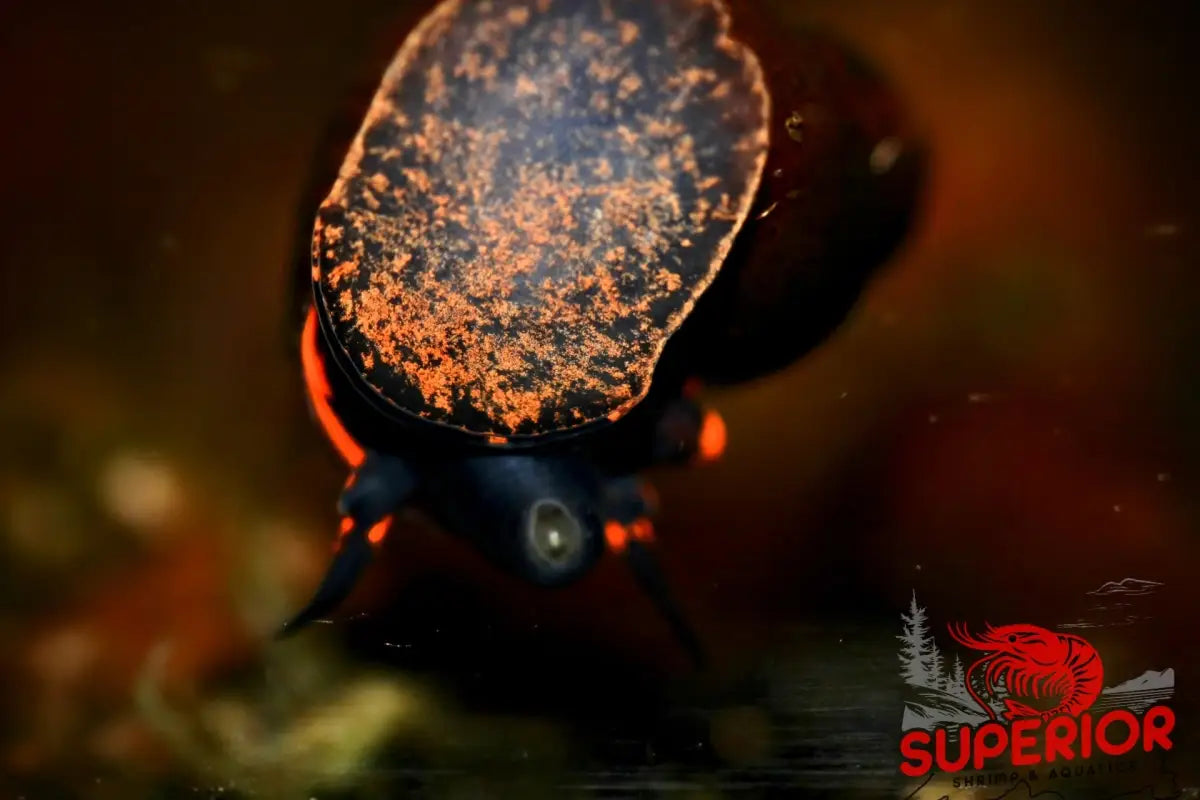
Brown-black shell over a vivid blue body speckled with orange — a live-bearing Viviparus with more color than its name suggests.
Blue Body with Orange Speckles Live-Bearing Species Operculum Equipped Algae & Biofilm Grazer Shrimp Safe Beginner Friendly
The Blueberry Snail (Viviparus sp.) is a live-bearing freshwater snail whose name makes more sense once you see the body — a vivid blue soft body speckled with orange that peeks out beneath a deep brown-black shell. The shell itself is smooth, rounded, and dark, but when the snail is active and fully extended the blue and orange body is on full display, making this one of the more colorful freshwater snails available despite its understated shell. Like all Viviparus, it carries an operculum for protection and health assessment, gives birth to fully formed juveniles at a slow, manageable rate, and spends its days grazing methodically across plant surfaces, substrate, and hardscape. Fully shrimp-safe and compatible with all Neocaridina and Caridina setups.
7.0–8.0 pH Range
GH 6–15 General Hardness
KH 3–10 Carbonate Hardness
65–78°F Temperature
Appearance & Behavior Over Time
Brown-black shell, vivid blue body speckled with orange — the rounded shell is a smooth, deep brown-black that sits understated above the real visual story: a vivid blue soft body covered in orange speckles that becomes fully visible when the snail is active and extended. The combination of the dark shell and the colorful body beneath it is where the name Blueberry comes from — and what makes this snail genuinely distinctive in the tank compared to most other freshwater snail species. Operculum as a health and vitality indicator — a healthy Blueberry Snail seals its operculum flush against the shell opening when disturbed or retracted. A snail that cannot or does not seal its operculum, or one that hangs limply from its shell, may be stressed or declining. The operculum is the most reliable non-invasive health check for any Viviparus. Slow, manageable reproduction — as a live-bearing species, Viviparus produces fully formed juvenile snails rather than egg masses, and does so gradually. Population growth is self-limiting under normal tank conditions and overpopulation is not a concern with this species. Deliberate, methodical grazer — the Blueberry Snail moves steadily across substrate, glass, hardscape, and plant surfaces, consuming algae, biofilm, and organic detritus as it goes. Most active during low-light periods and after lights out, though visible grazing during the day is common in established tanks. Shell requires adequate mineral support — soft or acidic water causes progressive shell pitting and erosion. Moderately hard, slightly alkaline water in the pH 7.0–8.0 range with KH 3–10 supports strong, intact shells and long-term health. Avoid pure RO water without remineralization. Pairs naturally with the Orange River Snail — the deep dark shell of the Blueberry Snail and the warm rounded orange of the Orange River Snail create a strong visual contrast in the same tank — two Viviparus variants with identical care requirements but completely opposite color characters that complement each other naturally in any planted setup.
How to Set It Up
Getting Started
1 Acclimate slowly to the new tank — float the bag for 15 minutes to equalize temperature, then add small amounts of tank water over 20–30 minutes before releasing. Viviparus are sensitive to abrupt parameter changes and benefit from a patient, gradual acclimation process.
2 Maintain stable, moderately hard water — target pH 7.0–8.0 with GH 6–15 and KH 3–10. Consistent mineral levels are the most important long-term care factor for shell integrity and overall health. Avoid soft or acidic setups without adequate remineralization.
3 Provide a varied food source — the Blueberry Snail grazes naturally on algae and biofilm but benefits from supplemental algae wafers or blanched vegetables when natural food sources run low, particularly in newer tanks with less established biofilm.
4 Use sand or fine gravel substrate — fine-grained substrate allows natural movement and effective substrate grazing. Coarse gravel can impede movement and may trap juvenile snails between particles as they develop.
💡 Bonus Tip
The operculum check is the most reliable way to determine whether a motionless Blueberry Snail is alive — a living snail seals its operculum firmly against the shell opening when retracted, while a deceased snail will have a loose or missing operculum and will typically produce a noticeable odor within 24 hours. When in doubt, check the operculum before removing the snail from the tank.
Complete the setup with live plants
→
Plants provide essential hiding spots and enhance the natural look of your tank, creating a healthier, more enriching environment for your snails and shrimp. Browse our Aquatic Plants collection.