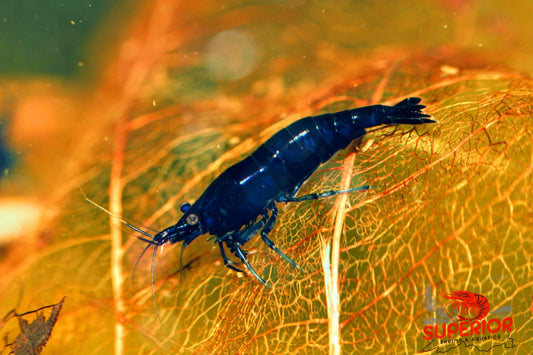
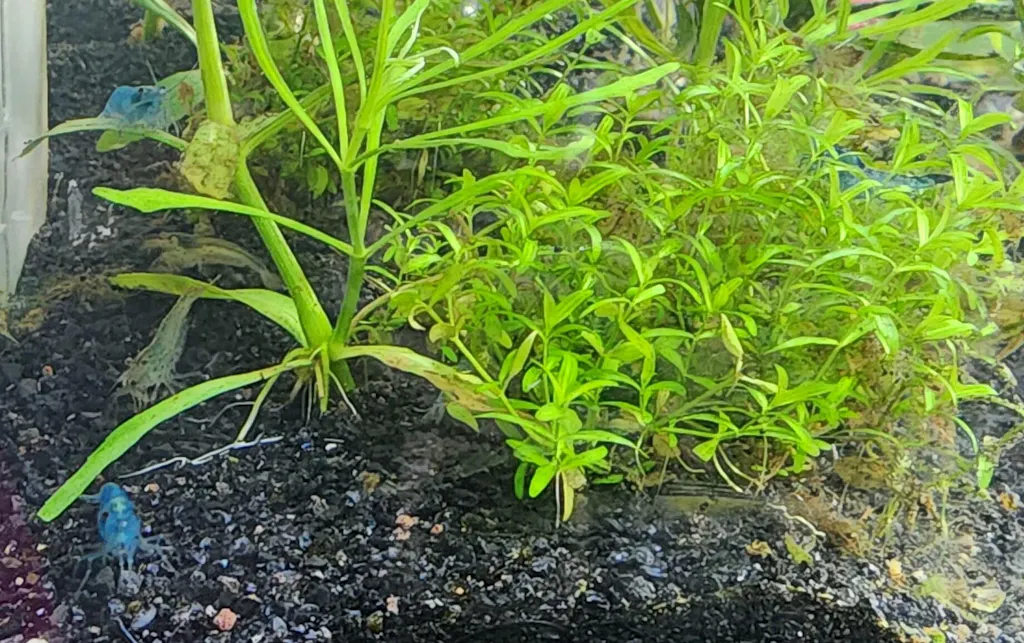
Blue Jelly Shrimp are a Neocaridina colour variant occupying the palest end of the blue spectrum -- a light, translucent blue body with a jelly-like, slightly glowing quality that results from the combination of partial body translucency and pale blue pigmentation. Where Blue Velvet and Blue Diamond carry progressively deeper and more opaque blues selected for saturation and coverage, Blue Jelly carries a deliberately lighter, more translucent expression -- the pale blue reads as cool, clean, and somewhat luminous rather than vivid and saturated. The jelly quality comes from the light passing through the semi-transparent body tissue tinted by the pale blue pigment, giving each shrimp a slightly lit-from-within appearance that solid-colour morphs cannot achieve. A distinct aesthetic contribution to a multi-colour Neocaridina display alongside deeper-coloured companions. Hardy, beginner friendly, breeds freely in freshwater. Do not house with other Neocaridina colour variants.
6.8-7.8pH
6-14GH
2-8KH
65-78FTemperature
What to Expect
Colour Character and Behaviour
Pale translucent blue with a jelly-like luminous quality -- the defining characteristic of Blue Jelly is not saturation but translucency -- the pale blue pigment combined with semi-transparent body tissue creates a colour effect that reads differently depending on the light angle and the substrate beneath the shrimp. Against dark substrate the pale blue reads as a cool glowing presence; against pale substrate the translucency becomes more apparent and the jelly quality is most visible. The colour is immediately recognisable as different from the deeper blues in the catalog despite the shared colour temperature.
Lightest blue in the Neocaridina catalog -- a different aesthetic from Blue Velvet and Blue Diamond -- Blue Jelly occupies a distinct aesthetic position from Blue Velvet and Blue Diamond. The progression from Blue Jelly through Blue Velvet to Blue Dream to Blue Diamond is a progression from translucent-pale to opaque-deep within the blue Neocaridina spectrum -- four distinct colour expressions sharing a colour temperature but presenting very different visual characters. Blue Jelly is the ethereal end of that spectrum; Blue Diamond is the jewel end.
The translucency is a characteristic, not a quality deficiency -- the pale, translucent quality of Blue Jelly is a selected characteristic of the morph, not a sign of poor colour or poor grade. Internal organs are partially visible through the body tissue in well-lit conditions -- this is the intended colour expression of the Blue Jelly line, not an indicator of an under-developed colour line.
Dark substrate shows the pale blue most clearly; pale substrate emphasises the jelly quality -- both substrate choices produce attractive results but different visual presentations. On dark substrate the pale blue reads as a cool colour against a dark background and the glowing quality is most apparent. On pale or white substrate the overall colour appears lighter and the translucency of the body tissue is most visible, producing the most pronounced jelly effect.
Hardy and beginner friendly -- full Neocaridina tolerance -- Blue Jelly carry the same broad parameter tolerance and robust constitution as all Neocaridina. The pale colour does not indicate reduced hardiness.
How to Set It Up
Getting Started
1Dark substrate and stable parameters before introduction -- black aquasoil or dark sand, pH 7.0-7.4, GH 6-8, KH 3-5, temperature 72-75F. Run for at least one week and confirm stability with daily testing before introduction.
2Drip acclimate over 45-60 minutes -- float bag for 15 minutes to temperature-equalise, then drip tank water at one drop per second for 45-60 minutes before release.
3Dense moss and established biofilm surfaces before shrimp arrive -- Java Moss, Christmas Moss, or Flame Moss provides biofilm foraging and shrimplet shelter from the first breeding cycle.
4Feed varied diet and observe colony appetite as a health indicator -- comprehensive sinking food every one to two days, remove uneaten portions within two hours. Consistent appetite across the full colony is a reliable indicator of good overall health.
Bonus TipBlue Jelly alongside SSS Sunkist or Blood Orange Neocaridina in adjacent display tanks creates the most contrast between the cool luminous quality of the pale blue and the warm, fully opaque saturation of vivid orange -- the two colour characters are maximally opposite in both colour temperature and opacity, making each appear more distinctive by comparison with the other.
🦐
Browse more Neocaridina shrimpPair Blue Jelly with Blue Velvet, Blue Diamond, or warm-toned Neocaridina for a blue-spectrum display. Browse our Neocaridina Shrimp collection.
→