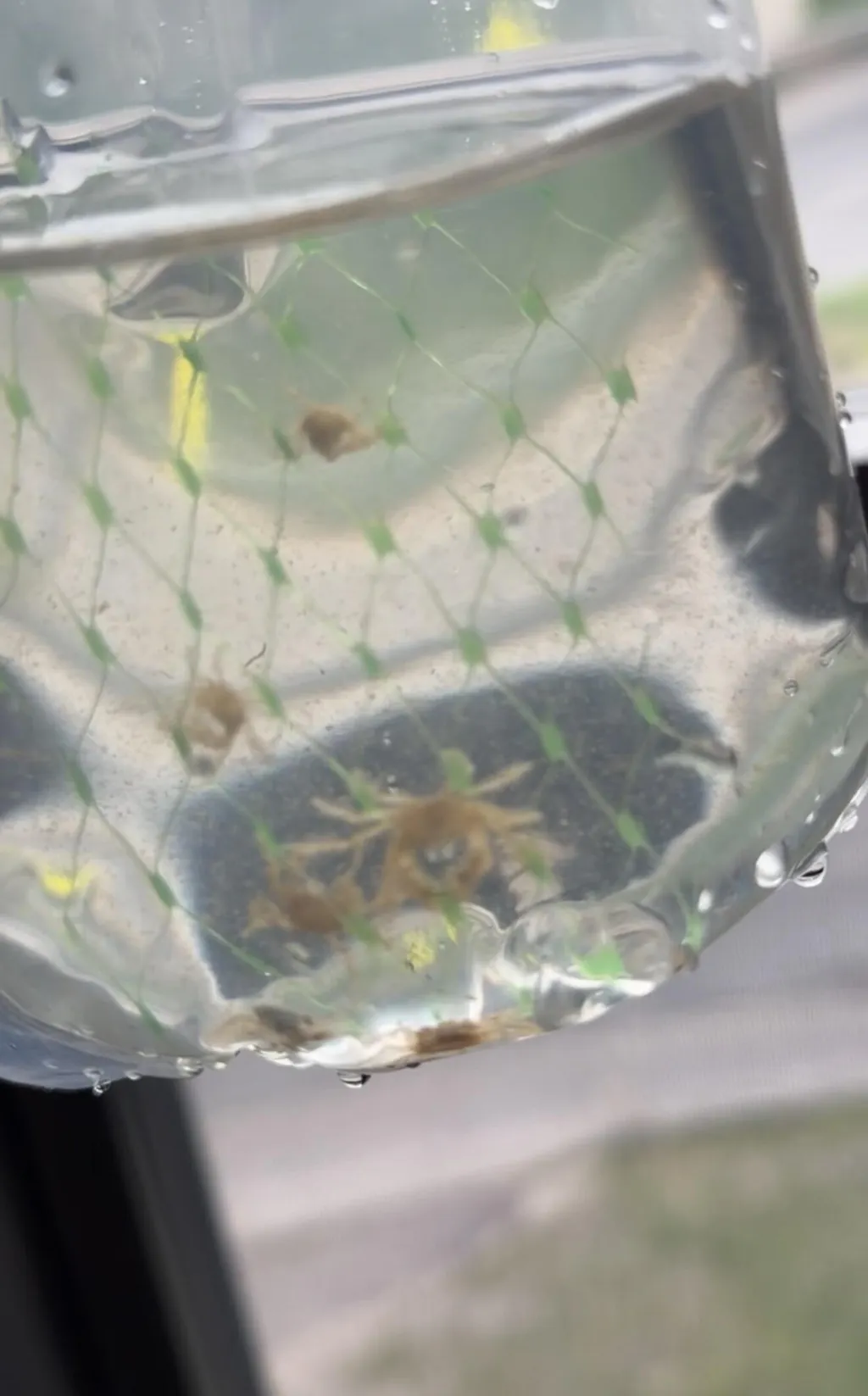
Thai Micro Crabs (Limnopilos naiyanetri) | Crab Freshwater Aquarium – Superior Shrimp & Aquatics
Skip to content

Sign In

Shipping Weather Check

Enter your ZIP for a 14-day forecast at your delivery address. We ship Tuesdays (orders by 1 PM) and Wednesdays (dry goods + 2-day or overnight only). Live shrimp and aquatic livestock are sensitive to temperature extremes during transit.

Thai Micro Crabs (Limnopilos naiyanetri)

Thai Micro Crabs (Limnopilos naiyanetri)

Regular price $37.50
Regular price Sale price $37.50
Sold out
Shipping calculated at checkout.
Pack Size: 5

Sub total:

$37.50
View full details
Description
Thai Micro Crab – Superior Shrimp & Aquatics
Freshwater Crabs

Thai Micro Crab

One of the smallest freshwater crabs in the world — a fully aquatic, plant-safe filter feeder that lives permanently submerged and coexists peacefully with shrimp.

Limnopilos naiyanetri Under 1cm Carapace Width Fully Aquatic Plant Safe Shrimp Compatible Passive Filter Feeder

The Thai Micro Crab (Limnopilos naiyanetri) is one of the smallest freshwater crabs in the world and one of the most unusual invertebrates available to the planted tank hobby. Native to a single river system in Thailand, Thai Micro Crabs are fully aquatic — unlike most freshwater crabs that require land access or brackish water to complete their life cycle, these crabs live, feed, molt, and reproduce entirely submerged in freshwater. They remain under 1cm in carapace width at full size, making them genuinely nano-appropriate and invisible as a threat to any tank inhabitant larger than newly hatched fry. Their feeding strategy is equally unusual: rather than scavenging or hunting, they extend feathery, hair-covered legs and claws to passively collect fine particles, biofilm, and microorganisms suspended in the water column — a filter-feeding behavior more reminiscent of a fan shrimp than a crab. Safe with adult Neocaridina, Caridina shrimp, and all plants.

7.0–8.0 pH
8–15 GH
2–8 KH
72–82°F Temperature

Behavior & Appearance

Exceptionally small — carapace under 1cm at full size — Thai Micro Crabs are genuinely tiny. The carapace of a fully grown adult is smaller than a fingernail, and the total leg span of even a large individual is modest by any standard. Their size makes them easy to miss in a planted tank initially — they tend to position themselves on plant leaves, fine-branched hardscape, and moss where their coloration and scale blends naturally into the environment. Fully aquatic — no land access required — this is the characteristic that separates Thai Micro Crabs from almost every other freshwater crab in the hobby. They do not need to leave the water, do not climb, and do not require a terrestrial zone or emersed area in the tank. A standard fully submerged planted tank setup is entirely appropriate, and no tank modifications for land access are necessary or useful. Passive filter feeding using feathered legs and claws — Thai Micro Crabs do not actively hunt or scavenge in the manner of most crabs. Instead they extend their legs and specialized claws — covered in fine, feather-like setae — and hold them outstretched in the water current to passively collect fine organic particles, biofilm fragments, and microorganisms. This feeding behavior is most visible when the crab is positioned on a plant leaf or piece of driftwood with legs extended into open water, moving gently with the current. Compatible with adult Neocaridina and Caridina shrimp — Thai Micro Crabs are too small to threaten adult Neocaridina or Caridina shrimp and coexist with them peacefully in practice. They share the same parameter preferences broadly and occupy a different behavioral and foraging niche — the crabs filter-feed from elevated positions on plants and hardscape while shrimp graze substrate and leaf surfaces below. Very small shrimplets may be at marginal risk but this is rarely observed in practice in a well-planted tank. Cryptic and easily overlooked in planted tanks — Thai Micro Crabs are not an active display animal in the way CPOs or large shrimp are. Their small size, tendency to stay still for extended periods while filter feeding, and preference for positions on plant leaves and fine-branched hardscape makes them easy to miss in a densely planted tank. Keeping a group of six or more significantly improves visibility — with enough individuals in the tank, at least a few will reliably be in observable positions at any given time. Requires a tightly covered tank — escape risk is real — Thai Micro Crabs are fully aquatic but will climb filter intakes, airline tubing, and equipment cables extending to the surface, and can exit through very small gaps in tank covers. A tight-fitting lid with no meaningful gaps, covered filter intake tubes, and no external equipment that provides a climbing route to the surface are essential. Loss through escape is the most common cause of disappearance in otherwise healthy Thai Micro Crab tanks.

Getting Started

1 Secure the tank before introducing the crabs — before adding Thai Micro Crabs, inspect the tank for gaps in the lid, uncovered filter intake tubes, and any cables or equipment that run from the water to the outside. Cover filter intakes with a fine sponge or mesh sleeve, seal or redirect any equipment cables that exit through open gaps, and confirm the lid sits flush with no meaningful openings. Do this before the crabs are in the tank — finding escape routes after the fact is too late.
2 Acclimate slowly and introduce into a planted tank — drip acclimate over 30–45 minutes before releasing. Thai Micro Crabs are sensitive to abrupt parameter changes and benefit from a longer, more gradual acclimation than Neocaridina. Introduce them directly into a well-established planted tank with mature biofilm on plants and hardscape — a tank with established surfaces gives them immediate access to natural food and reduces acclimation stress significantly.
3 Keep a group of at least six — Thai Micro Crabs fare better and are significantly more visible in groups. A single crab in a planted tank may rarely be seen; a group of six to ten will have individuals in observable positions throughout the day. Groups also reduce individual stress — crabs kept in isolation or very small numbers often remain hidden far more persistently than those in larger colonies.
4 Supplement filter feeding with fine powdered food — while Thai Micro Crabs collect natural particles passively, supplementing with ultra-fine powdered food ensures consistent nutrition, particularly in newer tanks with limited natural particulate matter. A small amount of fine powder added near the crabs' preferred positions — on plant leaves or elevated hardscape — disperses in the water column and passes through their extended feeding legs. Feed sparingly two to three times per week.
💡 Bonus Tip

Thai Micro Crabs are most consistently visible in the hour after lights-on and in the hour before lights-off — the transition periods when tank activity is highest and the crabs move most actively between feeding positions. If you rarely see your crabs during the main photoperiod, observe the tank during these transition windows instead. Positioning a small powerhead or filter outlet so a gentle current passes through the main plant mass also draws the crabs out to filter-feeding positions more regularly, making them significantly easier to observe and enjoy.

🦐
Browse our shrimp collection

Thai Micro Crabs pair naturally with Neocaridina and Caridina shrimp in planted nano tanks. Browse our Freshwater Shrimp collection.

Before placing your order, please review our 📋 DOA Policy 🚚 Shipping Info
Reviews

Customer Reviews

Based on 18 reviews
94%
(17)
0%
(0)
0%
(0)
0%
(0)
6%
(1)
N
Niko C
They were great! All alive and Very healthy

They were great! All alive and Very healthy, even got a an extra. I was so happy with them I ordered about a dozen more. Their lively spirits lessened the blow of the mishap I experienced with a separate item.

A
Anonymous
Half of the Thai micro crabs were delivered dead

Half of the Thai micro crabs were delivered dead. It’s been three days, and the packages are wrapped in a sponge-like material instead of insulated material. It’s currently 75 degrees Fahrenheit in San Jose. Another assassin snail was also dead, and the Japanese trapdoor snail is not in good condition either. This is a two-day air UPS shipment from Ohio and California, but I believe the package was packed properly.

Hi,

Thank you for reaching out and sharing your concerns.

I do want to clarify a couple of important points regarding your order. We ship all livestock from Minnesota, not Ohio or California, and every package is packed using proper insulated materials designed to maintain stable temperatures during transit. We do not use sponge-like material as a substitute for insulation, so it’s possible what you’re seeing is part of the internal packing used to secure livestock rather than the insulation itself.

Regarding transit conditions, while 75°F ambient temperature may seem mild, packages can still experience temperature fluctuations during handling, sorting, and time spent in transit hubs, which is why proper insulation is always used on our end.

As for the livestock concerns, we absolutely want to help, but we do require photos of any DOA or struggling animals within the policy window so we can properly assess and assist. Since it has been three days, this falls outside of our standard live arrival guarantee, which makes it difficult for us to determine what may have occurred during or after delivery.

That said, we still want to be fair and supportive where we can. If you’re able to provide any photos or additional details about the current condition of the remaining animals, we’re happy to take a closer look and offer guidance or possible solutions.

Please let us know how you’d like to proceed

M
Marielle Hartmann
Im in love

They all arrived alive. Varying sizes with one pretty large one. They are adorable.

G
GREGORY SPAULDING
they got here in good shape

they got here in good shape.

G
Gabriella

Very adorable

Home Shop
Wishlist
Log in