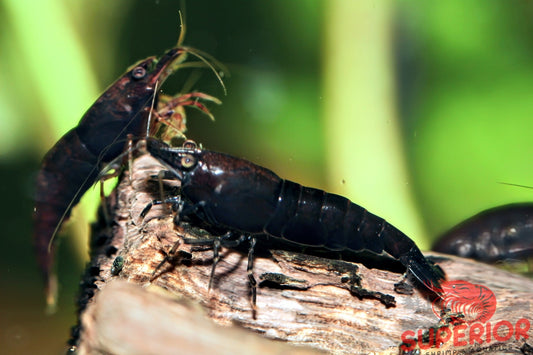
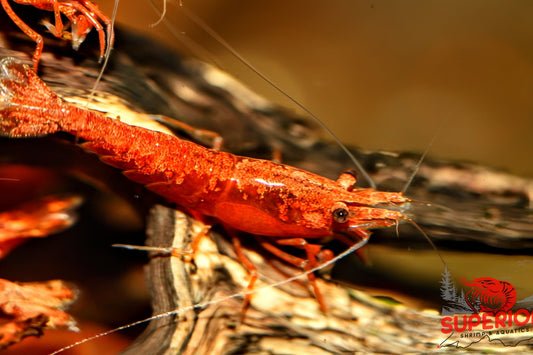
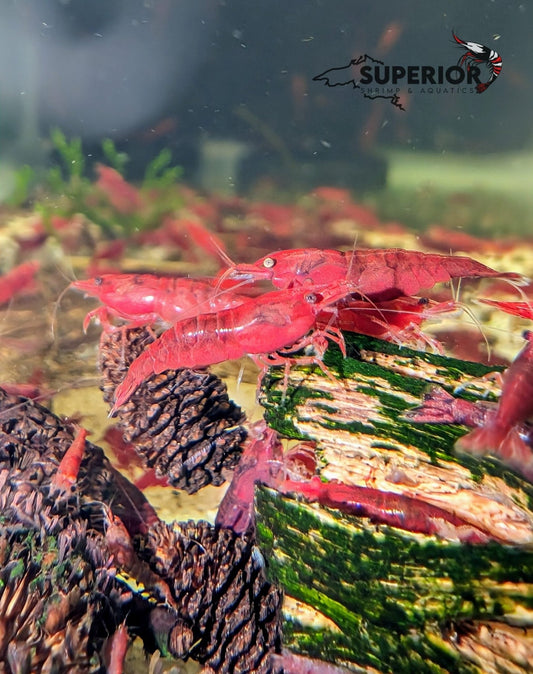
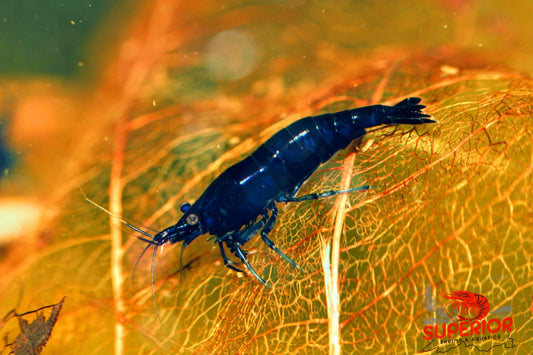
Red Amano Shrimp are a colour-selectively bred line of the legendary Amano shrimp (Caridina multidentata) — the largest, most effective algae-cleaning shrimp in the freshwater hobby. Standard Amano shrimp are transparent-grey with a row of dotted or dashed brown lateral markings; this line has been selectively developed to produce warm red to orange-red body pigmentation across the carapace and abdomen — a colour that the standard wild-type Amano shrimp never expresses. Like all Amano shrimp they are substantially larger than Neocaridina — adults reach 3–5cm — and their size translates directly into cleaning capacity: a single adult Amano consumes more algae in a day than multiple Neocaridina. They graze green hair algae, thread algae, green dust algae, biofilm, and uneaten food from every surface continuously. Amano shrimp require brackish water to successfully breed — larvae cannot survive in freshwater — making them self-limiting in any freshwater setup. The population you introduce is the population you will always have unless more are added. Fully safe with all aquatic plants, snails, and Neocaridina shrimp.
6.5–7.5pH
6–14GH (dGH)
1–8KH (dKH)
65–78°FTemperature
What to Expect
Colour, Size & Cleaning Behaviour
Warm red to orange-red body pigmentation — most vivid colour in the Amano category — the red colouration develops across the carapace and abdomen and varies between individuals from warm orange-red to deeper, more saturated red. The characteristic Amano lateral dot-and-dash markings remain visible through the body colouration in well-lit conditions, adding a secondary pattern element to the vivid base colour. Colour is most vivid in well-fed, settled individuals in stable water conditions.
Colour intensifies in stable conditions and with varied diet — like most selectively bred shrimp colour morphs, the red pigmentation is most vivid in individuals that have been in stable, well-maintained water for several weeks and are fed a varied diet including carotenoid-rich foods — spirulina, astaxanthin-containing wafers, or blanched carrot. Stress, parameter instability, or nutritional deficiency all reduce colour saturation.
Significantly larger than Neocaridina — 3–5cm at maturity — adult Amano shrimp are three to five times the body mass of adult Neocaridina, which translates to proportionally greater algae consumption capacity, greater visibility in the tank, and a more commanding physical presence. They are large enough to be visually significant display animals as well as functional cleaning crew members.
Most effective algae cleaners in the catalog per individual — Amano shrimp consume green hair algae, thread algae, green dust algae, and biofilm with greater efficiency than any other shrimp or snail in the catalog per individual. They are the first choice for tanks with visible algae problems and a permanent asset in any planted tank where algae management is a priority.
Self-limiting population — cannot breed in freshwater — eggs are laid and hatched but larvae require brackish water to develop. In a freshwater tank all larvae die shortly after hatching. The Amano population is therefore permanently fixed at the number introduced — there is no population management required and no risk of overpopulation.
Peaceful with Neocaridina, snails, and non-aggressive fish — Amano shrimp coexist without conflict with all Neocaridina morphs, all snails in the catalog, and all non-aggressive fish species. They do not prey on Neocaridina at any life stage, though very small shrimplets of any species should have adequate hiding space in any mixed tank.
How to Set It Up
Getting Started
1Introduce to a fully cycled, stable tank — Amano shrimp are more sensitive to ammonia and nitrite than Neocaridina — introduce only to tanks with zero ammonia, zero nitrite, and stable parameters. A tank that has been running for at least four weeks with stable readings is the minimum.
2Drip acclimate over 45–60 minutes — Amano shrimp are sensitive to parameter shifts during acclimation. Drip acclimate slowly — one drop per second — over 45–60 minutes. Do not rush the transition. Add tank water to the transport bag gradually rather than transferring abruptly.
3Stock at one per 10 litres for effective algae control — for meaningful algae impact in a planted tank, stock at approximately one Amano per 10 litres. In tanks with persistent algae problems, higher stocking density produces faster and more thorough results. In well-maintained tanks with low algae pressure, supplement feeding with algae wafers or blanched vegetables to prevent hunger.
4Supplement with algae wafers in clean tanks — in well-maintained tanks where algae is minimal, supplement with half an algae wafer per three to five shrimp every two to three days. Hungry Amano shrimp may begin grazing plant tissue — supplementary feeding prevents this and keeps them in the tank foraging on substrate and hardscape rather than plant leaves.
💡 Bonus Tip
Red Amano shrimp against a background of deep-green Anubias or dark-toned Bucephalandra creates a warm red-against-cool-green contrast pairing that works at the larger body scale Amano shrimp occupy — the same colour logic as Neocaridina red morphs against dark plants, but with substantially more visual impact per individual because of the larger body size. A group of five to seven Red Amano shrimp on a large Anubias leaf or piece of dark driftwood is one of the most visually striking display combinations achievable in a low-tech planted shrimp tank.
🦐
Browse more shrimpPair your Amano shrimp with Neocaridina, snails, or aquatic plants for a complete tank. Browse our Neocaridina Shrimp collection.
→