Ir directamente al contenido

Inicio de sesión

Bucephalandra Godzilla

Bucephalandra Godzilla

<p>Ganas%20[points_amount]%20cuando%20compras%20este%20art%C3%ADculo.</p>
Amount: Rhizome

Este producto no está disponible actualmente. Ver productos relacionados.

Subtotal:

$8.00

Productos complementarios

Cargando complementos…

Ver todos los detalles
Descripción


Aquatic Plants

Bucephalandra Godzilla

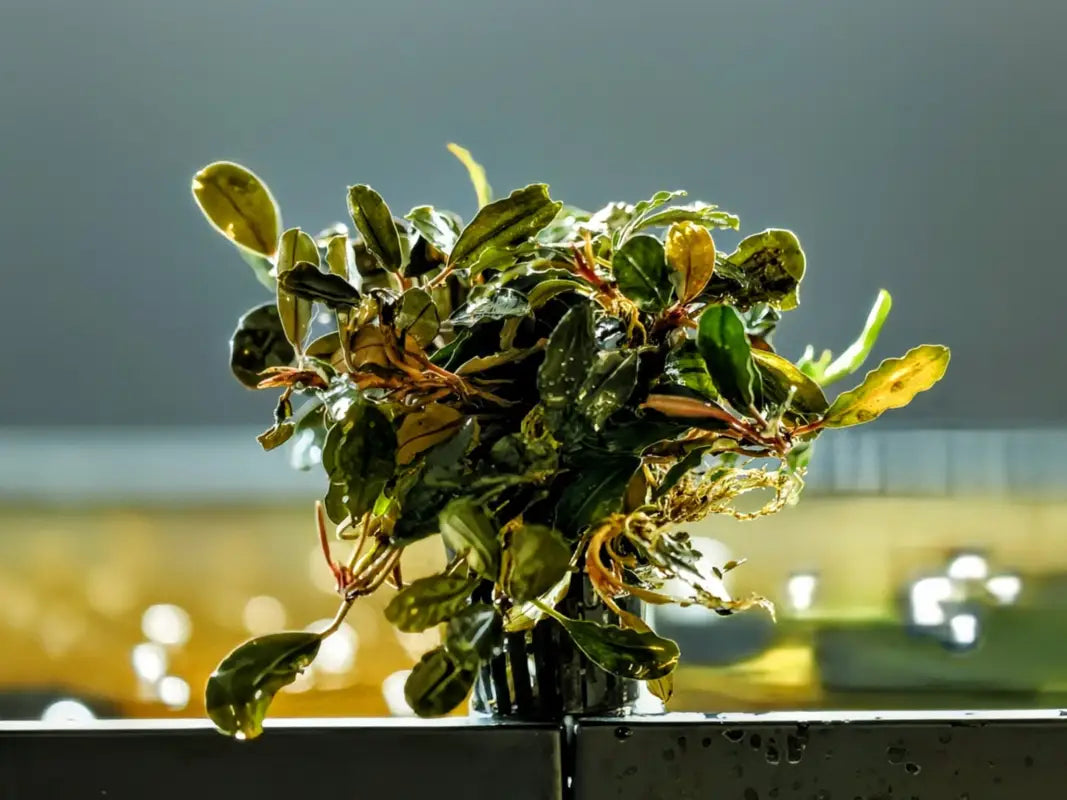
One of the largest Bucephalandra cultivars available — broad, substantial leaves with vivid blue-green iridescence that reads clearly from across the tank rather than only on close inspection.

Large Leaf Scale for a Buce Vivid Blue-Green Iridescence Substantial Midground Presence Rhizome — Do Not Bury No CO₂ Required Low to Medium Light

Bucephalandra Godzilla earns its name by doing what almost no other Buce cultivar does — growing large. Where most Bucephalandra cultivars produce leaves in the 1–4cm range that reward close observation, Godzilla produces broad, substantial leaves that can reach 6–10cm in established specimens, giving the plant a midground presence and visual weight that smaller Buce cultivars cannot achieve regardless of their iridescence. The blue-green iridescent sheen — vivid and immediately apparent rather than subtle — is visible from across the tank at the scale Godzilla operates, making it the only Buce in the catalog where the iridescence reads as a layout feature rather than a detail discovered on inspection. The large leaf surface accumulates biofilm generously and provides substantial foraging territory for shrimp. Like all Buce, it grows from a rhizome that must never be buried, attaches to driftwood and stone, and requires no CO₂.

Not RequiredCO₂
72–82°FTemperature
Low–MedLighting

Appearance & Growth Over Time

Leaves reaching 6–10cm — large by any Buce standard — Godzilla leaves are substantially larger than any other cultivar in the catalog, approaching the individual leaf scale of small Anubias barteri rather than the compact leaves typical of the Buce genus. The size is not just a novelty — it fundamentally changes how the plant functions in a layout. A single established Godzilla plant occupies meaningful midground real estate and carries visual weight proportional to a full-sized specimen of a smaller-leafed species with three or four times the leaf count. Vivid blue-green iridescence visible at distance — the iridescent sheen on Godzilla is among the most vivid in the catalog — a clear blue-green that reflects under direct light with an intensity that reads from across the tank rather than requiring the viewer to be within arm's reach. This is the key functional difference between Godzilla and the more subtle iridescent cultivars: the combination of large leaf area and vivid iridescence makes the sheen a layout-scale visual feature rather than a close-up detail. Dark green base color with a slightly textured surface — the underlying leaf color is a deep, rich green — darker than the bright greens of stem plants or Cryptocorynes — with a slightly textured surface that contributes to the way the iridescent sheen distributes across the leaf face. The dark base makes the blue-green iridescence more visually striking by contrast, in the same way that a dark background makes any iridescent surface appear more vivid. Slower to produce each leaf but each leaf matters more — Godzilla grows at the slow, deliberate pace characteristic of all Buce — adding one substantial leaf at a time over weeks. Because each leaf is large, the visual impact of each new leaf on the overall plant appearance is proportionally greater than on small-leafed cultivars. A single new leaf on Godzilla noticeably changes the plant's appearance and presence; the same is not true of a new leaf on Nana or most other compact Buce. Large leaf surface area provides generous biofilm foraging territory — each Godzilla leaf accumulates biofilm across a surface area equivalent to several leaves of a smaller-leafed cultivar, providing extensive grazing territory that shrimp and snails work across thoroughly and visibly. The large, flat leaf surface makes individual shrimp grazing behaviour easy to observe — a single shrimp methodically working across a full Godzilla leaf is one of the more satisfying incidental observations a planted shrimp tank produces. Rhizome must remain fully above substrate at all times — the rhizome must never be buried or covered. Attachment to driftwood or stone with cotton thread or super glue gel keeps the rhizome exposed and prevents rot. At Godzilla's leaf scale, positioning the rhizome on a substantial piece of driftwood where the large leaves have room to develop without being crowded by adjacent plants is worth planning before attachment.

Getting Started

1Attach to substantial hardscape with room for large leaves — secure the rhizome to a piece of driftwood or stone that provides enough surface and surrounding space for leaves reaching 6–10cm to develop without being crowded. Godzilla needs more clearance around its attachment point than any other Buce in the catalog — leaves that develop in a confined position between other plants will be smaller and less impressive than those with open space to extend into.
2Position for direct light and multiple viewing angles — place Godzilla where the large leaf faces receive direct light from the fixture above and are visible from the front viewing angle of the tank. The vivid blue-green iridescence is most apparent under direct light hitting the leaf face — a plant positioned in shadow or facing away from the primary viewing angle loses the defining visual quality that makes the cultivar worth having.
3Low to medium light — avoid intensity that encourages algae — Godzilla thrives under the same low to medium light conditions as all Buce. The large leaf surfaces are more exposed to algae accumulation than smaller-leafed cultivars under excessive light — moderate, consistent lighting maintains leaf quality long term. A stable 8–10 hour photoperiod at medium intensity produces the best leaf condition and most vivid iridescence.
4Fertilize consistently with balanced liquid formula including iron — regular liquid fertilization covering macros, micros, and iron supports the steady development of new full-sized leaves and the maintenance of the deep, rich green base color that makes the iridescence read most vividly. Iron supplementation is particularly important for sustaining leaf color depth — without it, new leaves may emerge slightly paler and the contrast that makes the iridescence vivid is reduced.
💡 Bonus Tip

Godzilla placed as the centrepiece of a mixed-Buce driftwood arrangement — flanked by smaller-leafed cultivars like Catherinae Green, Artemis, or Velvet — creates the clearest expression of the within-genus scale hierarchy the Buce catalog makes possible. Godzilla's large leaves provide the structural anchor and the vivid iridescent focal point; the smaller cultivars provide detail, texture, and tonal variation around it. The size difference between Godzilla and any other cultivar is large enough that the hierarchy reads immediately without needing deliberate arrangement to communicate it.

🌿
Browse more Bucephalandra

Pair Godzilla with Theia, Velvet, Artemis, or Catherinae Green for a complete multi-scale Buce arrangement. Browse our Aquatic Plants collection.

→
Before placing your order, please review our 📋 DOA Policy 🚚 Shipping Info
Reseñas
Policies & Disclaimers
Aquatic plants

Policies & Disclaimers

Choosing your portions, using the plant promotion, and knowing what to expect when your plants arrive.

Buy 2 Get 1 Free: add all three

Choose three eligible plant items and add all three to your cart, including the plant you want free. The discount applies automatically at checkout; no code is needed. Adding only two items does not add a third plant for you.

Mix and match eligible varieties or choose multiple quantities of the same eligible plant. The least expensive eligible item is free. For example, with eligible items priced at $5, $8 and $10, the $5 item is discounted and the plant subtotal is $18 before shipping and tax.

The offer repeats for complete qualifying groups: three eligible items give one free, six give two free, and nine give three free. The current offer has no per-order use limit. Items must be included in the promotion; Plant Weights and other non-plant accessories do not qualify.

An item means the sale unit in your cart. One bunch, cup, portion or multipack counts as one item when purchased at quantity one, not one item for every stem, leaf or bulb inside it. Check the listing and selected option for what each unit contains.

Check the discount and quantities in your order summary before paying. Other promotions can affect the final discount; multiple product discounts do not stack on the same item. This is an online checkout offer, not an automatic in-store POS discount.

Portions, sizes & what you receive

Read this plant’s description and selected option for its sale format, portion size and any stated stem or plant count. A bunch, loose portion, rooted plant, bulb, cup and mounted plant are different products; there is no single size or count that applies to every plant we sell.

A mature height or spread describes potential growth in an aquarium, not the size shipped. Use the advertised purchase portion to plan your order. A full carpet, dense moss-covered surface or established group in a photograph may require several portions and time to grow.

Do not assume that a pot, planting weight, rock, wood, substrate or other display accessory is included unless the listing explicitly says it is. If the received portion appears different from the selected listing, photograph it with its packaging and contact us promptly.

Photos, color & natural variation

Photos illustrate the named plant or variety and its appearance. Living plants vary in leaf size, shape, root development, branching and fullness; a photo of an established specimen is not a measurement of each portion shipped. The product description and selected option remain the reference for your purchase.

Aquarium lighting, camera settings and the growing environment affect perceived color. Red or pink varieties can look different under different lighting and growing conditions. Do not use a photograph alone to select a plant’s care requirements or expect immediate mature coloration.

Above-water growth & the transition underwater

Some aquarium plants can grow with their leaves above water as well as submerged. These growth forms can have different leaf shapes and appearances. New underwater growth may look different from older leaves as the plant adjusts. This explanation does not mean every plant is supplied in the same growth form; follow any specific information in the listing.

Leaf loss or softening after a change of environment is often called melt. Look at the plant as a whole and its growing points rather than judging only one older leaf. Do not assume that a damaged plant is simply transitioning or wait for new growth before reporting an arrival problem.

This is background care information, not a new exclusion from the Live Arrival Guarantee. Arrival damage is assessed under the existing policy.

Planting: match the method to the plant

For stem plants, separate the stems and plant with room between them. For rosette plants, position the roots in the substrate without burying the crown. Remove transport bindings and growing material carefully where appropriate.

For Anubias and Java fern, keep the rhizome exposed rather than burying it. Moss can be divided into smaller portions and attached to suitable hardscape. Floating plants belong at the surface. Bulbs and tubers need species-specific planting depth; do not assume every type should be fully buried.

Keep plants damp while working. Follow the individual listing for placement and care, especially when a plant has unusual requirements. These are planting tips, not additional conditions for a claim.

Growth, tank conditions & choosing companions

Plan for the plant’s mature size, available light and the space it will occupy. A background stem plant, slow-growing rhizome plant and floating plant serve different roles; a purchase portion does not instantly create a finished aquascape.

Use the listing’s guidance on light, nutrients and carbon dioxide rather than assuming every plant needs the same setup. Growth rate and final appearance depend on aquarium conditions and maintenance. More light alone is not a substitute for a balanced setup.

Consider animals that dig, uproot or eat plants before choosing placement. Floating growth can shade plants below it, and fast-growing plants may need thinning. Observe new growth and make gradual, species-appropriate adjustments.

Hitchhikers & introducing plants

Our existing policy does not guarantee pest-free arrival. Plants can carry tiny organisms or eggs, including snail eggs, despite inspection. Inspect new plants before introduction, and consider separate observation or quarantine to protect an established aquarium.

Do not assume a plant is sterile, pesticide-free or safe for a particular treatment unless the listing explicitly provides that information. Sensitive leaves, mosses and roots can respond differently to dips. Research the exact plant and any treatment before using it; do not apply an animal medication or a strong dip by default.

Arrival problems: document and contact us promptly

For damaged or dead plants, email support@superiorshrimpaquatics.com within two hours of the carrier’s recorded delivery time. Use the email address on the order and include all arrival concerns in your first message.

Send clear photographs of the affected plants and their packaging, with the shipping label or invoice visible for identification. Photograph packaging damage before unpacking or discarding materials, and consult the full guarantee’s documentation instructions. Keep the original photos.

The current guarantee covers aquatic plants but excludes promotional or free items. That existing exclusion also matters when ordering a free promotional plant. Claims and available resolutions are assessed under the full policy; this tab does not expand or reduce coverage.

Shipping your plants

Plants ship Monday and Tuesday, with Wednesday shipping available for 2-day or overnight services. Orders remain subject to stock, fulfillment timing and weather holds under our shipping policy. A shipping-service estimate is not a guaranteed dispatch date.

Plan to receive the package promptly and inspect it on arrival. Review the full shipping information for weather precautions, transit expectations and delivery issues. If your cart also contains live animals, review the shipping requirements for those animals as well.

Returns & order questions

Check the plant name, portion, quantity and selected option before completing checkout. Contact us before sending anything back; returns require prior written authorization under our existing policy. The full return policy explains the applicable conditions.

This tab explains the existing offer and policies alongside plant-care guidance. Care tips do not create new claim requirements or exclusions. Refer to the linked policies for complete terms.

Inicio Tienda
Lista de deseos
Iniciar sesión