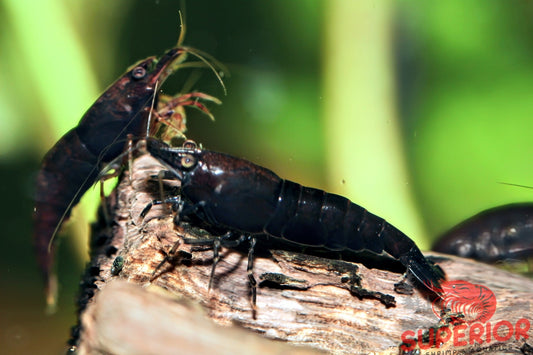
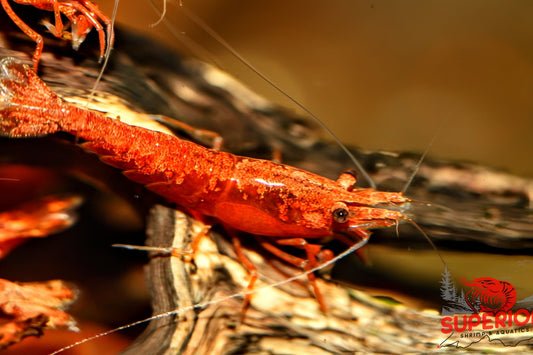
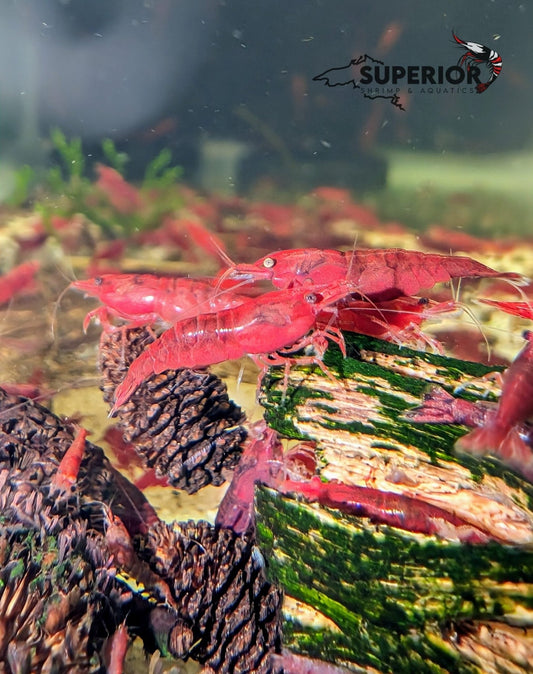
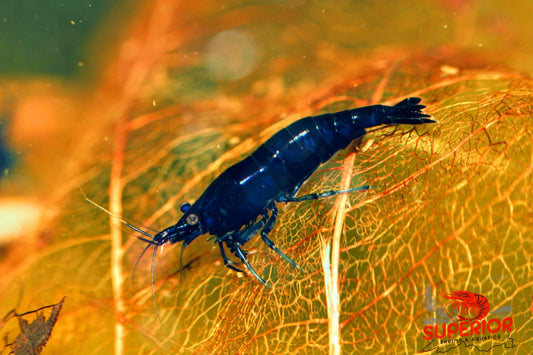
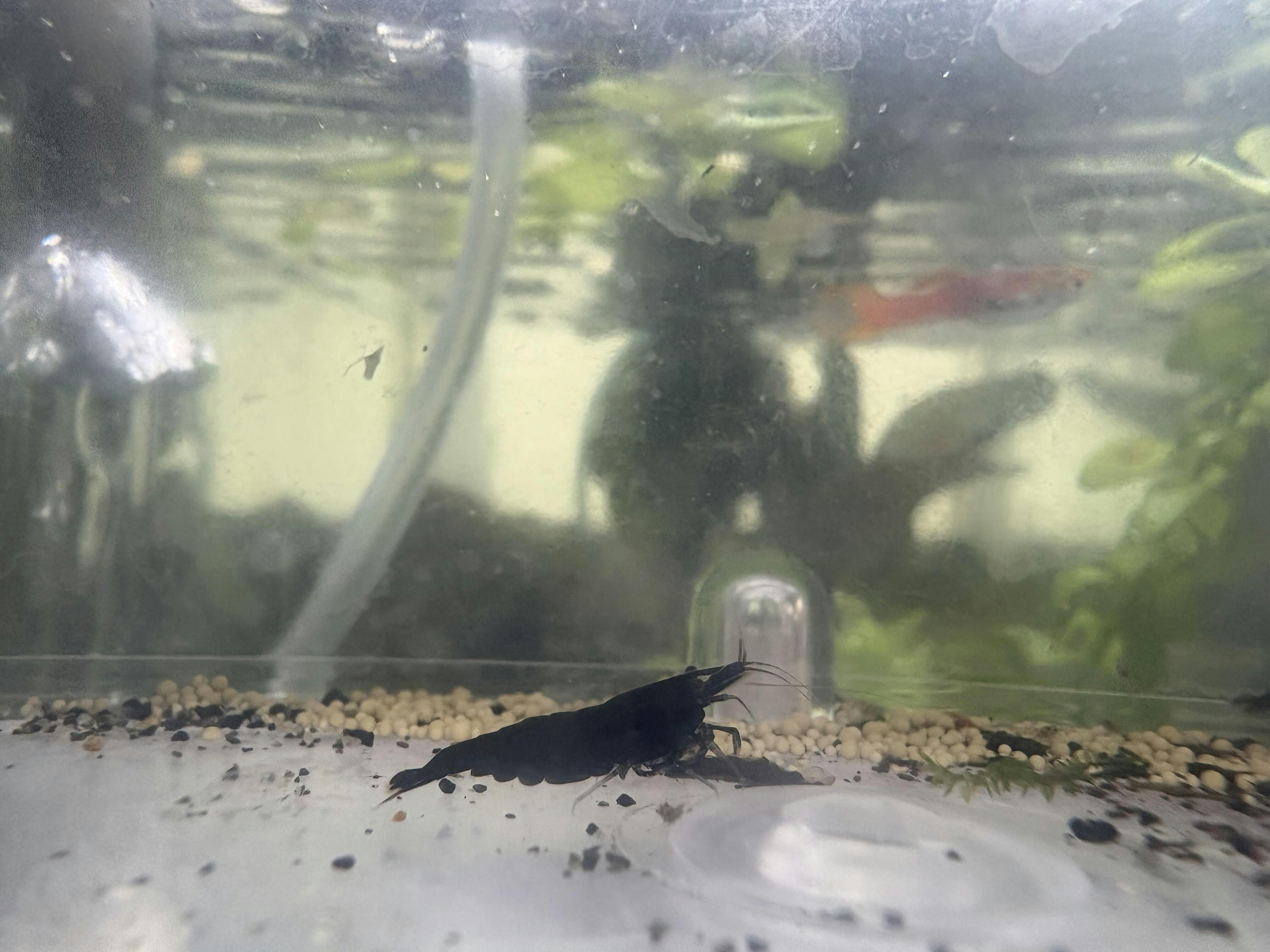
Black Rose Shrimp are the highest-grade black Neocaridina in the catalog -- a line selectively bred over many generations toward the deepest, most fully opaque black colouration achievable in the Neocaridina gene pool. At its best the black is dense, near-matte, and covers every surface of the body without pale areas at the legs, underside, or extremities -- a solid, fully realised black that reads as a strong, clear colour statement rather than a dark translucency or brownish near-black. The colour is the defining quality: Black Rose at maximum expression is as opaque and as fully black as any selectively bred Neocaridina colour can be. Uniquely among the dark-substrate Neocaridina, Black Rose makes one of its strongest visual statements on pale or white substrate, where the opaque black body reads as a striking dark presence against a light background -- a reversal of the usual dark-substrate convention that makes Black Rose distinctive in display tank design. Hardy, beginner friendly, breeds freely in freshwater. Do not house with other Neocaridina colour variants.
6.8-7.8pH
6-14GH
2-8KH
65-78FTemperature
What to Expect
Colour Depth and Behaviour
Full-body opaque black -- the deepest black achievable in Neocaridina -- at maximum grade the black covers the carapace, abdomen, all legs, tail fan, and rostrum with a consistent, fully opaque black that reads as a solid colour block. The internal organs are not visible through the body tissue, the colour does not lighten toward the extremities, and the near-matte quality of the best specimens absorbs rather than reflects light in a way that gives each animal a visual weight beyond its physical size.
Most striking display impact on pale or white substrate -- a reversal of convention -- while most coloured Neocaridina are most vivid on dark substrate, Black Rose creates its most striking display impact on pale or white substrate where the fully opaque black body reads as a bold, clear dark presence against a light background. On dark substrate the shrimp are visible but the contrast is between two dark elements; on pale substrate the contrast is maximum and the near-matte black reads with immediate clarity. Both substrate choices are valid -- the choice depends on whether maximum contrast (pale) or conventional presentation (dark) is the design goal.
Colour deepens with each generation in stable conditions -- like all selectively bred Neocaridina, Black Rose colour depth and opacity improve progressively with each generation produced in stable conditions. Selecting the most opaque, most fully black individuals from each generation as breeding stock drives the colour progressively deeper across successive generations.
Hardy and beginner friendly -- full Neocaridina tolerance -- Black Rose carry the same broad parameter tolerance and robust constitution as all Neocaridina. The depth of the colour grade does not reflect any increased care requirements.
How to Set It Up
Getting Started
1Dark substrate and stable parameters before introduction -- black aquasoil or dark sand, pH 7.0-7.4, GH 6-8, KH 3-5, temperature 72-75F. Run for at least one week and confirm stability with daily testing.
2Drip acclimate over 45-60 minutes -- float bag for 15 minutes, then drip at one drop per second for 45-60 minutes before release.
3Dense moss and established biofilm surfaces before shrimp arrive -- Java Moss, Christmas Moss, or Flame Moss provides biofilm foraging and shrimplet shelter from the first breeding cycle.
4Feed varied diet and remove uneaten portions within two hours -- comprehensive sinking food every one to two days. Consistent appetite across the colony is a reliable health indicator.
Bonus TipBlack Rose shrimp on white sand with a cluster of bright green Christmas or Java Moss and a single piece of pale driftwood creates the most graphically striking Neocaridina display achievable with a single morph -- the fully opaque black on white reads as a maximum-contrast, high-graphic presentation that draws the eye immediately and reads as deliberately composed rather than incidental. The same tank with dark substrate produces a more conventional planted-tank look; the pale-substrate version reads as a considered aesthetic statement. Both are visually effective but the pale-substrate approach is unique to Black Rose among common Neocaridina morphs.
🦐
Browse more Neocaridina shrimpPair Black Rose with Snowball, Fire Red Cherry, or Blue Diamond for a high-contrast display. Browse our Neocaridina Shrimp collection.
→