


No se le permitirá comparar más de 4 productos a la vez.
Ver compararCryptocoryne Lutea
Cryptocoryne Lutea
Precio habitual
$7.00
Precio habitual
Precio de oferta
$7.00
Precio unitario
por
Los gastos de envío se calculan en la pantalla de pago.
Subtotal:
$7.00<p>Ganas%20[points_amount]%20cuando%20compras%20este%20art%C3%ADculo.</p>

Descripción
Descripción
Aquatic Plants
Cryptocoryne Lutea
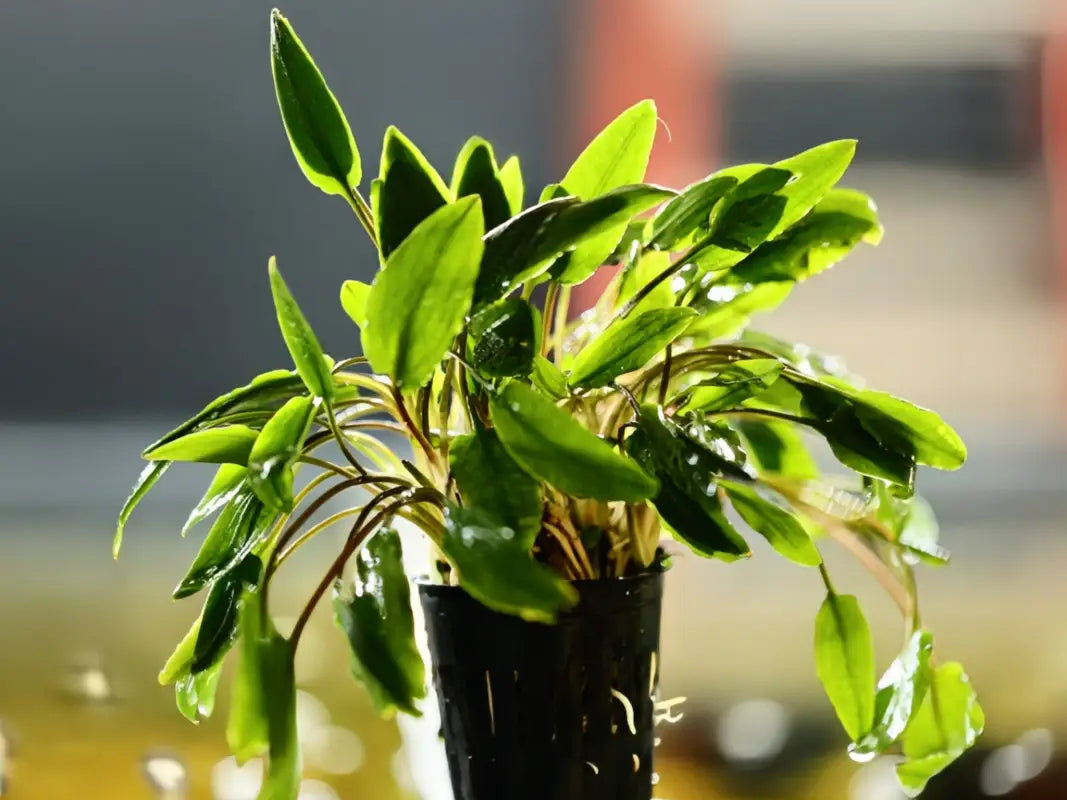
A mid-sized Crypt with narrow, slightly undulate leaves in warm olive-green to yellow-green tones — the brightest and most warmly coloured Cryptocoryne in the catalog, filling the midground with a colour no other Crypt provides.
Warm Olive to Yellow-Green Leaves
Mid-Sized Midground Crypt
Slightly Undulate Leaf Margins
No CO₂ Required
Low to Medium Light
Shrimp Safe
Cryptocoryne Lutea is a mid-sized Sri Lankan Cryptocoryne with narrow, slightly elongated leaves that develop a gentle undulation along their margins as they mature — a leaf form and colour combination that positions it as the warmest-toned Crypt in the catalog. Where Cryptocoryne Bronze sits in the warm brown-olive spectrum, Cryptocoryne Red in the red-brown range, and Pink Flamingo in soft rose, Lutea occupies a distinct warm yellow-green to olive-yellow zone — a brighter, more luminous green than most Crypts that provides a midground colour note no other species in the catalog replicates. It is a reliable, moderately sized Crypt — neither as small as Parva nor as tall as Balansae — that establishes steadily, tolerates low light, spreads by runners over time, and produces new leaves consistently once settled. Like all Crypts it will melt on introduction and recover. Fully safe with all Neocaridina, Caridina shrimp, and snails.
Not RequiredCO₂
72–82°FTemperature
Low–MedLighting
Colour, Growth & Behaviour
Warm yellow-green to olive colour distinct from every other Crypt — Lutea leaves are brighter and more yellow in tone than the deep olive-browns of Bronze or the muted greens of Parva and Balansae — a warm, slightly luminous green that catches available light and reflects it more actively than darker-toned Crypt species. The colour intensifies toward yellow-green under medium to high light and sits closer to olive-green under lower light, but remains distinctly warm and bright relative to the other Cryptocorynes in the catalog across all light levels.
Narrow leaves with a gently undulate margin on mature growth — leaves are narrow and slightly elongated with a gentle undulation or waviness along the margins that becomes more pronounced on fully mature, full-sized leaves. The undulation is subtle — less dramatic than Balansae's deep crinkling — but adds a soft surface variation that catches light differently across the leaf face than a flat-margined leaf would. Individual leaves are clearly distinguished from each other at the midground scale Lutea occupies.
Mid-sized — fits between Parva and Balansae in the Crypt height hierarchy — Lutea reaches 10–20cm in established specimens under good conditions, making it a genuine midground plant — taller than Parva and Pink Flamingo at the foreground-midground boundary, shorter than Balansae at the background scale. In a layout using multiple Crypt species across the substrate, Lutea occupies the middle height zone naturally and bridges the scale gap between foreground and background Crypt plantings.
Melt on introduction is normal and temporary — like all Cryptocorynes, Lutea drops existing leaves when moved to a new tank. The rhizome survives and produces new submersed-adapted growth within two to four weeks. Leave completely undisturbed during the melt — do not uproot or reposition. New leaves emerge progressively over several weeks and will be the submersed form of the leaf, which may look slightly different from emersed-grown leaves shipped from the nursery.
Spreads by runners to form a midground cluster over time — established Lutea produces short rhizome runners that develop daughter plants, gradually building a loose cluster of narrow yellow-green leaves across the midground. The spread is undemanding — runners appear and root without intervention, and the cluster can be left to develop naturally or individual plants separated and replanted to extend coverage more quickly.
Roots deeply — substrate nutrition drives performance — Lutea feeds primarily through its roots and benefits directly from nutrient-rich substrate or root tabs. In aquasoil it establishes quickly and produces full-sized leaves; in inert substrate without supplementation growth is slower and leaves remain smaller. Root tab renewal every three to four months sustains the nutrient supply that supports maximum leaf development.
How to Set It Up
Getting Started
1Plant in the midground with crown at substrate surface — position Lutea in the midground where its 10–20cm height works naturally between lower foreground plants and taller background plants or Vallisneria behind it. Push roots into substrate with the crown just at the surface — not buried. In a multi-Crypt layout, position Lutea between Parva at the front and Balansae at the rear to create a three-tier height gradient in a single genus.
2Use nutrient-rich substrate or root tabs — place root tabs within 5cm of the planting point if using inert substrate. Lutea's warm yellow-green colour is most vivid and leaves reach maximum size in adequately nourished substrate. Without supplementation the plant grows more slowly and leaves are smaller and paler than in properly supported conditions.
3Leave undisturbed through the melt period — do not move or reposition after planting. Remove only fully decomposed leaf matter. New growth will emerge from the crown within two to four weeks of the melt settling and will accelerate progressively as the root system establishes.
4Fertilise consistently with liquid formula and root tabs — dose balanced liquid fertiliser two to three times weekly. The warm colour of Lutea is maintained most vividly under consistent iron and micronutrient availability — plants in well-fertilised tanks produce the most distinctly yellow-green new leaves, while underfed plants tend toward a more muted, less differentiated green.
💡 Bonus Tip
Lutea planted immediately in front of a dark-toned Anubias barteri or Bucephalandra in the midground creates the most immediate warm-cool colour contrast available in the Cryptocoryne catalog without CO₂ — the bright yellow-green of Lutea against the deep cool green or dark iridescence of the Anubias or Buce behind it reads clearly across the tank and makes both plants more vivid than they are planted separately. The narrow leaf form of Lutea against the broader leaves of barteri adds a simultaneous scale and texture contrast that reinforces the colour difference.
Browse more aquatic plants
→
Pair Lutea with Balansae, Parva, Pink Flamingo, or Anubias for a complete planted layout. Browse our Aquatic Plants collection.