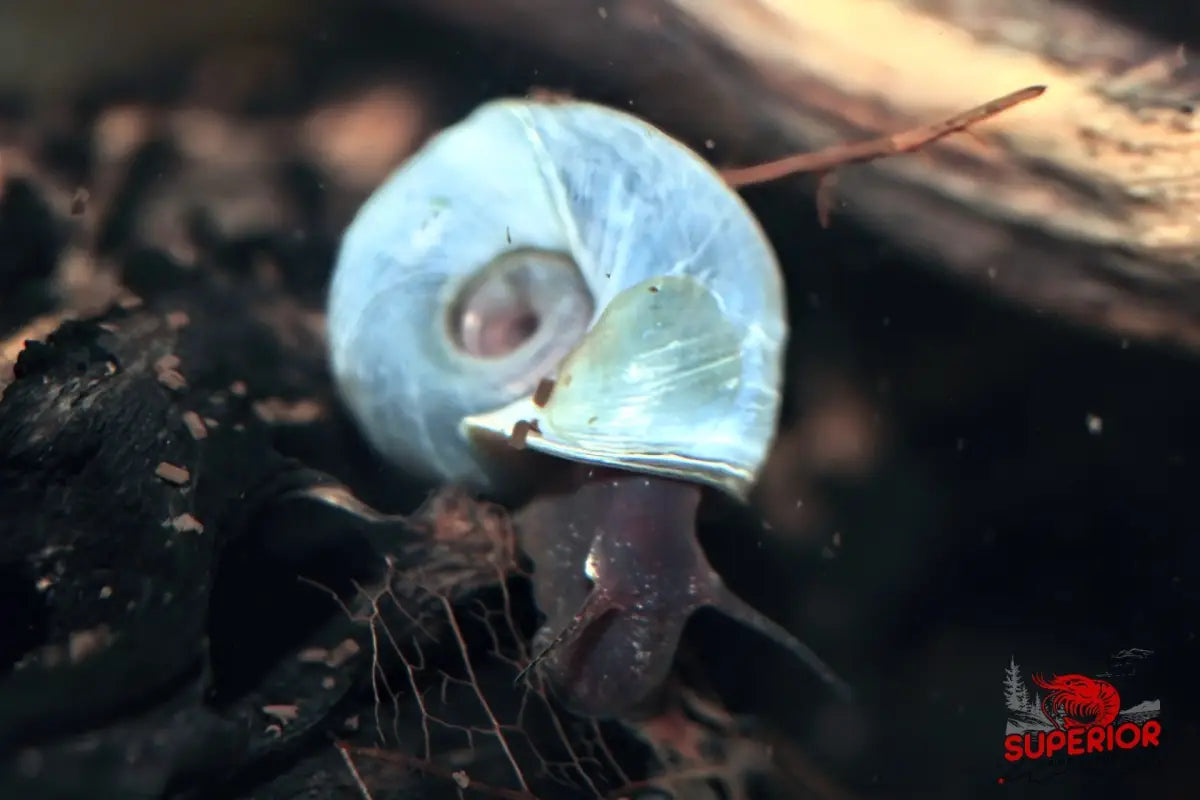
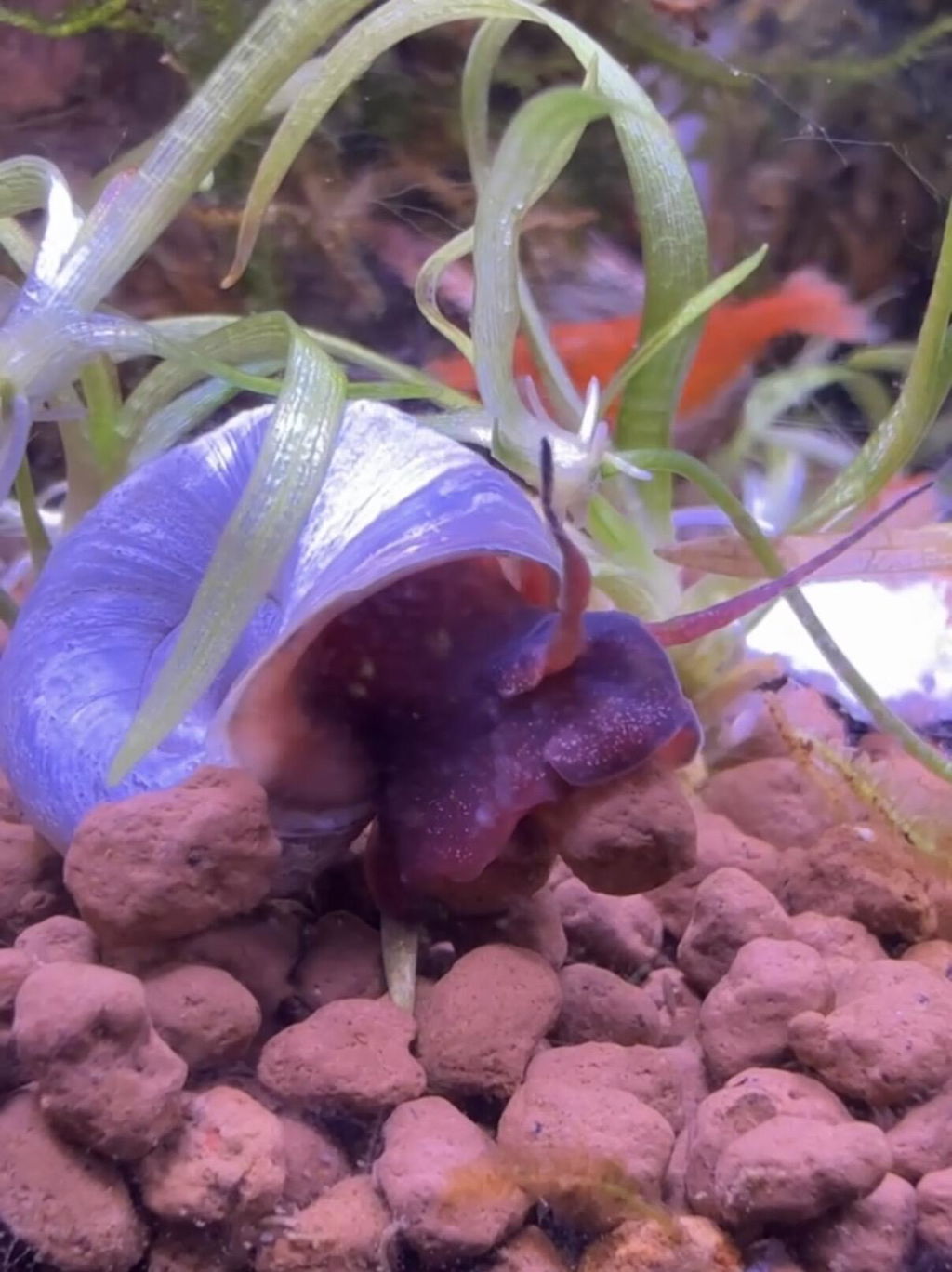
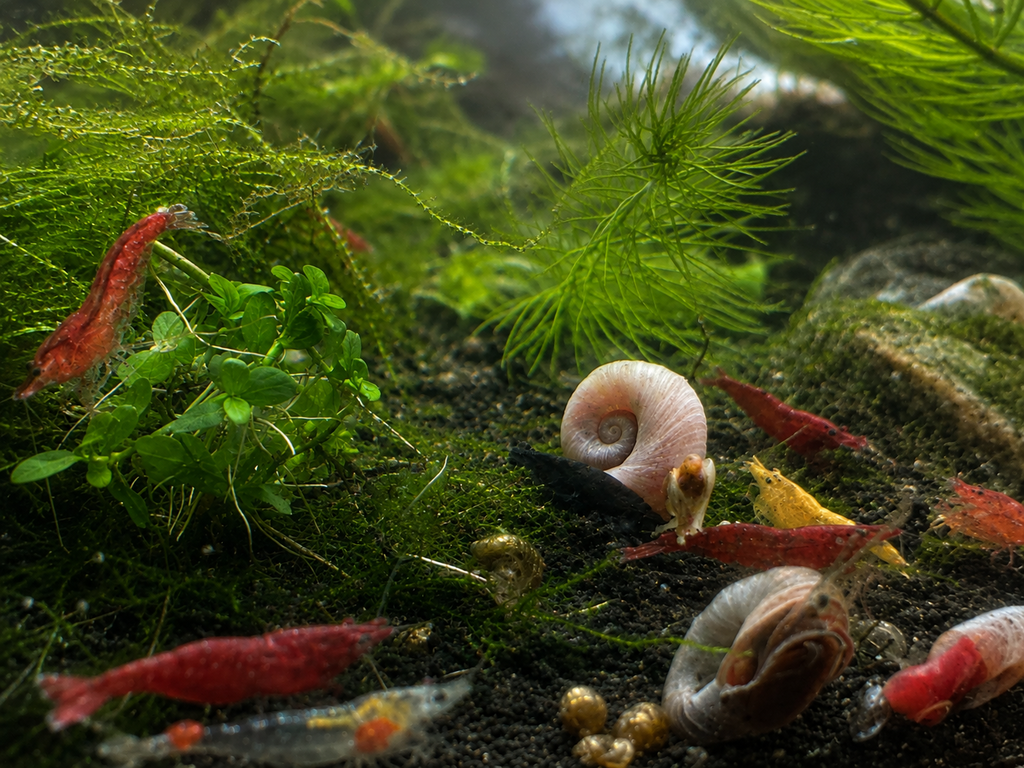
Blue Ramshorn Snails are a selectively bred color morph of the common Ramshorn (Planorbarius corneus or Planorbella duryi) — a line developed specifically for the vivid blue-grey coloration of the shell and the deep blue body pigmentation that shows through the translucent shell walls and across the visible mantle and foot. Where standard Ramshorns come in brown, red, and pink morphs, the Blue Ramshorn is the most visually striking — a genuinely unusual color for a freshwater snail that makes it as much a display animal as a cleanup crew member. The flat, disc-like spiral shell form and the active, visible grazing behaviour of all Ramshorns is present in the Blue morph unchanged — this is a color variant of a well-established, hardy, beneficial cleaning snail. Population is food-limited and self-regulating in the same way as all Ramshorns. Fully safe with all Neocaridina and Caridina shrimp. Does not eat healthy plant tissue.
7.0–8.0pH
6–15GH (dGH)
2–8KH (dKH)
65–82°FTemperature
What to Expect
Color, Behavior & Benefits
Translucent blue-grey shell with vivid blue body showing through — the defining characteristic of the Blue Ramshorn is the combination of the translucent shell — pale blue-grey in color, flat disc-spiral in form — and the vivid blue body pigmentation visible through the shell walls and across the exposed mantle and foot. Against a dark substrate the blue body color reads clearly and immediately; against light substrate it is still visible but less vivid. The color is consistently produced in selectively bred lines and is stable across generations maintained in good conditions.
Dark substrate and dark backgrounds enhance the blue color significantly — the vivid blue of the body and the pale translucent quality of the shell are both more apparent against dark backgrounds. On black or dark sand, dark aquasoil, or dark hardscape, the blue reads immediately from across the tank. On pale sand or light substrate the snails are still visible but the color contrast is reduced. Positioning a piece of dark driftwood or dark stone in the foreground gives Blue Ramshorns a high-contrast background to graze against that shows their coloration to maximum effect.
Active, visible grazing across all surfaces — Ramshorns are among the most visible and actively grazing snails in the catalog, moving continuously across glass, plant leaves, hardscape, and substrate surfaces throughout the day. The Blue Ramshorn's distinctive color makes its constant movement and grazing activity clearly visible in a way that more camouflage-colored snails are not — individual snails working methodically across a plant leaf or glass panel are clearly identifiable and easy to observe.
Flat spiral shell allows access to tight spaces — the disc-like flat spiral shell of Ramshorns allows them to access gaps and surfaces that dome-shelled snails cannot reach — under plant leaves, in the grooves of textured hardscape, between closely spaced plant stems, and along the substrate-glass junction. The combination of flat shell form and continuous activity makes Ramshorns more thorough surface cleaners than dome-shelled species of comparable size.
Population is food-limited and self-regulating — like all Ramshorns, the Blue morph's population is controlled by available food. In a well-managed tank with appropriate feeding the population stabilises at a modest level. Population growth is a feeding indicator rather than a snail problem — reduce organic load to reduce population. Blue Ramshorns breed more slowly than Bladder Snails, which makes population management easier in practice.
Requires adequate GH for shell integrity — the flat, thin shell of Ramshorns is more susceptible to pitting and erosion in soft water than thicker-shelled species. Maintain GH at 6 or above for healthy, clearly pigmented shells. In very soft water (GH below 4) the shell thins, pits, and loses the translucent quality that makes the blue body color most visible — adequate GH maintains both shell health and the visual quality that makes the Blue Ramshorn distinctive.
How to Set It Up
Getting Started
1Introduce to a stable, established tank — Blue Ramshorns acclimate well to stable, established parameters. Float the bag for 15–20 minutes to temperature-equalise, then add small amounts of tank water to the bag over 20–30 minutes before releasing. Avoid introducing directly to a cycling or parameter-unstable tank — Ramshorns are hardy but shell quality is sensitive to pH instability during development.
2Use dark substrate to maximise color visibility — if possible, place Blue Ramshorns in a tank with dark substrate or ensure dark hardscape in the foreground where the snails will graze. The color contrast between the vivid blue body and a dark background is the most immediate visual impact this snail offers — a layout decision that costs nothing and makes the difference between a snail you notice and one you have to search for.
3Maintain GH at 6 or above for shell quality — ensure GH is maintained at 6 dGH or higher for healthy shell development and the clear translucency that makes the blue body colour most visible. In soft water tanks running below GH 6, add a GH+ supplement to water changes or place a small piece of cuttlebone in the filter. This benefits shrimp mineral requirements simultaneously.
4Manage numbers by controlling feeding rather than culling — if the population grows beyond the level you find visually acceptable, reduce feeding frequency and quantity rather than manually removing snails as a primary strategy. Ramshorns breed more slowly than Bladder Snails and population control through feeding management is more reliable and less labour-intensive than ongoing manual removal. A vegetable trap — blanched zucchini or cucumber overnight — collects snails efficiently when manual reduction is needed.
💡 Bonus Tip
Blue Ramshorns and Blue Velvet or Blue Dream Neocaridina in the same tank create the most cohesive single-color themed cleanup pairing available in the catalog — the vivid blue of the shrimp bodies and the blue-grey of the snail shells read as a considered color choice rather than a coincidence, and the two species occupy different surface-cleaning niches (shrimp focus on substrate and plant surfaces at midwater level; snails cover glass, upper plant surfaces, and substrate at close range) that together provide more comprehensive tank maintenance than either does alone.
🐌
Browse more freshwater snailsPair Blue Ramshorns with Nerite Snails, Bladder Snails, or Mystery Snails for a complete cleaning crew. Browse our Freshwater Snails collection.
→